
The Emerging AI SEO Strategist and Market Impact
An AI SEO Strategist is a specialized search marketing professional who designs, guides, and audits generative AI systems, agentic workflows, and semantic knowledge graphs to optimize brand discovery across AI Overviews and answer engines.
The seismic transformative impact of Artificial Intelligence on SEO places the “AI SEO Strategist” as a key player in this new era.
Expanding search options demand higher technical skill and strategic investment. Balancing traditional SEO fundamentals with AI strategies is my recommended hybrid approach.
An AI SEO strategist automates complex workflows, extracts deeper data insights, and aligns businesses with evolving search behaviors and Google’s AI Mode. As SEO and media networks expand beyond traditional retail, the core objective is becoming the trusted voice in AI-powered answers.
AI SEO is Business Opportunity
- Retail Media Consolidation: Saturated retail media networks face consolidation, making emerging technologies and protocols foundational to AI SEO and business growth opportunities.
- Cross-Industry Media Networks: Brands across healthcare, finance, travel, and food service—including Chase, United Airlines, and Marriott—now operate proprietary media networks.
- First-Party Data Monetization: Enterprises leverage brand authority and first-party customer data to generate new media revenue streams.
- Operational Execution: Network viability depends on operational execution and sustained advertiser demand.
- Budget Fragmentation: Rapid network expansion fragments the market, complicating media budget allocation.
- Consumer Price Sensitivity: Heightened price sensitivity escalates the need for audience research to deliver measurable value.
The Paradigm Shift: From Traditional SEO to AI-Powered Search
Fundamental changes in search behavior transition SEO from navigating blue links to direct AI answers and conversational search.
The new paradigm is conversational, answer-oriented search, reshaping how brands capture, nurture, and close sales:
- Agents Replace Websites: AI agents act as the primary interface between users and information.
- From Navigation to Answers: Users bypass traditional website navigation in favor of direct AI synthesis.
- Beyond Links and Keywords: AI search prioritizes semantic context and entity authority over isolated keywords and blue-link rankings.
- Conversational Search: Single queries evolve into multi-turn, contextual dialogues with AI.
- Accelerated Visibility: With proper technical architecture, influencing AI search visibility can occur within days.
- Holistic Brand Trust: AI SEO is inseparable from verifiable brand authority.
- Prompt Journey Mapping: Optimization targets the multi-step prompts users employ across AI interactions.
“AI isn’t driving the change in Google Search — users are. Younger audiences are shifting to video, forums, and creator content.” – Liz Reid, VP of Google Search [1]
User behavior drives the strategies and technical skills required for AI SEO.
AI SEO Agent: Model Context Protocol Integration
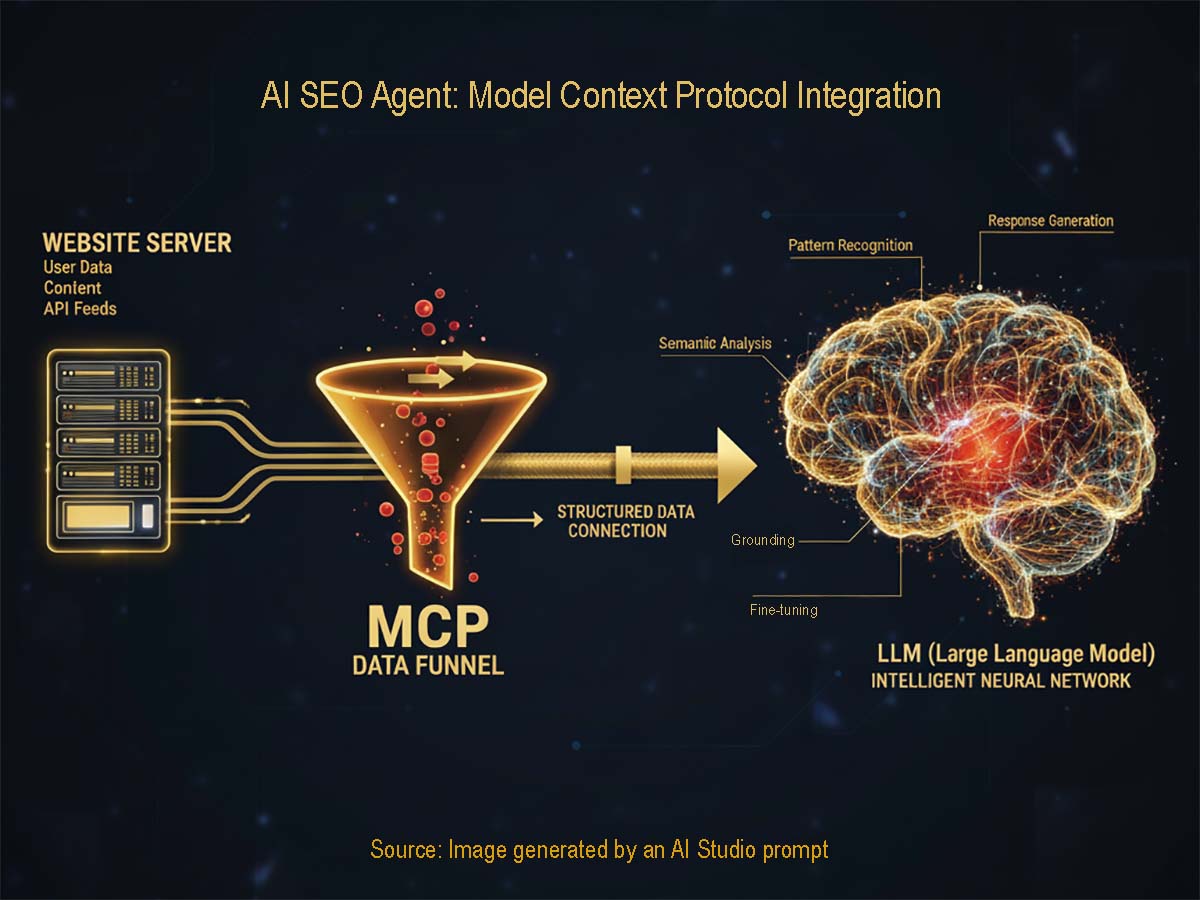
The Model Context Protocol (MCP) functions like an AI-native HTTP layer, establishing a direct client-server connection between large language models (LLMs) and your website’s structured data.
SEO professionals use Google’s Vertex AI and MCP to create, optimize, and distribute content across LLM ecosystems. Through MCP, models such as Anthropic’s Claude interact directly with live site repositories for deeper analysis and smarter content workflows.
Understanding how Content is Evaluated
Customers acquired through AI recommendations are reported to be 4.4 times more valuable than those from traditional search clicks [2].
With over 50% of new web content generated by automated systems (often redundant “AI slop”), authentic human expertise stands out. Search engines filter low-value pages using specialized evaluation systems. For example, Google’s internal system codenamed “Goldmine” scores candidate page titles against query intent and flags spammy, misleading, or poorly constructed headings before they reach users [3].
Agentic eCommerce SEO
Agentic eCommerce occurs when autonomous AI agents evaluate and execute purchasing decisions on behalf of consumers. Rather than replacing traditional SEO, agentic optimization extends it through rigorous data management.
SEO AI visibility is data management:
- Valid
Productstructured data markup. - Synchronized Google Merchant Center product feeds.
- Machine-readable content architectures built for AI retrieval.
In my practice, eCommerce sites capture clicks more readily than purely informational sites. Because AI Overviews synthesize evergreen informational answers directly on the SERP, informational publishers must deliver distinct, high-utility value to earn a click-through.
LLM & AIO Optimization Techniques for SEOs
Effective AI SEO consultants focus on Large Language Model (LLM) and AI Overview (AIO) optimization so answer engines can parse, ground, and cite brand content:
- Structure Content for LLMs: Use semantic HTML headings, validated schema markup, and direct, conversational phrasing.
- Build Entity Authority: Establish brand trust through expert content hubs, verifiable author bios, and consistent cross-platform entity signals.
- Measure Visibility and Revenue Over Raw Traffic: Prioritize citation share within AI-generated answers and the downstream revenue those high-intent visits generate.
- Capture AI-Driven Leads: Position verifiable product and service facts where AI syntheses drive qualified conversions.
Where to Keep Your Focus
- Your Entity Truth: Define the core expertise your brand is trusted for on the SERP, aligned with your staff capabilities, budget, and business goals.
- Iterative Monitoring: Search visibility fluctuates; maintain continuous auditing workflows aligned with shifting user intent.
- Model & Agent Governance: Mitigate hallucinations, data leaks, and outdated outputs through ongoing human oversight.
- Original Content Production: Publish original, people-first content that search engines and users rely on.
Content Velocity & Content Quality
Effective content production meets audience needs through deep topical context and structured entity facts.
Optimizing solely for search engines fails modern users. Taking an SEO Relevance Engineering approach pairs consistent, helpful publishing with core competencies in query research, technical SEO, data analysis, strategic business planning, and hands-on AI literacy.
Essential AI SEO Skills and Concepts:
- Context Engineering: Supplying an LLM with precise data and constraints within its context window for accurate enterprise outputs.
- Query Fanouts: Structuring content to answer the related sub-queries an AI generates when resolving a complex user prompt.
- Query Entities: Establishing brands, products, and authors as recognized Knowledge Graph entities.
- Co-similarity: Engineering semantic relationships across content pieces to build sitewide topical authority.
- WebRun Cloud Cache: Utilizing generative AI caching to reduce latency and compute costs for repeated context.
- Google Web Guide: Optimizing for AI-clustered topic groups in experimental search interfaces.
- Bot Mitigation: Filtering invalid automated traffic that drains server resources and skews campaign analytics.
- Encoding Personas in SEOntology: Using schema markup (such as
schema:Audience) to define target user personas semantically. - Semantic Layer: Structuring site architecture as a connected file system for ChatGPT, Gemini, OpenAI, Perplexity, and answer engines.
- An Agent’s Memory: Passing structured prompt context to inform an autonomous agent’s planning and execution state.
By utilizing schema markup, you explicitly define target personas and entities within your content’s semantic structure.
The Need for High-Level Technical AI SEO Skills
AI integration has created specialized roles such as “GEO/AI + LLM Strategist,” “AI Search & SEO Manager,” and “AI Growth Hacker,” with compensation reflecting their technical demand:
- OpenAI Content Strategist (ChatGPT.com) salary range: $310K–$393K [4].
- Top 2026 AI SEO and search roles command base salaries from $175K to $340K [5].
- US AI Business Development Manager average annual salary: $196,491 [6].
What Future AI Search Will Likely Devalue:
- Thin, automated pages built solely to manipulate LLMs.
- Repetitive, low-value “best of” listicles.
- Unverified, self-serving promotional copy.
- Sites relying on duplicate content for Generative Engine Optimization (GEO).
- Mechanical AI “chunking” that degrades human readability and UX.
- Off-topic content that dilutes a business entity’s core authority.
- Manipulative GEO spam tactics such as prompt injection.
How do you maximize the upswings and avoid the volatility of search trends?
Partner with an Advanced AI SEO Strategist
Looking to architect semantic schemas, implement Model Context Protocol workflows, or optimize for Google AI Overviews? Schedule an executive consultation or explore our Specialized Website Audits.
Your Guide to the Future of AI Search
Thriving in an AI-first search landscape requires continuous monitoring, iterative workflows, and a relentless focus on user needs. Hill Web Marketing helps you define and build upon your brand’s core truth—optimizing your models, agents, and original content to serve both your audience and the AI systems they rely on.
How the Human-in-the-Loop (HITL) can Influence Better AI Output
Preventing misinformation requires a disciplined factual content strategy for AI search backed by trusted datasets, regulatory compliance, and Knowledge Graph grounding.
AI should work for people—both users and search engines reward a human-centric approach.
Structured Prompt Input
Supply unambiguous context through structured prompts and human editorial review for accuracy, bias, and relevance. By aligning prompts with a data feed’s schema, you can trigger direct function calls for immediate execution or delayed, model-routed invocations that govern when and how methods execute.
A structured prompt input combines explicit instructions, context, constraints, and output formats to guide an AI model. When paired with knowledge graphs (structured networks of entities and their relationships), it bridges the gap between raw language generation and factual, context-aware content improvement.
Structured On-Site Information for Improved LLM Performance
Semantic triples establish explicit node relationships. Connecting entities in your copy and supplying valid Product schema markup across your Product Pages enables LLMs to extract accurate, verifiable facts.
Provide Grounding “Knowledge” for Custom Gems
When creating custom “Gemini Gems”, upload proprietary Knowledge files to define target personas, ground responses in your expertise, and enforce brand behavioral guidelines.
How Humans Influence AI Output in NotebookLM
Ground NotebookLM outputs by curating up to 50 verified sources:
- Google Drive documents via “Discover sources”
- Verified web URLs
- YouTube videos, MP3, and WAV audio files (transcribed into searchable text sources)
- Instructive human notes
Your Notes: Use the right-hand “Notes” panel to inject real-time instructions, boundaries, and voice constraints so synthesized outputs reflect your exact methodology.
Human Oversight for LLM Automated Workflows
Human-in-the-Loop (HITL) governance integrates expert validation at critical checkpoints in autonomous workflows—modifying an agent’s internal state or editing proposed outputs before execution continues. Frameworks like LangGraph and building apps with Google AI Studio and Antigravity combine modular AI skills with human logic.
Turning AI Search Disruption into AI SEO Opportunities
Answer Engine Optimization (AEO) reshapes product discovery, engagement, and conversion across synthesized responses and AI-powered multisearch. Implement a resilient AEO framework built for tomorrow’s search reality.
Increase your AI visibility: request your personalized Marketing Plan Backed With AI Measurement
Resources & Citations
- Search Engine Land: Liz Reid on Google AI & User Behavior Shifts
- Semrush: AI Search SEO Traffic Study
- Hobo Web: Google Goldmine Title Evaluation System
- LinkedIn / OpenAI: Content Strategist (ChatGPT.com) Role
- SSBM: Top Highest-Paying AI Jobs in 2026 (SEO Edition)
- Nexford University: Highest-Paying AI Jobs