Knowledge Graphs & Ontologies (For Complex AI Systems)
Experience the transformative power of structured knowledge and graph intelligence for business outcomes.
In today’s data-driven world, the strategic advantage lies not just in collecting information, but in making it truly intelligent and actionable. Knowledge Graphs and Ontologies for the Agentic Web provide this crucial edge, transforming raw data into a coherent, interpretable, and executable foundation for your business. They serve as the “control plane” for AI agents, enabling them to retrieve, validate, remember, plan, and act without losing meaning.
Improve your readiness for emerging agentic ways that consumers find products and services. Centralizing your data is the most critical step to prepare your business for the rise of AI-driven, agentic consumer behavior.
As consumers transition from traditional search engines to autonomous AI agents (like personal assistants that research, negotiate, and purchase on their behalf), AI agents rely on structured output, highly accessible, and real-time data in order to recommend your products or services. Ontologies act as the active nervous system of autonomous AI agents.
Table of Contents
- Knowledge Graphs & Ontologies (For Complex AI Systems)
- Ontologies for the Agentic Web Provide Decision Makers with Strategic Advantages
- LLMs as Enablers of Ontology Engineering
- Ontologies Adapting for Agent Digestibility
- Richer Natural-Language for Content Discoverability
- Ontologies Enhance SEO for LLM Agent Reliability
- Lexical Layer and Semantics-First Retrieval
- Contextual Understanding and Grounding
- Operationalized Negation and Validation
- Guarding Against Hallucination
- Enabling Action and Trust
- Driving Business Value
- Revenue Impact Summary
- Frequently Asked Questions
- Adopting Knowledge Graphs and Ontologies
Knowledge graphs and ontologies impact multiple aspects of website revenue:
- Customer experience.
- AI SEO.
- Fraud detection.
- Operational efficiency.
The shift from disparate data to an interconnected, understandable knowledge layer is where the significant revenue-driving benefits emerge.
| Capability | Technical Mechanism | Revenue Metric Impact |
|---|---|---|
| AI Discovered Visibility | Feeds structured entity relationships to AI agents and LLM crawlers. | ↑ Organic Traffic & Leads |
| Semantic Recommendation | Matches complementary products based on ontological traits (e.g., compatibility, use-case). | ↑ Average Order Value (AOV) |
| Intelligent Site Search | Eliminates zero-result pages by understanding contextual user synonyms. | ↑ Conversion Rate (CR) |
| Programmatic Scaling | Dynamically constructs landing pages based on graph queries. | ↓ Customer Acquisition Cost (CAC) |
According to Google Cloud and MIT Technology Review research, 55% of enterprise data remains inaccessible to AI due to unstructured silos and a lack of business semantics—while data leaders that engineer connected context unlock over 70% of their assets. Discover how shifting from flat content creation to connected ontology engineering aligns your site architecture with enterprise revenue goals.
“When AI moves beyond answering questions to taking actions, it is more critical than ever to get it right. If AI agents fail to make accurate decisions and take relevant actions, the effects could be negative. If agents consistently get it right, they could transform company fortunes.”
Hill Web Marketing continues to work extensively on strong guardrails and grounding strategies. We are committed to getting it right for our clients.
Ontologies for the Agentic Web Provide Decision Makers with Strategic Advantages
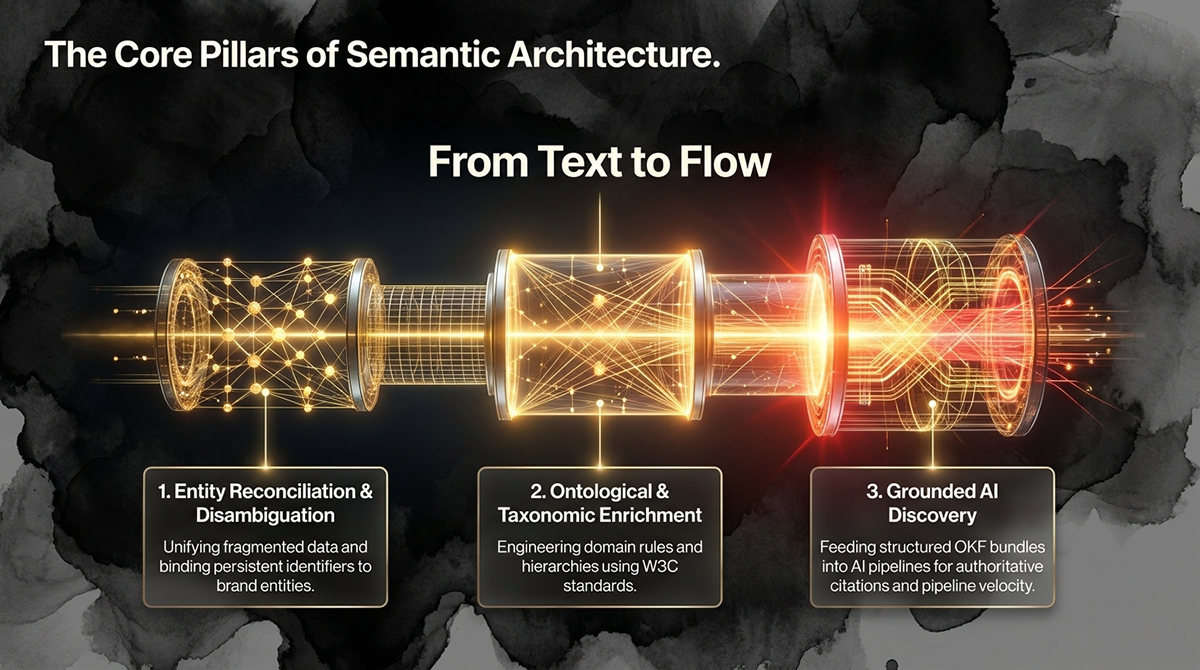
Here’s a concise breakdown of the strategic advantages they offer:
LLMs as Enablers of Ontology Engineering
Large Language Models are changing ontology engineering by being able to operate on language, which is the material from which ontologies are born. LLMs can:
- Read documents.
- Extract terms, propose classes, suggest definitions, and identify candidate relations.
- Generate competency questions and write documentation.
- Help validate if a model captures intended meaning.
This means LLMs can assist in building and refining ontologies, making the process more conversational, iterative, and semi-automated.
Ontologies Adapting for Agent Digestibility
The design of ontologies is shifting from solely “logic-first” to a “hybrid form” that is part formal model and part language interface, making them more “agent-digestible”.
At Google I/O 2026, Google talked about its move into the agentic era. It is integrating technologies like Google Antigravity and the agentic coding capabilities of Gemini 4 Carbon directly into Google Search. For AI agents to generate structured answers entirely on the fly, they must interact with websites that have adapted their data representation to be highly “digestible” and semantically unambiguous.
Richer Natural-Language for Content Discoverability
Important classes and properties now benefit from richer natural-language descriptions like rdfs:comment, skos:definition, schema:description, and dcterms:description. These are no longer just documentation for humans but are “semantic affordances” for language models, influencing retrieval, extraction, disambiguation, and generation.
Knowledge Graphs and Ontologies help solve “keyword blindness” and multi-hop questions, allowing for sophisticated information retrieval. This means better content discoverability and improved SEO, leading to more organic traffic and potential conversions.
Ontologies Enhance SEO for LLM Agent Reliability
They facilitate markup optimization, enhancing search engine visibility through structured data. This helps expand readership and optimize information accessibility.
Despite the initial complexity, ontologies become essential for grounding, inspecting, and making LLMs useful, especially in enterprise environments where the “jagged” intelligence of LLMs can be fragile.
Lexical Layer and Semantics-First Retrieval
They define what kinds of structured memories exist, how they relate to entities, and how they should be retrieved, allowing agents to navigate a structured memory environment rather than just searching for similarity.
An additional “lexical graph and retrieval layer” sits between the formal graph and the agent. This layer defines how entities appear in language, how they are mentioned, searched, and connected to evidence, effectively carrying “the instructions for memory formation” for the LLM.
Contextual Understanding and Grounding
Ontologies organize both semantic (stable knowledge) and episodic (experiences, events) memory for agents, guiding how information is timestamped, its provenance, and how it should be retrieved. This helps agents navigate a structured memory environment instead of just looking for the nearest chunk.
By providing contextual understanding for AI, agents move past simple lookups into “real reasoning and memory.” This leads to better business strategies.
Imagine a web developer seeing a “What Breaks If I Touch This?” sidebar panel that instantly lists downstream dependencies when they click an object, preventing catastrophic mistakes. This proactive feature saves time and resources, indirectly boosting your business plan and revenue.
Operationalized Negation and Validation
The knowledge layer brings together scattered organizational knowledge for increased operational efficiency and automation options. It enables AI agents to “act on what your company actually knows” for tasks like onboarding or resolving support tickets. This directly increases operational efficiency, impacting your bottom line.
Instead of relying on LLMs to interpret complex negative logic, “negation-heavy constraints” are moved to validation layers like SHACL (Shapes Constraint Language). This helps agents understand what is possible, expected, allowed, and required, ensuring that data is valid and actionable.
Guarding Against Hallucination
An ontology provides the “ground truth” or “guardrails” for AI, ensuring that the data engine never invents relationships that don’t exist. By mapping LLM outputs directly against a runtime knowledge graph, the system can instantly flag and reject relationships or facts that violate structural rules.
This helps to ensure that AI-generated content and structured data remain accurate, contextually relevant, and tightly aligned with a specific business domain. Instead of letting an AI or search engine guess what your website is about, an ontology explicitly defines your data’s rules, entities, and relationships.
Enabling Action and Trust
Ontologies define meaning, evidence, action, memory, and trust, providing identity, structure, validation, provenance, memory, and governance for agents. Without them, agents improvise; with them, agents operate.
Driving Business Value
- Potential buyers: The semantic model for your knowledge graph enhances various aspects of users’ online experience by making interactions more efficient, personalized, trustworthy, and secure.
- Internal staff: Knowledge Graphs pull disparate customer history data into one clear picture, enabling customer-facing teams to respond effectively. This directly leads to improved customer experiences and can result in higher conversion rates.
- Software: Ontologies allow software to understand the user’s real-world problems and recommend actions to drive desired outcomes, moving beyond rigid database tables. This leads to features that customers value, such as quickly identifying fraud rings or understanding downstream dependencies.
Revenue Impact Summary
Choosing the right structured data architecture depends on whether your goal is public search discoverability, real-time application sync, agentic progressive disclosure, or deep enterprise reasoning:
| Approach | Primary Formats | Best Used For | Target Audience |
|---|---|---|---|
| Schema Markup | JSON-LD, Microdata | SEO, AI search presence, rich snippets | Search engines, AI crawlers |
| Web APIs | JSON, XML | Real-time data sync, dynamic applications | Developers, B2B integrations |
| Open Datasets | CSV, Parquet, XBRL | Financial reporting, large analytics datasets | Analysts, regulators, data scientists |
| Open Knowledge Format (OKF) | Markdown (.md), YAML, JSON |
Progressive-disclosure LLM Wikis, token-efficient agent context | AI agents, GraphRAG pipelines, developer teams |
| Knowledge Graphs | RDF, OWL, Turtle, SHACL | Semantic AI systems, complex mapping, runtime validation | AI models, internal enterprise search |
Frequently Asked Questions
How do knowledge graphs and ontologies directly increase website revenue?
Knowledge graphs and ontologies increase website revenue across four measurable levers: feeding explicit entity relationships to AI crawlers to grow organic traffic and qualified leads, matching complementary products by ontological traits to lift Average Order Value (AOV), resolving contextual user synonyms in site search to boost Conversion Rates (CR), and programmatically scaling intent-matched landing pages to lower Customer Acquisition Cost (CAC).
What is the difference between an ontology and a knowledge graph in AI systems?
An ontology is the formal schema or “rulebook” that defines the classes of entities, allowed properties, constraints (such as SHACL validation rules), and relationship types within a business domain. A knowledge graph is the populated network of real-world entity instances (products, authors, locations, customers, and events) structured according to that ontology so autonomous AI agents can reason over verified facts without hallucinating.
How does the Open Knowledge Format (OKF) bridge Schema.org JSON-LD and enterprise ontologies?
Public Schema.org (JSON-LD) markup feeds Google’s public Knowledge Graph and search crawlers, whereas traditional RDF/OWL enterprise graphs require specialized graph databases. The Open Knowledge Format (OKF) bridges both worlds by serializing entity nodes, sameAs URIs, and semantic triples (Subject → Predicate → Object) into plain-text Markdown files with YAML frontmatter that AI agents can traverse via progressive disclosure.
Why are natural-language properties like rdfs:comment and skos:definition critical for LLMs?
In modern hybrid ontologies, properties such as rdfs:comment, skos:definition, and schema:description act as “semantic affordances” rather than passive human documentation. They supply Large Language Models with the lexical context required to disambiguate similar concepts, resolve multi-hop queries, and connect natural-language user prompts to formal graph nodes.
Adopting Knowledge Graphs and Ontologies
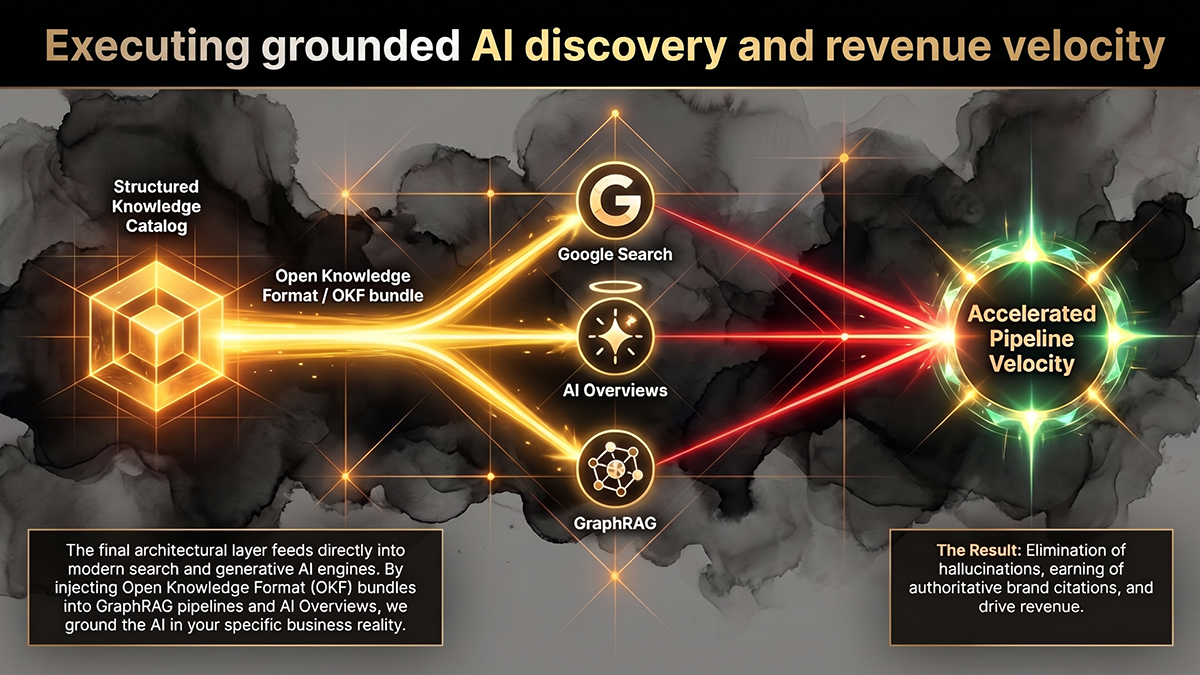
Empower your data so it stops being just a software tool and becomes an operating memory. Hill Web Marketing understands how expert knowledge management enables positive ripple effects of business decisions. Learn how prioritizing knowledge graph management will become indispensable for driving and protecting website revenue.
When your website and internal documentation are connected through a clear ontology and knowledge graph, AI agents don’t have to guess what your business offers. Instead, they can confidently find your pages, verify your facts, and recommend your services to buyers:
- More Qualified Traffic & Leads: Clear entity definitions help AI search engines and autonomous assistants match your pages to complex buyer questions.
- Higher Conversions & Order Values: Connected product and service data eliminates dead-end searches and powers smarter recommendations.
- Reliable AI Without Hallucinations: Explicit business rules and guardrails keep AI systems from inventing facts or making costly mistakes.
Whether you are moving from a traditional website to a knowledge graph or organizing an Open Knowledge Format (OKF) Brand Graph, Hill Web Marketing will help you build a foundation that drives lasting revenue.