
How to Optimize Content for Synthesized Answers in AI Search
Written by Jeannie M. Hill | Updated 11.3.2026
Optimizing for synthesized answers requires shifting from ranking whole webpages for single keywords to engineering verifiable, self-contained content passages that AI models can extract and cite.
Visibility in AI search engines means brands must establish consistent entity schema, write answer-first capsules, maintain high fact density, and build off-site consensus across reviews and industry publications.Digital marketing has permanently transitioned from traditional Search Engine Optimization (SEO) to AI Answer Optimization (AIO), Answer Engine Optimization (AEO), and Generative Engine Optimization (GEO). While the acronyms vary, the objective is identical: you are no longer optimizing merely to appear in a list of blue links; you are optimizing to become the cited answer itself.
In May 2018, I wrote about The Transition to Google’s Answer Engine, and in October 2023, I documented the rise of AI Answers. Today, generative synthesis is the default search experience. During Alphabet’s Q2 earnings call, Google CEO Sundar Pichai confirmed that AI Overviews now reach over 2 billion monthly users across more than 200 countries and 40 languages. [1]
These statistics are staggering. Meeting searchers’ quest for answers now entails more nuanced questions that also include subtopics (Query Fan Outs). Simultaneously, while you search for relevant information and products across the web, Google search is now synthesizing its findings into concise, direct AI responses.
Table of Contents
- How to Optimize Content for Synthesized Answers in AI Search
- How Google AI Mode Generates Synthesized Answers
- The 5-Phase AEO Implementation Framework
- Interactive Diagnostic: Synthesized Answer & Passage Readiness Scanner
- What This Means
- Answer Synthesis Processes
- “What People Are Saying” Google SERP
- How is AI Search Reshaping SEO?
- Necessity of Answer Citations in the AI-Driven Landscape
- Optimization for Synthesized Answers: Clear Steps
- Traditional SEO vs. AEO/GEO vs. OKF Brand Graph Architecture Matrix
- What are Timeless Content Principles?
- Frequently Asked Questions About Optimizing for Synthesized Answers
- Embrace Synthesized Answer Optimization
Some have coined AI answer optimization (AIO), Algorithm Experience Optimization (AEO), and generative engine optimization (GEO). However, the core principle is simple: we’re no longer just optimizing for a list of links. We are optimizing to become the answer itself. Essentially, an AI SEO approach aims to make your website content the preferred answer when users interact with AI assistants or chatbots.
How Google AI Mode Generates Synthesized Answers
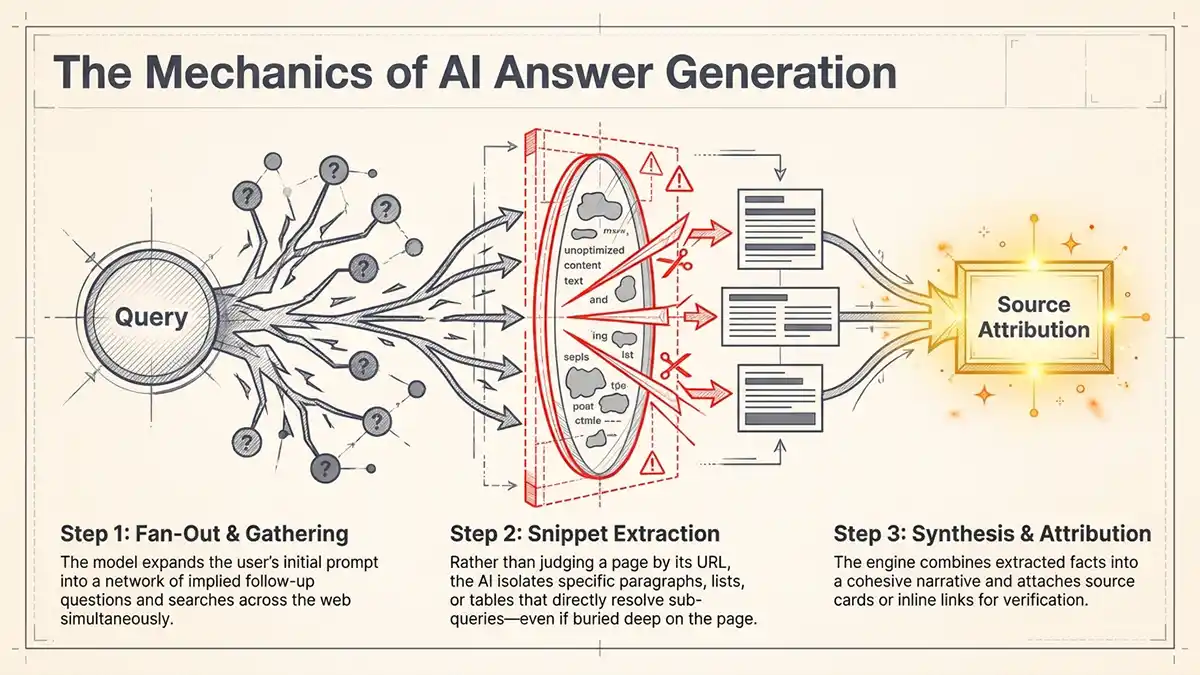
According to Google’s engineering documentation, AI Mode and AI Overviews build answers through three distinct steps:
- Query Fan-Out & Information Gathering: The model expands the user’s initial prompt into a network of related follow-up questions and searches across the web simultaneously.
- Passage-Level Snippet Extraction: Rather than judging a page solely by its title tag or URL, the AI isolates specific paragraphs, lists, or tables that directly resolve sub-queries—even if those passages sit deep down the page.
- Answer Synthesis & Source Attribution: The engine combines extracted facts into a cohesive narrative and attaches source cards or inline links so users can verify the claims.
The 5-Phase AEO Implementation Framework
To earn consistent citations in Google AI Mode, AI Overviews, and large language models (LLMs), organizations must execute a five-phase optimization framework that aligns entity identity, factual density, passage structure, off-site consensus, and technical schema markup.
Phase 1: Entity Consistency and Knowledge Graph Alignment
AI models evaluate the web through entities—verified people, organizations, products, and concepts—rather than isolated keyword strings. If your brand name, address, leadership credentials, or service definitions vary across directories, social profiles, and press releases, answer engines cannot confidently verify your identity.
- Audit Your Digital Footprint: Ensure 100% uniformity in how your business name, executive team, location, and core services are described across your website, Google Business Profile, LinkedIn, and industry directories.
- Connect Your Entity Graph: Implement Organization and Person JSON-LD schema utilizing sameAs properties to explicitly link your official website to authoritative third-party profiles and knowledge bases.
- Define Entities Explicitly: Introduce core topics and brand offerings in the opening sentences of your pages using clear, unambiguous subject-verb-object sentences.
Phase 2: Fact Density and Primary-Source Trust Engineering
To prevent hallucinations, answer engines prioritize sources with a high ratio of verifiable facts to subjective commentary. Pages padded with narrative fluff, vague qualifiers, or unsupported marketing claims are routinely filtered out during AI answer synthesis.
- Lead With Verifiable Data: Anchor every major section with specific statistics, dated benchmarks, clinical or technical metrics, and first-party research findings.
- Eliminate Promotional Filler: Remove speculative adverbs, superlative sales language, and repetitive introductory paragraphs that delay the core answer.
- Cite Authoritative Primary Sources: Reference official documentation, earnings calls, and peer-reviewed studies so retrieval models can cross-verify your assertions against trusted nodes in their training data.
Phase 3: Passage Retrieval and Answer-First Formatting
AI retrieval systems extract specific passages (“chunks”) rather than ranking entire pages as a single unit. When an engine performs query fan-out, it searches for self-contained paragraphs, lists, and tables that directly resolve both the primary prompt and its implied follow-up questions.
- Use Question-Based Headings: Structure H2 and H3 headings around natural-language questions every 250 to 300 words to mirror conversational search prompts and People Also Ask queries.
- Write 40-to-60-Word Answer Capsules: Place a direct, standalone summary answer immediately after every question heading before expanding into supporting details.
- Keep Paragraphs Concise: Restrict paragraphs to 75 to 150 words so each block represents one coherent concept with clean extraction boundaries.
- Structure Data With Native HTML Lists and Tables: Present sequential steps in ordered lists, feature breakdowns in unordered lists, and multi-variable comparisons in semantic HTML tables.
- Optimize for Multisearch: Pair text passages with original diagrams, descriptive image alt text, and video transcripts to capture multimodal search queries.
Phase 4: Multi-Source Authority and “What People Are Saying” Optimization
Answer engines rarely rely on a single domain to formulate a response; they cross-reference multiple web properties to verify consensus and gather real-world user perspectives. Features like Google AI Mode’s “What People Are Saying” actively synthesize community discussions, short videos, and customer reviews alongside brand pages.
- Cultivate Verified Customer Reviews: Build a steady stream of detailed, authentic customer reviews and case studies across independent review platforms to feed positive sentiment into AI synthesis.
- Address Community Discourse: Monitor forums, Reddit threads, and customer support logs to uncover the exact phrasing and edge-case questions your audience asks, then answer them directly on your site.
- Earn Third-Party Citations: Secure expert mentions, podcast appearances, and citations in trade publications so LLMs encounter consistent external validation of your brand’s claims.
Phase 5: Continuous Content Freshness and Schema Architecture
Real-time AI search engines heavily weight content recency and machine readability, particularly in fast-changing sectors like healthcare, finance, and technology. Outdated statistics and unmarked HTML cause previously cited pages to lose visibility to fresher competitors.
- Establish a Quarterly Refresh Cycle: Regularly update historical statistics, replace broken or outdated outbound links, and revise timestamps to reflect substantive content updates.
- Deploy Comprehensive JSON-LD Schema: Implement and validate Article, TechArticle, FAQPage, Organization, and Product schema so AI crawlers can parse relationships without guessing.
- Monitor AI Citation Share of Voice: Track how frequently your brand and URLs are cited across Google AI Overviews, Google AI Mode, ChatGPT Search, and Perplexity, and re-engineer underperforming passages.
What This Means
- We’ve moved past optimizing for keywords; we optimize for questions.
- We’ve moved past optimizing for pages, we optimize for “chunks” or “passages.”
- The focus has changed from largely being about websites; it’s now about a business entity’s overall web presence.
- It is harder to gain and track conversions, but CRO remains vital for revenue.
“Zero-click searches,” where the user’s query is answered on the results page itself, are now prevalent. Rand Fishkin stresses how outdated and worrisome it is that 60% of marketing leaders still think that increasing web traffic is a top SEO strategy. [2]
Today, offsite brand attention is just as important as what you publish on your site. Using traffic growth as a metric needs to change.
Answer Synthesis Processes
This means tailoring your content specifically for generative AI platforms and inclusion in LLM answer engines, in addition to traditional search.
For the writer, it’s about:
- Understanding core concepts of AI engines.
- Anticipating needed preparations for AI parsing.
- Tracking how your brand and content show up in synthesized answers.
- Agile AI search strategies that quickly update.
The Key Difference: Traditional SEO centers on efforts to rank in a link list; GEO centers on becoming the source of a direct, comprehensive answer. It’s the difference between being a pop-up shop on a busy street and being the go-to expert sought out for answers.
For the AI engine, it’s about:
- Data consumption from all over. Its digital scope encompasses collecting information from every corner of the web.
- Synthesizing disparate information bits into a woven-together and coherent whole.
- Prioritizing and providing the “best” info based on relevance and quality.
- Constant learning and refinement. This means forever absorbing new data and tweaking its synthesized answers.
Early adoption can give your business an edge.
Exploding Topics states in its 50 NEW Artificial Intelligence Statistics (July 2025) report that “38% of medical providers use computers as part of their diagnosis.” Author Josh Howarth reports that 33% of businesses have started implementing limited AI use cases.
Every niche is unique. The medical industry has a commanding lead in healthcare AI synthesized answer adoption.
Here is an example of the AI answer process in action.
“What People Are Saying” Google SERP

The role of “What people are saying”:
Within this process, Google AI Mode seems to emphasize and display diverse perspectives and information. This feature is another user query response it gathers from points across the web.
This Google response highlights specific content snippets that it believes offer valuable insight or a direct answer to aspects of the user’s query. Others have reported seeing various formats of what people are saying in their search results. I’ve replicated this before, in short video clips and on mobile in expandable carousel format.
By testing and showcasing “What people are saying,” AI Mode seeks to offer a more comprehensive understanding of a topic that helps users explore different perspectives. This seems a bit like reading product reviews to make informed decisions. Shoppers using AI Mode like learning from real-world experiences and opinions available on the web.
How is AI Search Reshaping SEO?
It takes a new mindset to understand how Google AI responses generally work.
My engineering mind always likes knowing what’s going on. What is happening behind the scenes?
When a searcher raises a question, AI Mode strives to understand the underlying intent behind the query. We learn directly from Google how this new AI Mode generates answers. This builds on how it used Ask a follow up question in AI Overviews.
“Query fan-out and information gathering: It expands the original query into a series of related questions and searches across a wide range of web sources simultaneously.
Identifying relevant snippets: AI Mode identifies passages or sections of content that directly address parts of the expanded query, even if they’re not at the top of a webpage.
Displaying synthesized answers and source links: AI Mode then presents a synthesized answer, drawing information from these relevant snippets, along with links back to the original sources where users can delve deeper.” – Get AI-powered responses with AI Mode in Google Search
Necessity of Answer Citations in the AI-Driven Landscape
Adapt an “AI thinking” approach that values citations along with inbound links.
Winning inclusion in AI Mode Content now requires more than indexable and informative content. It means providing more content that is “generally relevant” to your audiences’ queries. It requires SEO relevance engineering and being the most relevant answer.
Currently a whopping 12% Of People Also Ask results are found in Google AI Overviews.
Optimization for Synthesized Answers: Clear Steps
Steps to gain mentions and visibility in large language models (LLMs) responses:
- Write with a logical flow: Capsulize your article’s introduction. Expand on complex question answers in your main content, provide key takeaway points, and, lastly, offer a helpful summary.
- Structure your Q&A: Direct, immediate, and concise answers should immediately follow questions.
- Answer in the correct tone: Keep answers positive, simple, and without added promotion. Focus on matching the query’s intent.
- Take advantage of structured data: AI agents quickly find, categorize, extract, and match answers to queries when your content supports the Answer Synthesis Processes with schema markup.
- Use Natural Language Processing: Avoid advanced jargon that’s above your audience’s knowledge or manner of speaking.
- Shorten sentences and paragraphs: In-depth articles can provide focused answers. Paragraphs with only 75-150 words provide a better user experience.
- Chunk your answers: Leverage bulleted and numbered lists for succinct clarity.
- Use headings: Incorporate H2s and H3s to introduce new content concepts. This article structure works great for approximately every 300 words.
- Adapt for multisearch: People are using images, text, audio, and video when searching to find solutions. Strategize for users engaging with content in multiple ways.
Traditional SEO vs. AEO/GEO vs. OKF Brand Graph Architecture: Decision Matrix
While traditional SEO optimizes full documents for keyword rankings, Answer Engine Optimization (AEO), Generative Engine Optimization (GEO), and Open Knowledge Format (OKF) Brand Graphs engineer modular passages and verified entity triples for AI synthesis. Use this comparison matrix to align your content and technical stack across each layer:
| Optimization Layer | Primary Retrieval Unit | Core Technical & Editorial Signal | When This Layer Wins & Key Trade-Offs |
|---|---|---|---|
| Traditional SEO | Full URL / HTML Document | Title tags, backlinks, internal link equity, Core Web Vitals, and crawlable indexation. | Wins: High-intent transactional clicks and organic rankings (often a prerequisite pool for AI retrieval). Trade-off: Ranking in the top 10 alone does not guarantee passage extraction if copy is buried in narrative fluff. |
| Answer Engine Optimization (AEO) | 40–60 Word Answer Capsule & Q&A Pair | Question-based H2/H3 headings, immediate direct answer capsules, native HTML lists/tables, and FAQPage JSON-LD. |
Wins: Direct resolution of conversational prompts, People Also Ask (PAA), and voice/assistant answers. Trade-off: High zero-click rate on basic definitions unless paired with interactive tools or deeper implementation steps. |
| Generative Engine Optimization (GEO) | Multi-Passage Fan-Out Chunks & Consensus | High fact density, primary-source citations, off-site review corroboration (“What People Are Saying”), and multimodal assets. | Wins: Inline source cards in Google AI Mode, AI Overviews, ChatGPT Search, and Perplexity. Trade-off: Requires ongoing quarterly freshness updates and off-site reputation management across third-party platforms. |
| OKF Brand Graph & Unified JSON-LD | Verified Entity Node (@id) & Semantic Triples |
Unified Schema.org @graph (#website, #organization, #author) synced with progressive-disclosure Markdown/YAML entity nodes and Wikidata sameAs URIs. |
Wins: Eliminates entity ambiguity and prevents AI hallucinations across Google’s Knowledge Graph and enterprise GraphRAG. Trade-off: Requires disciplined schema hygiene and cross-channel NAP/entity governance. |
What are Timeless Content Principles?
AI technology remains true to the following pillars of content creation:
- Provide value.
- Do so with clarity.
- Be a trustworthy source.
Implementing these strategies requires a major content update in how content is planned, created, and structured. It’s a detailed process that requires technical SEO, expert writing, and constant AI SERP analysis. While these steps provide a strong foundation, strategic application and implementation is where many teams need support.
Frequently Asked Questions About Optimizing for Synthesized Answers
What is a synthesized answer in AI search?
A synthesized answer is an AI-generated response in Google AI Mode, AI Overviews, ChatGPT Search, or Perplexity that combines extracted passages from multiple web sources into a single, cohesive explanation. Instead of returning a single webpage link, the answer engine performs query fan-out across sub-questions, extracts verifiable chunks (paragraphs, lists, and tables), and attaches inline source citations.
What is the ideal passage length for Google AI Mode and AI Overviews?
Place a direct, self-contained 40-to-60-word answer capsule immediately below each question-based H2 or H3 heading so retrieval models can extract a complete summary in one chunk. Keep supporting paragraphs between 75 and 150 words, and introduce a new heading every 250 to 300 words to maintain clean semantic boundaries.
How do AIO, AEO, and GEO differ from traditional SEO?
Traditional SEO focuses on ranking entire URLs in search engine results pages (SERPs) for target keywords. AI Answer Optimization (AIO), Answer Engine Optimization (AEO), and Generative Engine Optimization (GEO) focus on engineering fact-dense passages, explicit entity definitions, and unified Schema.org JSON-LD so large language models (LLMs) select and cite your brand inside synthesized responses.
How does Google’s “What People Are Saying” feature affect AI answer citations?
Google AI Mode and SERP carousels cross-reference official brand claims against real-world user perspectives from forums, short-form videos, and independent customer reviews. Earning consistent third-party mentions, verified Google Business Profile (GBP) reviews, and addressing real community edge cases on your site strengthens multi-source consensus during answer synthesis.
Which Schema.org JSON-LD types help AI engines verify synthesized answers?
Deploy a single, unified JSON-LD @graph that separates your root WebSite (#website) from your publishing Organization / ProfessionalService (#organization), links your Article to a verified Person author node (#author), and pairs visible Q&A sections with FAQPage markup. Including authoritative Wikidata and official documentation URIs inside sameAs, about, and mentions disambiguates your entities for retrieval models.
Embrace Synthesized Answer Optimization
Turn obstacles into opportunities. The internet’s information landscape has fundamentally changed. It’s exciting, fast-paced, perhaps daunting, but full of opportunity. The digital world is reshaping right now.
This is where we come in. Partner with Hill Web Marketing to create and structure your content. We’ll help you adapt and remain relevant as your future makes this imminent. Let’s shape it together.
Request Your Marketing Plan With AI Measurement
Sources:
[1] https://blog.google/inside-google/message-ceo/alphabet-earnings-q2-2025/
[2] https://sparktoro.com/blog/in-a-zero-click-world-traffic-is-a-terrible-goal/