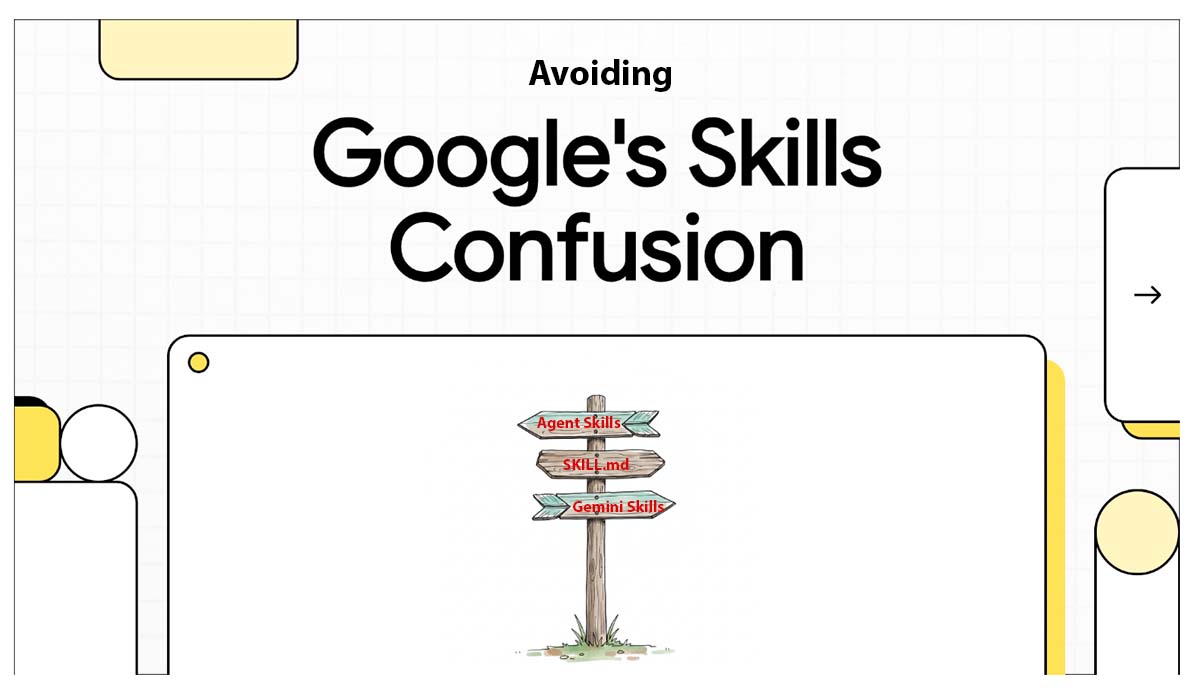
The Anatomy of a “Skill” in the AI Era: Navigating Google’s Overlapping Terminology
The term “skill” is surfacing more often across several distinct concepts within Google’s ecosystem, leading to potential ambiguity.
I have sought to understand this overlapping terminology due to shared nomenclature for fundamentally different functionalities. Today’s successful digital marketers have moved from skills to provide implicit, inferred knowledge to providing explicit, structured, and auditable knowledge that AI agents can reliably process, significantly enhancing client performance and trustworthiness.
With so many emerging concepts closely related to AI agents, there’s a potential for confusion. For instance, in conversations surrounding agentic architecture, it is often noted: “If you’ve seen SKILL.md and Google’s Open Knowledge Format (OKF) in the same week and thought they were the same thing, you’re not alone.” While an AI SEO professional gains clarity between two technical file formats for AI agents, I’m also hearing broader confusion across more diverse “skill” categories.
Given these different skill types, from human certifications to specific file formats for AI agents, to productivity features within an AI chatbot, and broader conceptual “AI skills” for SEO, I have mapped them out below. I’ll compare “Skills” across the Google and AI Ecosystem.
Table of Contents
- Table Comparing Google Cloud Certifications, SKILL.md, Gemini Skills, and Agent Skills
- Complexity for AI SEO Professionals: AI SEO and Generative Engine Optimization (GEO)
- Explicit UUIDv4 Fields and a Structured References Array
- My End Goal: Building Reliable, Interpretable, and Machine-Readable Knowledge Systems
- Hill Web Marketing Skills That You Can Benefit From
- CONCLUSION: Request Your SEO AI Strategy Today!
Here is a Table Comparing “Google Cloud Certifications skills,” “SKILL.md,” “Gemini Skills,” and “Agent Skills”
| Category | What it is | Target Actor(s) | Format / Structure | Primary Purpose | Ecosystem / Context |
|---|---|---|---|---|---|
| Google Cloud Certifications skills | Human-centric professional capabilities validated by Google Cloud’s formal certification programs. These are credentials available through a Google learning platform called “Google Skills”. | Humans (IT professionals, cloud engineers, architects, and developers). | Acquired through exams, badges, and practical engineering experience. Involves completing a series of courses for Skill Badges or passing proctored exams for Certifications. Training credentials can also be earned. | To prove a human’s technical competence in designing, building, and managing infrastructure, security, data pipelines, and AI deployments directly on Google Cloud Platform (GCP). Focuses on career advancement and technical architecture validation. | Google Cloud Platform (GCP), Google’s learning platform “Google Skills”. |
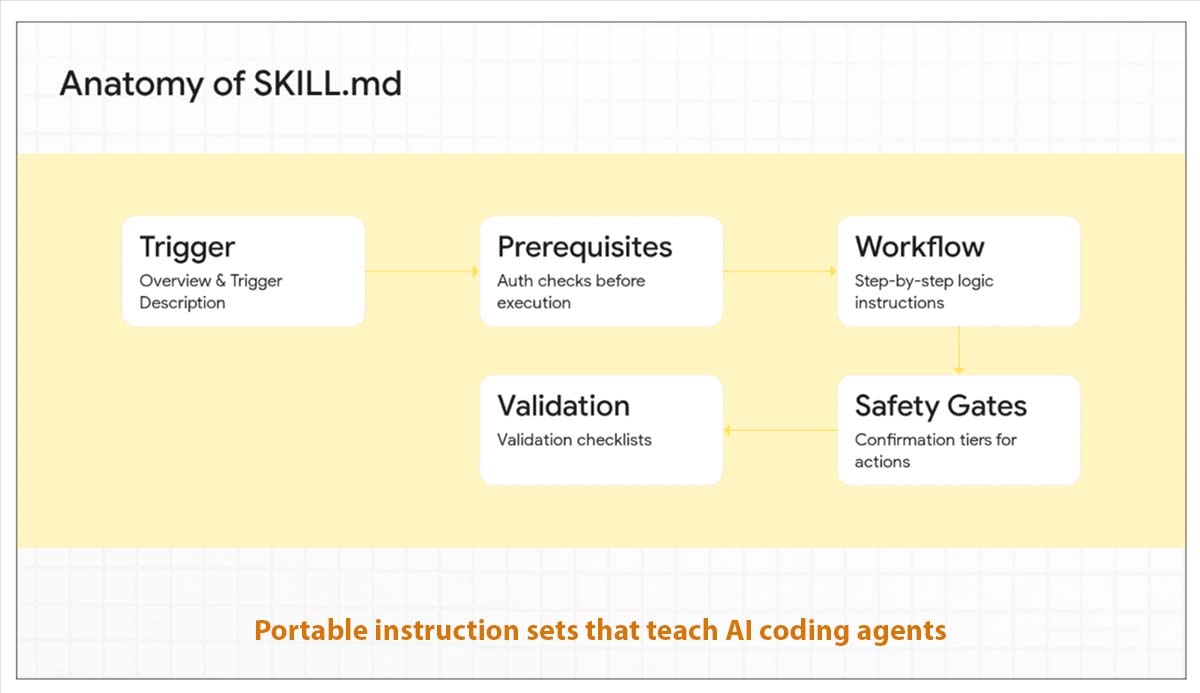
| SKILL.md | An open standard Markdown file format. It is the core component of any Agent Skill and the heart of every skill. It is executable instruction code for AI coding agents. | AI coding agents (as the entity that reads and executes it). Developers (who author it). | A plain-text Markdown file beginning with a YAML frontmatter block. The YAML frontmatter includes `name`, `category`, and a `description` which acts as the activation trigger for the agent. The Markdown body contains procedural instructions, step-by-step guidance, and examples. | To provide executable instruction code for AI coding agents. Teaches an agent how to do something (a procedure, workflow, recipe). Functions as a “procedural playbook” or instruction manual for AI agents. | Open Source / Cross-platform AI tools, built on the agentskills.io open standard. It is housed within Agent Skills packages. |
| Gemini Skills | A native productivity feature within Google Gemini and Google Workspace. It is the official, upgraded replacement for Google’s previous custom AI personas, known as “Gems”. These are reusable, modular prompts or “recipe cards”. | General knowledge workers, enterprise teams, and daily Gemini users. Humans interacting with Gemini. | Can be interactively built or imported via the Gemini Settings panel, or created from user chats. Users can save custom instructions once and reuse them endlessly. They can include reference files (plain text documents, PDFs, or images). They are built on the open, Markdown-native SKILL.md standard, allowing users to copy skills from other platforms into Gemini and Workspace apps. Activated using a forward slash (/) command in the prompt bar. | To streamline everyday text, business, and productivity workflows. Eliminates repetitive prompting. Allows combining multiple skills (stacking) or adding reference files for complex automated workflows. | Google Ecosystem (Gemini app, Google Workspace apps like Docs, Gmail, Drive). Gems will be migrated to skills automatically starting November 17, 2026. |
| Agent Skills | Reusable packages of instructions and context. These are portable instruction sets that teach AI coding agents how to work with specific technologies safely and efficiently. An Agent Skill is a self-contained directory or folder that includes the instructions and assets needed for a specific task. It represents a lightweight, modular approach for AI development towards reproducible, version-controlled workflows. | AI coding agents. Developers (who build, install, and leverage them). | A directory/folder containing a mandatory SKILL.md file, and optional supporting subdirectories such as `scripts/` (for executable Bash/Python scripts), `references/` (for detailed documentation or policies), or `assets/` (for templates or diagrams). Agent Skills use a progressive disclosure model to manage instructions efficiently. They are managed via Git as version-controlled, modular filesystem directories. | To extend an AI agent’s capabilities and provide specialized expertise for specific tasks. To help agents complete complex, multi-step workflows that the base LLM might not reliably handle on its own. To provide verified workflows and safety gates to prevent agents from “blindly guessing a gcloud command and breaking a production cluster”. Enables agents to perform tasks like security audits, deploying serverless applications, or optimizing BigQuery pipelines. They enforce deterministic workflows and executable logic. | Primarily the Google Cloud AI ecosystem (Gemini Enterprise Agent Platform, Agent Development Kit (ADK), Google Kubernetes Engine), but also works with Anthropic Claude (Claude Code), Cursor, VS Code, Antigravity CLI, and any other tools supporting the agentskills.io standard. The official `google/skills` repository is an open-source collection of these. |
Complexity for AI SEO Professionals: AI SEO and Generative Engine Optimization (GEO)
Where our client work heavily relies on “skills” to connect website data to AI engines, it’s vital to decipher skill types and applications. AI models now use extensions, plugins, and native skills to browse the live web and pull real-time data into AI Overviews. Digital marketers and AI SEO professionals are urged to optimize for these AI skills to remain visible in the next generation of search.
For an example use case, a SKILL.md file instructs an AI coding agent exactly how to orchestrate, validate, and maintain a client’s Open Knowledge Format (OKF) directory without hallucinating or breaking links. This is placed at the root of my client’s automation repository.
“AI agents do not look at beautifully styled web pages; they ingest and rely on highly structured, deterministic markdown with explicit semantic relationships.”
I’ve been asked for examples of how I might use this strategy. Below is an example.
Explicit UUIDv4 fields and a structured references array:
- Unique Identifiers (UUIDv4): For healthcare entity building and marketing, this means ensuring that every piece of information—a specific medical condition (e.g., “Type 2 Diabetes”), a treatment (e.g., “Insulin Therapy”), a clinic location, a doctor’s profile, a patient education pamphlet, or a marketing campaign — is assigned a unique identifier.
- Structured References Array: The AI Agent is instructed (via SKILL.md) to maintain explicit links and relationships between these uniquely identified entities. This prevents ambiguity and ensures that the AI consistently refers to the correct entity. In YMYL content marketing workflows, this is crucial when dealing with medical terminology and patient safety.
My End Goal: building reliable, interpretable, and machine-readable knowledge systems
A clear understanding is crucial for both AI agent performance and generative search optimization. It hinges on the distinction between “how to do something” (SKILL.md) and “what things exist” (Open Knowledge Format or OKF).
When I can make a website’s data part of a “hardcoded Knowledge Graph,” the AI can “query structured databases directly” instead of scrolling through traditional results. This forms the foundation of a modern factual content strategy for AI search.
Hill Web Marketing skills that you can benefit from:
- Creating and maintaining Open Knowledge Formats (OKFs).
- Implementing robust Schema.org markup.
- Managing clean product feeds for Google Merchant Center.
- Architecting a business’s knowledge for AI engineering.
- Managing Google Business Profile optimization.
Google rewards unique, people-first content that fulfills user needs, regardless of how it is produced. As search evolves to answer complex questions instantly, success requires providing structured, highly readable data. Ultimately, optimizing for generative engines means speaking the exact deterministic language of machines to elevate and protect the human experience.