
Boost Author E-E-A-T: The jobTitle Schema Guide
Nesting the “jobTitle” property within the Person Schema markup of Article schema can enhance authors’ online presence.
As AI-generated content floods search engine result pages (SERPs), proving human expertise is more critical than ever. This guide moves beyond basic author schema to show you how nesting the jobTitle property is a critical signal for building trust and differentiating your expert-led content in Google’s eyes.
Table of Contents
- The jobTitle Schema Guide
- Turning Author Bylines into Verifiable Credentials
- Benefits of Adding Authors’ Job Title to Article Schema
- Information Extraction Algorithms can Clearly Identify Authors & Their Credentials
- Nested Schema Markup Provides Structured Data that Strengthens E-E-A-T
- A Semantic Triple is Great for Stating an Article’s Authorship
- Explanation of Cited Schema Elements
- Why This Matters for Writers
- Why The Job Position of Authors Matters to Publishers?
- Google Discover Chooses Between Display Author Name or Site Title
- Is Google Using Job Title Data to Identify Authors?
- Implement Job Title Schema Today!
- FAQs
Turning Author Bylines into Verifiable Credentials
You’re already using Article and Person schema for your authors. But are you leveraging it to its full potential? Many teams stop at the name and URL properties, missing one of the most powerful signals of professional credibility: jobTitle.
Google’s own documentation explicitly tells us to use this property to establish who an author is. This guide provides the practical “why” and the technical “how” to implement jobTitle schema.
Adding an individual’s job title makes their professional role clearer to search engines. In turn, this may lead to increased visibility in SERPs, more qualified website traffic through rich results (like knowledge panels), and improved user trust and credibility.
Clarifying roles for using “job titles.”
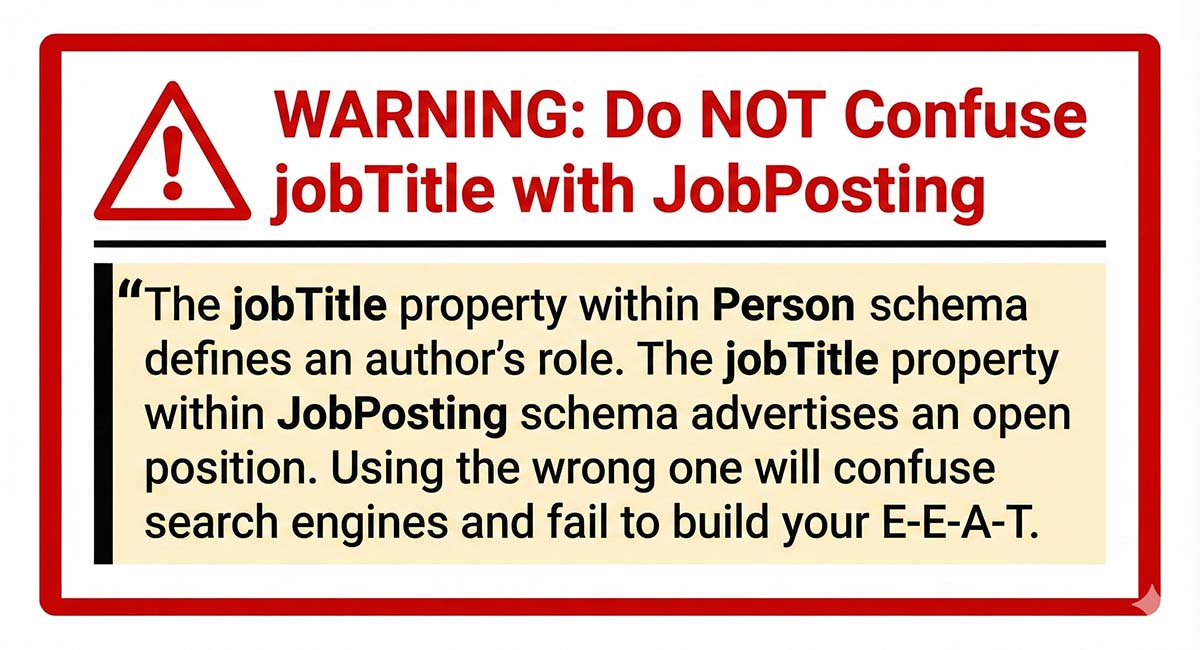
Google allows job titles in Person schema, even while clarifying it shouldn’t go into author.name or be confused with JobPosting schema.
This distinction allows search engines to clearly differentiate between an active job advertisement and a piece of content referencing a person’s profession.
To specify an author’s job title for an article using Schema.org, you should use the jobTitle property within a Person object, which is then nested under the author property of your Article or CreativeWork schema.
If you are going to invest time in adding jobTitle schema markup, what benefits you can expect to gain?
Benefits of Adding Authors’ Job Title to Article Schema
Knowing someone’s job title directly on the SERP gives individuals and authors the following advantages
The author property in Schema.org is crucial for attributing content to a Person or Organization. It has become increasingly important for SEO and AI visibility in 2025, as search engines and generative AI use this data to understand and cite sources.
- Consistent Search Visibility: Structured data allows an author another way to manage consistent presentation of personal information across search results. This helps disambiguate similarities between similar person entities.
JobTitleschema markup helps to ensure your personal brand is represented consistently across sites you control. - Improved E-E-A-T factors: This helps people and search engines understand and verify the expertise, experience, authoritativeness, and trustworthiness (E-E-A-T) of content creators. Including affiliations demonstrates “trust” from other persons.
- Rich Results and Knowledge Panels: The job title can contribute to a quick and richer display of personal information in search results. This may take the form of a “personal knowledge panel,” or “person entity card.” This makes a person’s profile stand out and encourages SERP prominence.
- Improved Click-Through Rates (CTR): By presenting key information, like a job title, directly in the search results, users are more likely to click. Users can find a link to your bio page or to learn more, which boosts CTR.
- Increased Authority and Credibility: Clearly stating a person’s job title through schema markup helps to establish their authority and credibility in their field, making them seem more trustworthy and knowledgeable.
- Targeted Audience Attraction: Stating a clear job title in the schema markup can help attract individuals looking for that particular expertise. It can act as a filter, resulting in a more qualified audience.
- Better Brand Representation: It easier to build your personal brand entity. This type of nested structured data helps search engines display information in a visually appealing way.
Information Extraction Algorithms can Clearly Identify Authors & Their Credentials
An author’s job title appearing directly in a Google search snippet (like the “By [Name], [Job Title]” format is rare. While it may display, it is not a guaranteed feature. Search algorithms constantly evolve. While they use Schema.org markup to understand authorship and expertise, what they decide to display visually is up to them.
Regardless, the nested Schema markup is valuable at this time.
Its primary role is to provide structured data that strengthens E-E-A-T (Experience, Expertise, Authoritativeness, and Trustworthiness) signals behind the scenes.
This can influence your visibility in other powerful ways, such as:
- 🔎 Knowledge Panels: Google may use the data to build or enrich a Knowledge Panel for the author, which prominently displays their job title and other details.
- 🔎 Author-Specific Carousel: For renowned experts, Google sometimes displays a carousel of their articles at the top of the search results.
- 🔎 Implicit Ranking Factors: By clearly defining an author’s expertise, you increase the chance of their content ranking higher for relevant, expert-level queries.
“Your domain and authorship build a semantic reputation.” – Ipullrank
This refers to the concept that both the authority of a website (domain authority) and the credibility of the content creators (authorship) contribute significantly to how search engines and people perceive the quality and relevance of your content.
Together, the two help build a comprehensive semantic reputation:
- What the content is about.
- Who is providing it.
- How trustworthy the source is.
Ultimately, this influences your SERP visibility.
Who may find and connect with the person based on their specific role and expertise?
- Potential collaborators.
- Future employers.
- Customers.
Nested Schema Markup’s Provides Structured Data that Strengthens E-E-A-T
Disclosing the expert’s professional details and qualifications is a crucial practice for establishing Experience, Expertise, Authoritativeness, and Trustworthiness (E-E-A-T). This is essential for content ranking, especially for high-stakes topics (YMYL content).
Here’s a breakdown of how Google uses schema markup for authors and job titles:
- Author property: To inform Google about the creator of a piece of content (such as an article or blog post), you should use the author property. This property should be nested within Article schema for the creative work, such as Article or NewsArticle.
- Person schema: The author property can refer to a Person schema, which can contain additional properties like name, url (for the author’s bio page), and sameAs (for social media profiles).
- Google’s guidelines: Google’s documentation explicitly states that you should only use the author.name property for the author’s name, and not for their job title. This distinction helps Google accurately understand and represent the content’s author.
- Distinction from JobPosting schema: The jobTitle property has a separate purpose. It is used exclusively within the JobPosting structured data. This markup provides details about a job opening, enabling the listing to appear in Google’s specialized job search experience.
- Separate purpose: The jobTitle property in JobPosting is for the title of the position being advertised (e.g., “Software Engineer”), not the title of the author of a piece of content.
“JobTitle is the basic building block: the minute description that people and companies provide to describe a series of activities performed at work: a job.” – Classification for Occupational Category [1]
Why does the “organization” name sometimes display versus the “author” name?
While this may simply be Google testing what users like to see on Google Search, it does indicate intent to acknowledge human authors. In the explosion of AI-generated content, this may be one way to highlight “human” expertise.
A buyer can then go directly to that human if they have more questions or want personal application information.
Google AI Search’s decision of whether to prioritize the author or the organization in SERPs comes from a sliding scale. My testing signals that it’s influenced by the subject matter. At times, the content writer’s expertise matters most.
A Semantic Triple is Great for Stating an Article’s Authorship
A semantic triple that clearly states an article’s authorship has this format:
(Subject: Article Title) – (Predicate: Has Author) – (Object: Author Name)
For example, I’ll use this post.
“Authorship and JobTitle Schema” – Has Author – “Jeannie M. Hill”
While an H1 tag is primarily for a human-readable main heading, the semantic triple for authorship isn’t typically displayed directly under the H1 on a webpage in that exact format. Instead, it’s embedded in the page’s metadata using formats like Schema.org JSON-LD, which search engines and AI bots understand.
A way to represent the semantic triple in a human-readable way that directly relates to the H1, on a conceptual level, can be presented like this:
Authorship and JobTitle Schema
By Jeannie M. Hill
Article Schema
└── author (property)
└── Person Schema (@type)
├── name (property): “Jane Lemin”
├── jobTitle (property): “Lead Medical Writer”
├── affiliation (property):
│ └── Organization Schema (@type)
│ └── name (property): “Health Insights Corp.”
└── url, sameAs, etc.
So, while the semantic triple “Authorship and JobTitle Schema” – Has Author – “Jeannie M. Hill” is the underlying concept, on the actual page, you’d see the H1 followed by a byline for human readers. The underlying structured data (like JSON-LD) is for search engines.
Explanation of Cited Schema Elements
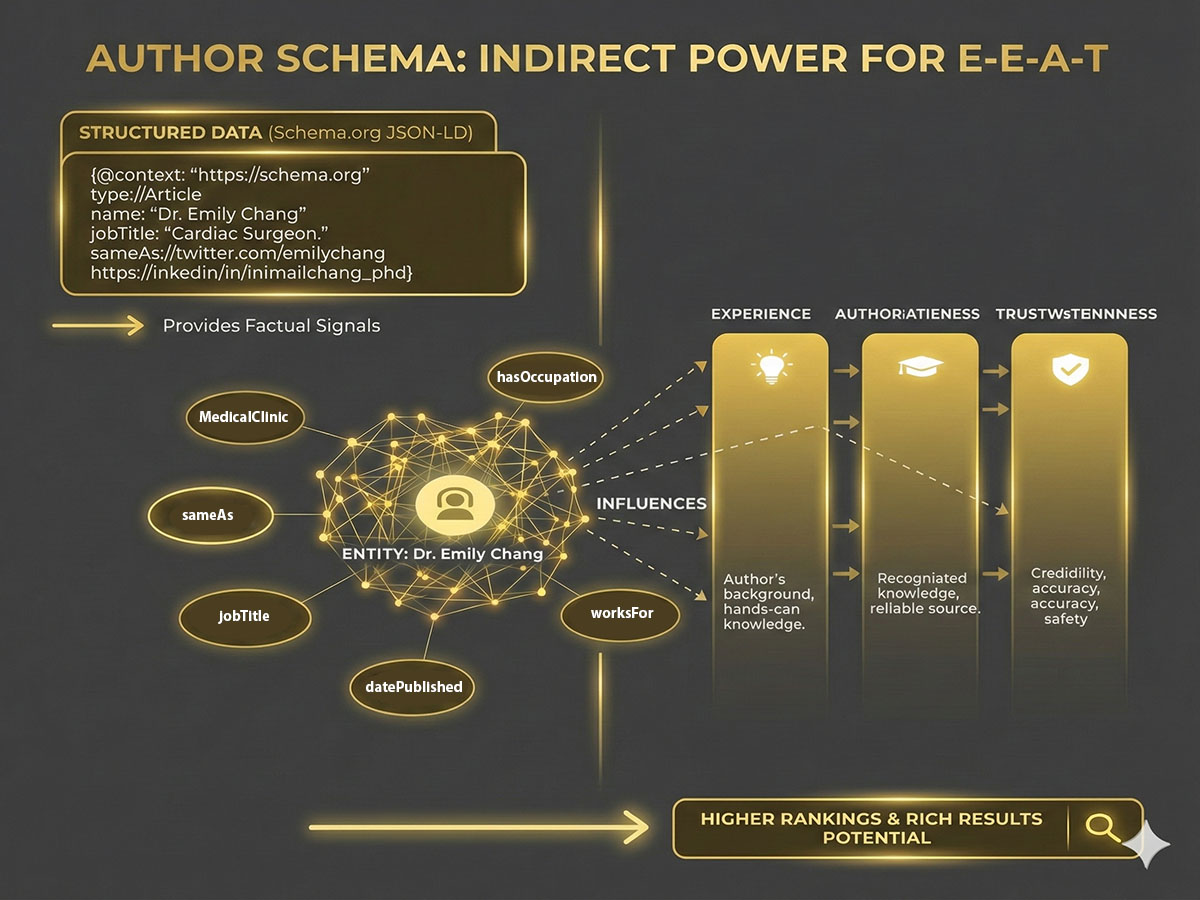
- @context and @type: “Article”: The Author property is designed to be added to Schema types like
Article. The schema is typically nested within a script tag using JSON-LD format. - author and @type: “Person”: The author property is used to declare the content creator, utilizing the Person schema type to define the individual writer.
- name and jobTitle: The sources provide specific examples of using jobTitle (like “Journalist” or “Editor in Chief”) within the Person type to give search engines explicit context about the author’s professional role and credentials.
- worksFor (Affiliation): While the term “affiliation” was used in your query, the functionally equivalent property for declaring the organization an author works for is worksFor. This is supported because including details about an author’s industry affiliations and organizations is vital for establishing their expertise.
- url and sameAs: The url property is recommended to link to the author’s unique profile page for disambiguation. The sameAs property is used to link to social media profiles, which helps search engines group the author’s contributions by entity and confirms their niche involvement and authoritativeness (often referred to as reconciliation).
Why This Matters for Writers
For writers, this SERP result indicates a growing demand for original content in AI-generated results. Attributing sources to human authors encourages responsible content creation and maintains the value of expert contributions. It is more important in a world increasingly influenced by AI summaries and AI synthesized answers.
By displaying author names and site source citations, Google and AI bots can improve trust in AI summaries, showing that the information is backed by real sources. I first saw this May, 2025.
“This could impact how content creators approach SEO and content marketing, emphasizing authoritative, well-cited work.” – Google Tests Author Names and Citations in AI Overviews
Why Authors’ Job Position Matters to Publishers?
People and Google want transparency about who created published content.
A professional role signals that the writer utilizes the related skills of an experienced author. This is demonstrated by their position in the business entity and the title given to their role.
Strategic roles that signal high authority include:
- The Chief Content Officer (CCO).
- The Director of Content Strategy.
- Head Writer / Lead Writer
- Editorial Director / Editor-in-Chief
“Accurate attribution of authorship is crucial for maintaining the integrity of digital content, improving forensic investigations, and mitigating the risks of misinformation and plagiarism. Addressing the imperative need for proper authorship attribution is essential to uphold the credibility and accountability of authentic authorship.” – Authorship Attribution in the Era of LLMs: Problems, Methodologies, and Challenges
Google Discover Chooses Between Display Author Name or Site Title
While this may be Google testing what users prefer, it indicates an intent to acknowledge human authors. In the explosion of AI-generated content, this is a method to highlight “human” expertise.
Google AI Search’s decision to prioritize the author or the organization in SERPs comes from a sliding scale. Testing signals that the subject matter influences this; at times, the content writer’s expertise matters most.
Is Google Using Job Title Data to Identify Authors?
While Google doesn’t have a single document titled “Schema is Critical,” there is significant cumulative evidence. SEOs who are also long-time coders are more likely to confirm the value of schemas.
Cumulative signals that Google is using schema:
- From their developer documentation.
- Google’s quality rater guidelines.
- AI Search initiatives.
The fact that Google recently added the use of jobTitle signals its value for visibility, entity understanding, E-E-A-T, and preparing for AI-powered search results.
It’s the language of AI Bots. Perhaps, it’s a key way to communicate directly with Google’s systems about your content and its creators.
Google says, it should be “self-evident to your visitors who authored your content.” It is a key part of the “Who” component in Google’s E-E-A-T guidelines, which evaluates content based on Expertise, Experience, Authoritativeness, and Trustworthiness.
Shallow content vs creator perspective content
Content that lacks the creator’s perspective is often described as “shallow” or “formulaic.” Google’s search algorithms aim to filter out this low-quality material.
In its Creating helpful, reliable, people-first content article, Google wants answers to the following questions:
- Is it self-evident to your visitors who authored your content?
- Do pages carry a byline, where one might be expected?
- Do bylines lead to further information? (Such as job title.)
Connecting Schema to E-E-A-T (by inference):
When Google’s documentation for Article schema asks for author.name and then suggests jobTitle for further information, it’s precisely because this information contributes to the E-E-A-T signals about the author. It helps establish who the expert is.
Google for Developers: explicit instructions for author name and job title
Learn About Article Schema Markup | Google Search Central
Make sure that all the authors that are presented as authors on the web page are also included in markup. Only specify the author’s name in the author.name property. In the author.name property, only specify the name of the author. Don’t add any other piece of information. For the author’s job title, instead, use the appropriate property if you want to specify that information (jobTitle).
Learn About Job Posting Schema Markup | Documentation
Jun 12, 2025 — Best practices:[2]
- This property must be the title of the job only.
- Don’t include job codes, addresses, dates, salaries, or company names in the title property.
How a Google for Developers’ personal profile is established
For articles and participation on Google for Developers, the primary explicit instruction for author information is to be clear, accurate, and tied to a public profile. A key factor in establishing a Google Developer Program profile includes confirming your name, job title, and other information for public display.
Your article’s main author represents the credibility of your content. The main content creator is the name behind the content that you believe is valuable enough to publish. It is a huge signal to your readership.
So, you might be wondering what this JSON-LD code snippet looks like.
Here is an example of Person schema markup showing how to add JobTitle:
{ @context https://schema.org/,
	@typePerson,
	name: Individual's name,
	jobTitle: AI Consultant,
	affiliatio: {
	@type Organization,
	name Example: business entity},
	url: example.com/person,
	sameAs: [
	linkedin.com/in/person,
	twitter.com/person
	] }
When implemented correctly, jobTitle schema can lead to enhanced visual elements in search results. Imagine a personal knowledge panel answering questions about you as an expert author. It could display your name, followed by your ‘AI Consultant’ title and the organization you work for. Or, it could be a featured snippet that clearly attributes content to ‘Dr. Somebody, Lead Physician at [Clinic Name]’.
We help businesses with schema markup audits to find opportunities to better connect with your target audience. We can partner with you and cover this aspect of technical SEO.
Implement Job Title Schema Today
The competitive advantage of clearly defined author expertise is undeniable. Ensure your content creators are recognized for their true value by implementing these schema strategies to solidify authority and boost search visibility.
Discover precisely how your authors are recognized (or overlooked) in search results.
Call 651-206-2410 to gain our SERP Analysis: Learn How Your Authors are Rcognized
Sources:
[1] https://github.com/schemaorg/schemaorg/issues/2192″
[2] https://developers.google.com/search/docs/appearance/structured-data/job-posting
[3] https://developers.google.com/search/docs/appearance/structured-data/article#author-bp
FAQs
Does jobTitle schema carry a more important role in some niches?
For specialized content, particularly Your Money or Your Life YMYL) topics, insist on the main content being created by experienced, expert human writers. Additionally, have it potentially peer-reviewed by topic experts whose job titles are also disclosed.
For example, in healthcare content, readers and search engines need assurance that the information is coming from a qualified professional, not just an eager graduate.
To reduce chances of AI misinformation, SEOs can work with authors to amplify their answers in search, making their expertise findable and helpful.
Should a peer-reviewed topic expert also have jobTitle disclosed?
Yes, a peer-reviewed topic expert should have their jobTitle disclosed as well.
Why use structured data to amplify author information?
“Author Schema helps search engines understand the expertise and credibility behind your content, which is a major factor in user trust, and visibility. It provides search engines with explicit, machine-readable information about content creators.
The emphasis is mine in the following. Google states that “Structured data is a standardized format for providing information about a page and classifying the page content.” [3]
How to “classify” a page’s authorship?
To classify a page’s content by its author, you must first identify who wrote or is primarily responsible for the content. Websites typically have a standard format and present this information in various ways.
Blog posts, articles, and news content, typically provide the author’s name in a “byline,” located:
- Near the top of the page, often directly below the H1 title.
- At the end of the article, sometimes this includes a short biographical author summary.
- As a link, where a user clicks the author’s name which takes them to their profile page.
How do LLMs handle authorship?
LLMs identify and process authorship through powerful stylistic signals for attribution, mimicking, and verification. Additionally, they have biases capabilities once they have sorted author identity such as:
- Human vs. AI.
- Nationality.
ChatGPT, Google “Learn About”, and other AI tools use linguistic features that are part of the complex process of how people discover information. Brands and authors can’t afford to be invisible.
LLMs and AI platforms are playing a larger role in how your brand is seen in search results.
“If they don’t recognize and trust you, they won’t source you.
Meaning, your brand doesn’t exist where it used to be matched to queries.
“LLMs are safest when they are used to assist reasoning, rather than to replace it: useful assistants, but never judges.” – AI Models Judge Texts Differently When They Know the Author