
Google’s Helpful Content Update so Users Find Useful Information
Written by Jeannie M. Hill | Updated 11.13.2026
Google intends to diminish ‘Search-Engine First’ content and escalate helpful, trusted content in Google search.
The helpful content algorithm update targets unhelpful content. It wants to avoid content that users find problematic. The SEOs that have wrongly pressed for content quantity over helpfulness have generated too many low-quality publications.
Duplicate content, fluff content, thin content, and non-relevant content are all problematic. They primarily miss focusing on people-first content. They may boast of having all the possible query entities, keywords, and modifiers that tools say will help it rank – and still be unhelpful. Write to be helpful from the searcher’s perspective (over yours). Satisfy the human reader’s intent. If you are experiencing a sudden drop in web traffic, it may be because the search giant has determined that someone else is providing more helpful content.
Table of Contents
- Providing Relevant, High-quality, and Helpful Content
- Helpful Content for Your Audience
- Google’s Helpful Content Update: How to Strategize Content Writing
- What is Helpful Content?
- Create Helpful Healthcare Content that’s Aligned with E-E-A-T
- What Content Types Build High-Quality Websites?
- Opportunities for Your Content to Stand out in Search
- Overview of Google Search Quality Rater Guidelines
- Write Content that is Valuable vs Trending
- Value-Added Content Created for People
- The Hidden Mechanics Behind Content Helpfulness
- SUMMARY: Creating People-First Content
November 2026 Core Update & Multi-Format SERP Shifts: The November 2026 Core Update (which evaluates content helpfulness across all search features) signals the broader shift toward multi-format SERP carousels and AI-driven layouts. We’re spotting more horizontal carousels to surface diverse, experience-driven, and visual results. Access the PDF here.
Top Takeaways:
- Entity-level author authority is needed: Establish verifiable credentials and authorship signals across your domain.
- Clarify the page’s purpose: Ensure visitors immediately understand your page’s objective.
- Highlight essential information: Present the key details prominently, preferably at the top, and eliminate unnecessary filler content.
- Provide unique value: Supplement pages with extra resources like sizing charts, product comparisons, or Q&As. For vendor lists, share personal experiences with the products.
- Address user intent promptly: Quickly fulfill the user’s search intent (skip those overly-long intros). Offer additional information carefully and less conspicuously.
- Enhance usability: Avoid pop-ups or elements that make it harder to navigate your page.
- Cite authoritative sources for YMYL topics: For “Your Money or Your Life” subjects, reference reputable sources and include expert quotations.
- Be patient: When Google announced the Helpful Content Update, they stated that recovery is possible, and that sites could begin to regain traffic after making changes and improvements that would lift the classifier. However, my observation is that this can take six months or more.
Providing Relevant, High-quality, and Helpful Content
Google’s Helpful Content Update (HCU) is a leading aspect of Google’s search algorithm that aims to provide its users with the most relevant, high-quality, and helpful content on search engine result pages (SERPs). The HCU was initially introduced in August 2022 and became part of the core algorithm in March 2024.
It helps Googlebot understand if webpages are unhelpful, have a good or poor user experience, or were created for search engines instead of people. The HCU rewards high-quality pages that thoroughly answer searchers’ questions and provide educational, value-added information that aligns with user search intent.
Don’t prune pages blindly. Request a Sitewide Helpfulness & Entity Audit or call 651-206-2410.
What most sites hit by Google’s Helpful Content Update have in common:
- Need to declare article authorship and job title more often (transparency).
- Need to provide more evidence of author’s experience (E-E-A-T factor).
- SEO content is too templated versus unique with value-added information.
- Too many disruptive ads displaying per page.
- Video ads begin playing automatically.
- Still lack a recognizable online brand entity.
- Lacking sources that back up facts and claims.
- Still relying on stock photography rather than original multimodal images and videos.
- Misleading or inappropriate use of affiliate links.
- Avoid a site that appears to be SEO-run where all monetization is via ads and affiliates. Google’s Gary Illyes has signaled that these sites often don’t fall into a category Google is looking to promote.
- Easy to identify SEO strategies meant for search engines versus site visitors.
Google’s helpful content system has changed – again. Its systems strive to prioritize content that users genuinely find helpful, not just optimized for search engines to find and favor. The former standalone HCU classifier has been removed entirely. Multiple systems have replaced it. They assess content helpfulness and are part of Google’s core ranking systems. So “helpfulness of content” is not a separate algorithm.
The systems it relies on to determine which “Discussions and Forums” will be “helpful” for users seem, for whatever reason, to lack the usual YMYL content filters. For a website to have been hit by the Helpful Content Update, the majority of its content will have been deemed “unhelpful.”
Helpful Content for Your Audience
Know what factors influence how you write for end users and search engines.
Focus on your audience, not yourself or search engines. If you first meet customers’ needs, search engines can help them find you; your revenue will follow. The niche jargon you naturally fall back into may leave your readers confused. Content gain occurs when data is materialized into a presentation that audiences can easily consume. This means that your writers have to overcome content ambiguity. When your content creation is structured to align with your business goals, simple phrasing can serve both you and your audience.
If you understand their content consumption needs on mobile devices, that demonstrates being people-centric. Roughly 96.98% to 97.56% of all organic search clicks go to websites and pages ranking on the first page (top 10 results) of Google, while pages past position 10 capture a minuscule fraction of traffic, according to Ahrefs.[3] Furthermore, when users click from search results with AI Overviews, those clicks are higher quality, as visitors receive deeper context and spend more time engaging on your site.
Google is prioritizing:
- The quality of the content (unique, non-commodity information fulfilling complex and follow-up queries).
- The quality of the experience (low latency, mobile readiness, and clear distinction between main content and other page elements).
The search ranking algorithm targets low-quality, unoriginal content that is intended to game. It improves its system to ferret out content designed for ranking well in search engines, rather than helping people. Back on December 28, 2022, John Mueller posted on Mastodon about how rollouts progress: “Sometimes things take longer, for good or for bad. We try to reduce the amount of change in our systems over the holidays for safety reasons, and that sometimes means things that started before take a bit longer to complete.”
There’s less need to unquestioningly trust what others say if your marketing team can map out how Google Search and other search engines work. This takes head knowledge and first-hand experience to determine which elements fit in (or not) and where. This applies to technical SEO, topical content modeling, interlinking, aiming for SERP rich results, and more.
Google’s Helpful Content Update: How to Strategize Content Writing
Don’t rush to delete your old content without a clear and correct strategy.
The Helpful Content Update heralded by Google has caused quite a stir. Indications are that this significantly affects many, if not most, websites. If your web content is primarily crafted for search engines, that will be sniffed out and demoted. To strategize effectively:
- Identify what types of content and writing techniques may lead to you writing unhelpful content (such as scaled automation without human oversight, keyword-stuffed intros, or chasing arbitrary word counts).
- Identify what types of content are likely to thrive in a Google helpful content world (experience-driven guides, original product comparisons, sizing charts, multimodal visuals, and conversational Q&As).
Content created for any purpose other than offering real value may get demoted. Google is tired of the volume of publications that seem primarily designed to boost rankings or are overly self-promoting. This algorithm can better assess self-promotional intent. The reason for this drastic content-filtering system is to favor people-first content and suppress search engine-first content.
Don’t judge this algorithm’s impact by initial volatility. Even if it is relatively flat at first, this system has long-running and deep implications for SEOs, content writers, and owners. Watch your SEO Reports closely during and after each core rollout.
Personal thoughts:
▶ This update extends beyond impacting individual pages’ “useless content”. It evaluates the content on a sitewide basis. This signals that E-E-A-T plays a significant role. It applies at the hostname level, in addition to signals collected at the page level.
▶ The repeated reference to content “expertise” also indicates that it is an E-E-A-T-focused update.
▶ Unedited AI-generated content (from early GPT-3 models to modern LLMs) draws from what is currently already on the web. It cannot write an article based on your many years of personal experience. While Google rewards high-quality content however it is produced, using automation primarily to manipulate search rankings violates spam policies (tracked by SpamBrain). Never list AI as the author of content; instead, evaluate your content through Who, How, and Why and provide AI or automation disclosures when readers would reasonably ask how it was created.
▶ Focus on answering niche searchers’ questions. Your audience and content should clearly relate to your domain. Avoid publishing on many disconnected topics. Authoritative content that fills question answer gaps is likely to perform better.
▶ Keyword entity research is still important, but only a path to providing your users with what they are looking for.
▶ Content will be effective if it is useful and consumed in semantic search that is well-written in a natural voice.
Consider this update as a gift. Change can be a good thing! We are being given greater specificity to understand better what defines helpful content. Both the Google Quality Rater Guidelines December 2022 update and the latest Search Quality Evaluator Guidelines PDF further highlight the importance of creating helpful, unique content.
What is Helpful Content?
Google considers helpful content as information that is useful to better connect people to helpful information. People should see more original, helpful content rather than duplicating content others have published. Since the tech giant is telling us what content they reward, it offers needed insights when preparing an updated content strategy.
Google is enforcing its need to sort unique, quality content from unhelpful content.
Google’s official statement helps us get our minds around this algorithm. It says to assess whether or not your approach to content creation is correct. It provides a list of questions. If you answer “yes” to several or all of the following questions, then definitely consider adjusting your content marketing and approach to content publications.
The following questions help determine what qualifies as helpful content:
- Is the content primarily to attract people from search engines, rather than made for humans?
- Are you producing lots of content on different topics in hopes that some of it might perform well in search results?
- Are you using extensive automation to produce content on many topics?
- Are you mainly summarizing what others have to say without adding much value?
- Are you writing about things simply because they seem trending and not because you’d write about them otherwise for your existing audience?
- Does your content leave readers feeling like they need to search again to get better information from other sources?
- Are you writing to a particular word count because you’ve heard or read that Google has a preferred word count?
- Did you decide to enter some niche topic area without any real expertise, but instead mainly because you thought you’d get search traffic?
- Does your content promise to answer a question that actually has no answer, such as suggesting there’s a release date for a product, movie, or TV show when one isn’t confirmed?
If you have many “yes” answers, your website might be at risk of a sitewide drop! Your honest answers to the questions above are meant to eliminate gray areas. By understanding what Google is looking for, your content pieces can become as helpful as possible to your audience.
A better content plan starts with being people-first. Second, there are tasks to structure and produce your content to rank better. Understanding this is critical because Google says in its Quality Raters Guide that they fight disinformation and low-quality content. It looks for E-E-A-T factors.
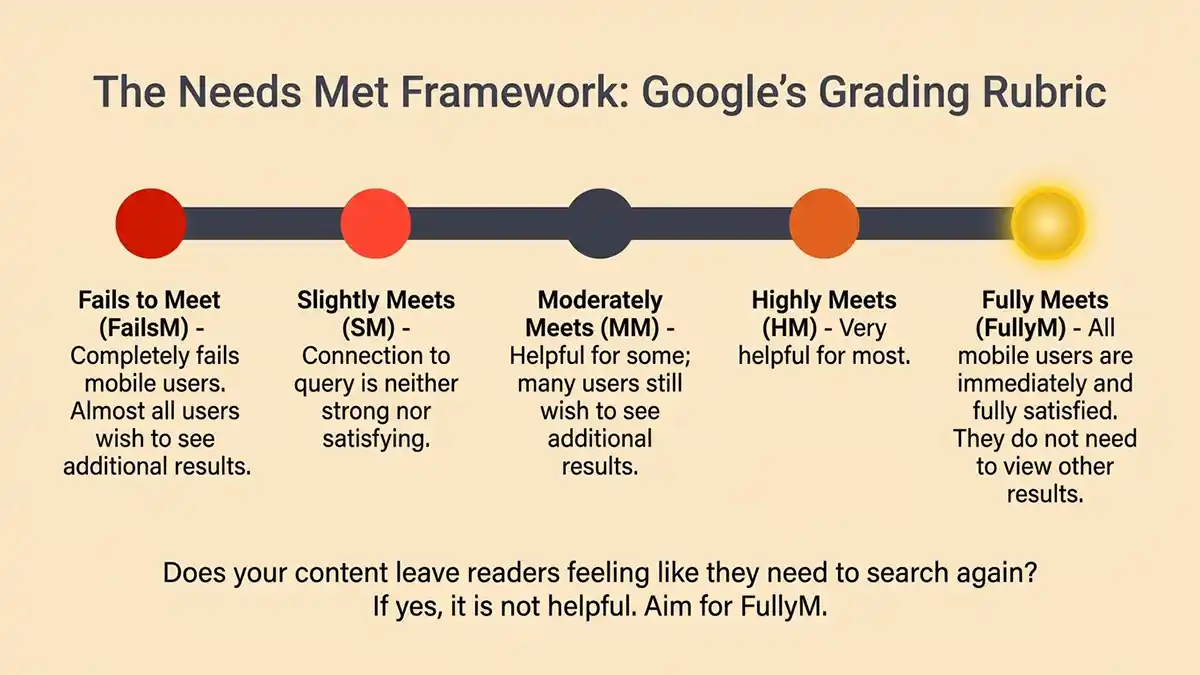
When the QRG describes “needs met”, it is referencing the user needs, not the business entity.
Example of one question that helps identify useful content
Google asks, “Does your content leave readers feeling like they need to search again to get better information from other sources?” This is where queries with informational intent often need comprehensive articles to be helpful. When a searcher looks for “how to fertilize roses”, gardeners consistently want to know when the best time is to apply rose food, trusted brands, organically versus chemically.
If your content isn’t helpful this way, people will likely search elsewhere to get their answers. Instead, you want to be getting your answers in your Google Knowledge Graph.
“The classifier didn’t start at launch. It already understood site content over a period of time. At launch, we just began using the signal for ranking. It does continually work to monitor sites & understand if there’s lasting change.” – Danny Sullivan [1]
Creating Helpful Healthcare Content that’s Aligned with E-E-A-T
YMYL topics continue to be more heavily scrutinized. On topics where information quality is critically important—like health, civic, or financial information—Google’s systems place an even greater emphasis on signals of reliability and well-established consensus, requiring you to cite reputable sources and include expert quotations. Google has already made significant investments in the healthcare industry. US Healthcare alone is more than a 4 trillion industry. When asked, on Oct 21, 2026, Google replied:
“Your site is only about three months old and research peptides is a niche where google is careful because the topic touches on health… In such niches, Google needs a lot of trust before it ranks product pages for big terms… Your homepage gets that trust first because it has most of your links.”
There’s no test that can separate trust from a tech issue. If the pages are indexed and canonical, it is almost always trust. 335 Pages Indexed, but Almost No Internal Pages Rank – Homepage Ranks Normally! [4]
In the healthcare niche, before every piece of content is created, you should ask yourself whether your topic and how you cover it has the potential to cause people significant harm. If yes, your content piece is considered YMYL content; then it’s necessary to understand E-E-A-T.
Deep Learning models can power the most relevant products and content per individual querier. Businesses offering connected cloud experiences can apply better data insights to create value in every interaction. Businesses introducing a new product or concept bear the burden of proving its value.
Many consider the health niche as incredibly difficult to compete in. With the content algorithm better explained, you can gain more domain and niche authority.
Refreshing content and producing new content has historically been what allowed business growth. If you’ve been relying on a handful of pages to generate your evergreen content/sales funnel, an update like this may result in significant traffic loss. Move fast to evaluate your content; be slower and wiser in what you trim, update, and publish going forward.
By investing in high-performing content with a supporting, effective SEO strategy, your content can perform better competitively. Combine content production with content refreshes and view them through the lens of this update.
You also need well-structured content. Here’s why.
Structured Content Provides the Following Advantages:
- Named components.
- Structure – words in your content become pairs of entities.
- Meaning is clearer.
- Intelligent connections.
- Content models for repurposing.
- An easier way to tie “helpful” content goals to business goals.
- An easier way to reach your target audience.
- Effective assists in providing value for your audience.
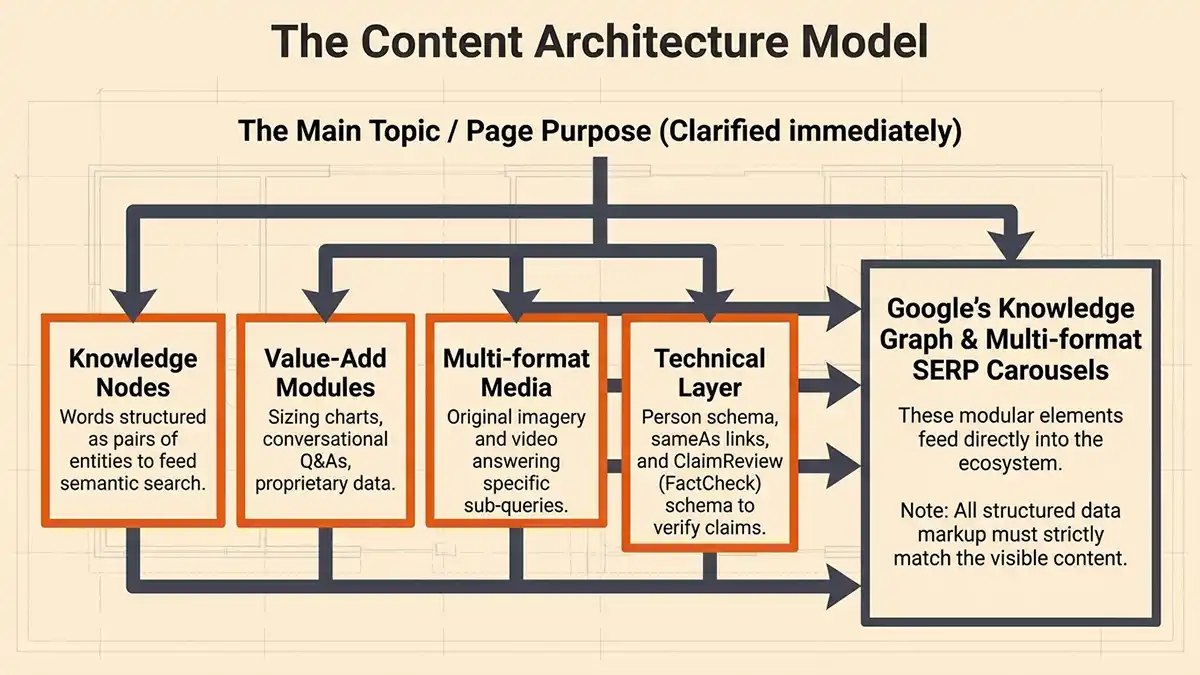
Keep in mind that when content is repurposed, the context changes meaning. With the proliferation of content, each search engine is tasked to surface the most helpful articles. A structured approach to web content creation places the user first. Content changes are the most common reason why schema drift occurs—and Google’s AI search guidelines strictly require that all structured data markup matches the visible content on your web page.
Modular content to get the most from your content pieces. Modeling content starts with knowledge organization. This is the science of the structuring and systematic arrangement of knowledge units (concepts in your content) according to their inherent knowledge nodes (connected characteristics) and the application of the so-ordered concepts and classes of concepts for the description of worth-knowing content objects.
What Content Types Build High-Quality Websites?
People-first content, helpful content, content that satisfies searchers – all are specified as useful.
To thrive in both classic blue links and multi-format SERP carousels, clarify your page’s purpose immediately, highlight essential details at the top, and supplement your text with unique resources like sizing charts, product comparisons, Q&As, and personal product experiences. To expand your knowledge on this, below is a list of related articles by Google. I’ve included a quote from each.
Content writers can benefit from reading:
More content by people, for people in Search
“We know people don’t find content helpful if it seems like it was designed to attract clicks rather than inform readers. So starting next week for English users globally, we’re rolling out a series of improvements to Search to make it easier for people to find helpful content made by, and for, people.
This ranking update will help make sure that unoriginal, low-quality content doesn’t rank highly in Search, and our testing has found it will especially improve results related to online education, as well as arts and entertainment, shopping, and tech-related content.” – Danny Sullivan, Search Liaison
What creators should know about Google’s helpful content update
“Avoid creating content for search engines first.
Our advice about having a people-first approach does not invalidate following SEO best practices, such as those covered in Google’s own SEO guide. SEO is a helpful activity when it’s applied to people-first content. However, content created primarily for search engine traffic is strongly correlated with content that searchers find unsatisfying.” – Chris Nelson, Search Quality
“Our site quality algorithms are aimed at helping people find “high-quality” sites by reducing the rankings of low-quality content.
We’re continuing to work on additional algorithmic iterations to help web admins operating high-quality sites get more traffic from search. As you continue to improve your sites, rather than focusing on a single algorithmic tweak, we encourage you to ask yourself the same questions we ask when looking at the big picture. This way your site will be more likely to rank well for the long-term.” – Amit Singhal, Google Fellow
It’s too early to hear responses from other search engines. They are taking due notice of their biggest competitor’s search update. Adherence to these guidelines is helpful to users, you, and search engines.
Opportunities for Your Content to Stand out in Search
Bottom-of-the-barrel sites that publish content in rapid-fire style may find that Google decimates them. This content update will weed them out and let people-focused content shine. Your best asset is your depth of knowledge. Others may publish content that mimics it, but you are a genuine expert in your field. Your audience needs you to speak up (get writing)! You know best what your audience searches for.
- Audit to see where you can make your content more factual and less opinionated. Look for statistics and case studies that can be fact-checked. Use the
ClaimReview(FactCheck) Schema type when reviewing specific claims to verify your grounded content in facts with consensus. - Authorship matters. Build a team of authors with incredibly well-thought-out experience to offer your customers. Use their knowledge for upcoming content topics. Use
sameAsandPersonSchema to supercharge your entity-level author authority. - Go beyond text for multimodal and AI shopping success: support textual content with high-quality original images and videos, and keep your Google Business Profile and Merchant Center data up to date so your products and expertise surface in Google’s Shopping Graph (which refreshes over 1.8 billion listings every hour across 35 billion product listings).
- Manage visibility with preview controls (
max-snippet,data-nosnippet,nosnippet) and ensure Googlebot receives an HTTP 200 status code with unblocked indexable content. - Identify your core topics and improve strategies for content planning.
- Worry less about what’s too difficult a SERP, like heart disease or cancer. Focus more on what people find helpful.
It doesn’t help to complain about consecutive algorithm updates. Even if you are product-focused, there is a way to provide buyers with clear, factual and useful content without pushing for a sale. We all have the opportunity to be smarter with our content production.
Overview of Google Search Quality Rater Guidelines
Google provides the following three key elements to inform their raters’ approach when determining content quality [1]:
- High-quality automated ranking: We design our automated ranking systems to identify information that people are likely to find useful and reliable.
- Helpful Search features: We have developed several Search features that not only help our users make sense of all the information they’re seeing online, but that also provide direct access to information from authoritative sources — including intergovernmental organizations or government entities.
- Content policies: We have policies for what can appear in Search to make sure that we’re showing high-quality and helpful content.
| Google Quality Raters Guidelines for Needs Met Ratings | |
|---|---|
| Fully Meets (FullyM) | A special rating category, which only applies to certain queries and results. All or almost all mobile users would be immediately and fully satisfied by the result. They would not need to view other results to satisfy their need. |
| Highly Meets (HM) | Very helpful for many or most mobile users. Some users may wish to see additional results. |
| Moderately Meets (MM) | Helpful for many users OR very helpful for some mobile users. Some or many users may wish to see additional results. |
| Slightly Meets (SM) | Helpful for fewer mobile users. There is a connection between the query and the result, but it is neither strong nor satisfying. Many, if not most, users would wish to see additional results. |
| Fails to Meet (FailsM) | Completely fails to meet the needs of the mobile users. Almost all users would wish to see additional results. |
Let’s go back to Google’s question: “Do you have an existing or intended audience for your business or site that would find the content useful if they came directly to you?”
Often when explaining to client content writers about what Google sees as people-first content, we ask “Are you writing for your audience”? Or “Would you want to publish this content piece if it wasn’t for search engines?”
Whether you’re a national organization seeking to reach customers, or a small local business, you’d still want to educate your customers about your products and services.
What is bad content?
Bad content across the worldwide web includes blog posts that serve no particular value to readers. Don’t forget to start with a unique value proposition for each new content piece. This includes your blog posts, evergreen articles, and all off-site publications as well. Given the proliferation of published data, ensure that all content that represents your business has a clear purpose.
Write Content that is Valuable vs Trending
What to be Aware of: Your website may need six months or more to recover if hit by this helpful content update.
Google says sites that it classifies as having unhelpful content may find this signal applied to them over some months. When Google announced the Helpful Content Update, they stated that recovery is possible, and that sites could begin to regain traffic after making changes and improvements that would lift the classifier. However, my observation is that this can take six months or more. It lets us know that the evaluation for the update runs continuously. Meaning, removing unhelpful content will help your site recover. It just may take time. Be sure you’re not trying to be like your competition or simply follow topic trends. Don’t forget: Bad content will be weeded out from your blog posts and articles published across the World Wide Web.
“The initial rollout is the first in a series of improvements. Buckle up! Online education, arts and entertainment, shopping, and tech content are likely to be strongly impacted.
Recovery will likely involve identifying which content is created primarily for SEO and removing it, ensuring you demonstrate first-hand expertise, revamping and improving content, clarifying the purpose of your content, and studying what type of content Google is ranking following the update.” – Google’s helpful content update – what you need to know by Marie Haynes [5]
As fast as AI Mode is changing what content it references, you may still be asking “What is helpful content for people?”
Value-Added Content Created for People
In 2023, Google updated its quality rater guidelines; “Content written by people” changed to “content created for people.” This wording change occurred about the same time that the company’s stance on using tools for AI-generated content ideas changed. Valuable content feeds your Knowledge Graph. As more openness to AI-generated content emerges, the key criteria becomes:
Helpful content “thinks” from the searcher’s perspective
- Is it high quality?
- Does it add value to searchers’ queries?
- Does it provide real-world perspectives and expertise?
- Avoid publishing targeted content designed to rank well in search engines. This is also called “search engine-first content” and “SEO-first content.”
- Avoid poor user experiences; don’t make the reader struggle past pop-ups and advertising to get the answers they are seeking.
- Avoid missing information on the content’s publication date or the date when it was significantly updated.
- Avoid not informing readers of which content and elements are sponsored content, or when AI/automation played a role in creation.
- Avoid failing to add an author byline and linking to a page that validates the author’s credentials.
The “value” of each content piece is the entire point of the content.
The intent of creating a content piece is misplaced if it is on “Rankings” and “Traffic” versus on “People” – your target audience. They are the ones who should most influence your content creation choices. The opinions they contribute, the questions your consumers ask, and the needs they express are all cornerstones to reaching your business goals via your content.
Focus on understanding the needs of searchers and ensure that your “main content” is easy to find, is relevant to their queries, and provides solutions to their needs. Quickly fulfill the user’s search intent at the top of the page, and offer additional information carefully and less conspicuously. Ask yourself: “Does the content provide substantial value when compared to my other pages or what’s already in search results?”
Aleyda Solis: International SEO Consultant, Author & Speaker, provides a useful “Google’s Quality Content and Helpfulness Questions” spreadsheet. Google’s Quality Content and Helpfulness Questions Spreadsheet [2]. I highly recommend using it to assess the helpfulness of content.
Content that SEO informs before writing is far better than attempting to integrate it after it’s been developed. Even your article topic should be researched first to determine its value-added factor before it is chosen. Before writing a word, plan how you’ll cover your topic comprehensively. It must have a high “usefulness” factor.
As user search behavior becomes increasingly complex, Google’s Knowledge Graph is now a critical component of our digital landscape and SEO strategies, demanding that we deeply understand client needs. Expectations: through thorough user research, ensure we deliver accurate and trustworthy information aligned with sophisticated queries.
The Hidden Mechanics Behind Content Helpfulness
This requires knowing what content is worth sourcing in its SERPs. That is decided based on user engagement metrics that reveal what people consider worth reading.
Content that comes across as written by an authentic human voice will perform better in AI Mode. The same is true for content that is more factual.
Hill Web Marketing offers solutions by helping businesses understand their Google Page Quality Rating Scorecard.
NOTE: In Google’s original communications around the helpful content update, it stated that Google needs you to prove, over several months – indeed, six months or more in our observation – that your content is actually helpful in the long run.
We followed up on the discussion with the internal Google Search team, including HCU, parasite SEO, and duplicate content issues. Stay tuned for updates to this article.
SUMMARY: Creating People-First Content
Some may call this update “Google-biased content”. But since it is supplying the majority of most sites’ organic traffic – for free – the tech giant has the right to filter for high-quality search results. Our personal definitions of helpful content are likely biased as well. Your revenue likely depends on whether or not you align with Google’s algorithm.
Final Summary: Your business survival and reader trust depend on replacing search-engine-first noise with verifiable human experience. Searchers and AI systems alike need immediate clarity, original insights, and transparent entity-level authorship that solve complex problems across every format. Stop writing to rank in algorithms; become the irreplaceable human authority that algorithms are built to find.
Call 651-206-2410 for services to evaluate your content creation strategy and Align Your SEO Tactics to Google’s Algorithm Update
Resources
[1] https://blog.google/products/search/overview-our-rater-guidelines-search/
[2] https://docs.google.com/spreadsheets/d/12-F9Z4NzDADOFRQtOiN-CtjY2aaqj-R5CcrJNCuTha4/edit#gid=0
[3] https://ahrefs.com/blog/almost-all-clicks-happen-in-the-top-10-results/
[5] https://www.mariehaynes.com/googles-helpful-content-update/
[7] https://developers.google.com/search/blog/2023/02/google-search-and-ai-content
[8] https://developers.google.com/search/blog/2025/05/succeeding-in-ai-search
[9] https://blog.google/products/search/generative-ai-search/