
Strategic B2B Lead Generation for Revenue Generation
By Jeannie M. Hill | Updated 11.13.2026
Table of Contents
- Quick Takeaways for Revenue-Driven B2B & Retail Lead Generation
- Monitor Click-Through Rates (CTRs) to Beat the “Sea of Sameness”
- What is B2B Lead Generation?
- B2B Buyer Qualification Matrix: IQL vs. MQL vs. SQL
- Information Qualified Leads (IQLs) in the Age of AI Overviews
- Combining Offline & Online Lead Generation
- Creative & Effective Aligned Communications
- 15 Effective Strategies for Improving B2B & Retail Lead Generation
- Expanded B2B Content Formats for Competitive Markets
- Frequently Asked Questions (FAQ)
- Interactive B2B Dark Funnel & Revenue Diagnostic Tool
- Use Current B2B Lead Generation Strategies & Tactics
Quick Takeaways for Revenue-Driven B2B & Retail Lead Generation
- Monitor Early Revenue Signals: Declining Click-Through Rates (CTRs) and conversion rates are your earliest indicators of ad fatigue and shifting buyer behavior.
- Capture the Full Funnel (IQL → MQL → SQL): Go beyond traditional MQLs and SQLs by capturing early-stage Information Qualified Leads (IQLs) through AI Overviews (AIO), schema markup, and Knowledge Panels.
- Unify Offline & Online Channels: Connect retail storefronts, trade show booths, GS1 QR codes, and in-person reviews directly to your CRM, marketing automation, and geo-targeted ad campaigns.
- Illuminate the “Dark Funnel”: With 67% of the B2B buyer’s journey happening anonymously online, combine predictive analytics, first-party data, and original research to convert hidden prospects before competitors do.
Monitor Click-Through Rates (CTRs) to Beat the “Sea of Sameness”
Click-Through Rates (CTRs) are an early signal for outreach performance and ad fatigue. If you notice a steady decline in your conversion rates despite ongoing Conversion Rate Optimization (CRO) efforts, it is a clear sign that your audience wants a fresh approach. This guide will help you modernize your B2B marketing strategy to attract and convert high-value leads.
To drive predictable revenue growth, your marketing efforts must rise above the noise and avoid the “sea of sameness” that makes it difficult to stand out in an increasingly crowded retail and commercial marketplace.
What is B2B Lead Generation?
Unlike consumer-focused (B2C) marketing that targets individual impulse buyers, B2B lead generation builds commercial relationships with business clients, wholesale buyers, and referral partners across longer sales cycles and multi-stakeholder buying committees. It is the strategic process of identifying, attracting, and nurturing ideal prospects into measurable revenue for your marketing and sales teams.
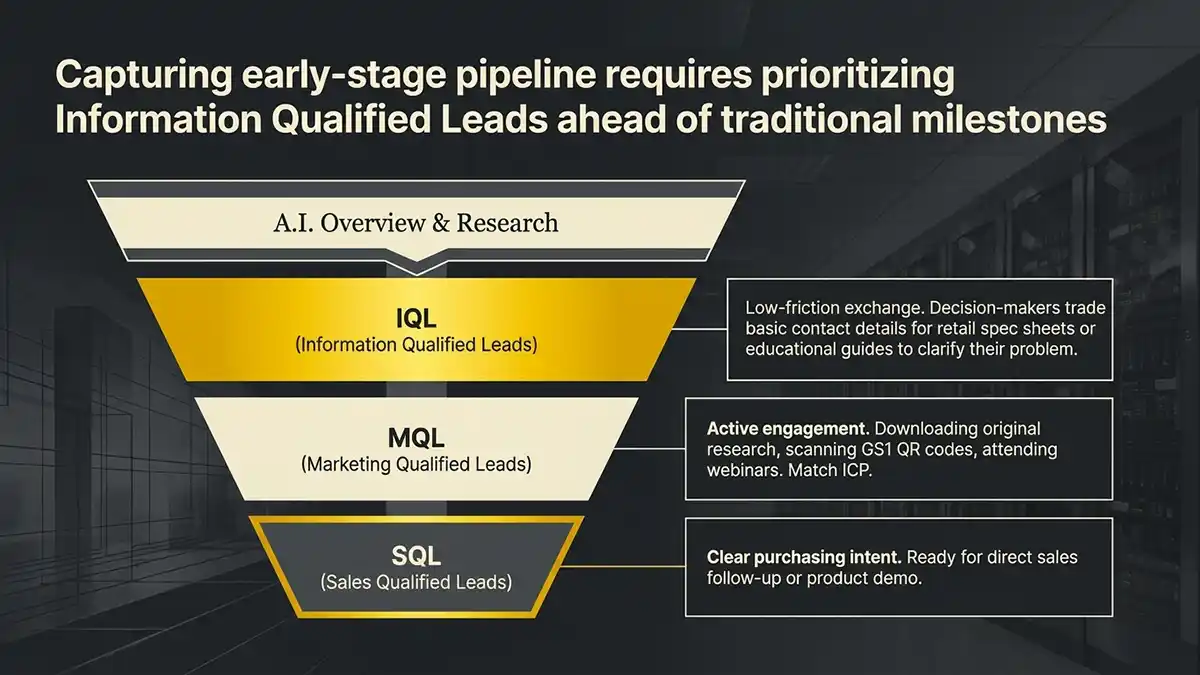
The goal is to build an accurate B2B database and guide decision-makers through three distinct stages of qualification:
- Information Qualified Leads (IQLs): Prospects at the very beginning of the buyer’s journey who are researching solutions to a problem. They are ready to exchange basic contact details (such as their email address) for helpful initial information, retail spec sheets, or educational guides.
- Marketing Qualified Leads (MQLs): Prospects who actively engage with your brand—such as downloading original research, scanning a product QR code, or attending a webinar—and match your target buyer profile.
- Sales Qualified Leads (SQLs): Vetted prospects demonstrating clear purchasing or partnership intent who are ready for direct sales follow-up, a product demo, or a consultation.
B2B Buyer Qualification Matrix: IQL vs. MQL vs. SQL
Understanding where a commercial buyer sits in your sales pipeline prevents premature sales pitches and accelerates conversion rates. The table below outlines how content and channels map across each qualification stage:
| Lead Stage | Buyer Mindset & Intent | Primary Touchpoint / Channel | High-Converting Content Asset | Target Next Step |
|---|---|---|---|---|
| IQL (Information Qualified) | Problem identification; zero brand awareness. | AI Overviews, Q&A Search, GS1 QR Codes. | Retail spec sheets, educational guides, infographics. | Low-friction email exchange. |
| MQL (Marketing Qualified) | Active solution evaluation & brand consideration. | Nurture emails, retargeting ads, webinars, trade shows. | Original B2B research reports, whitepapers, case studies. | Engagement with high-intent offers. |
| SQL (Sales Qualified) | Purchasing or vendor partnership decision. | Direct phone call, LinkedIn Sales Nav, consultation form. | Comparison tables, ROI calculators, live product demos. | Direct sales outreach / proposal. |
Information Qualified Leads (IQLs) in the Age of AI Overviews
While the core revenue goals of a lead-generation SEO plan remain consistent, the specific tactics required to achieve them are evolving rapidly. Today, AI Overviews (AIO) answer many early-stage questions directly on the search results page, providing fewer traditional website leads—unless you focus on making your website effective for click conversions in AIO.
Turn early-stage researchers into qualified pipeline. Request an AI Overview & Conversion Audit or call 651-206-2410.
Understanding and Nurturing IQLs
- Early Stage of the Buyer Journey: IQLs occur at the initial discovery phase and often lack awareness of your specific brand or full product line.
- Low-Friction Information Exchange: Decision-makers willingly share basic contact details in exchange for high-value, practical answers that clarify their problem and establish your value proposition.
- Targeted Lead Nurturing Required: Marketing teams must provide helpful content optimized for AIO and automated educational sequences to move IQLs smoothly toward becoming Marketing Qualified Leads (MQLs) and Sales Qualified Leads (SQLs).
Combining Offline & Online Lead Generation
Boost website conversions by aligning physical retail, event, and digital touchpoints.
Digital marketers generate significantly higher revenue when they think bigger and connect offline interactions with online conversion funnels. Reviews, industry events, and storefront traffic work naturally together when tracked holistically.
For example, a business buyer or community partner who sees you actively investing in your industry or local community will often highlight that commitment in a favorable online review. Attending industry conferences, retail expos, or community events gets you face-to-face with your ideal audience, allowing you to turn personal introductions into nurtured leads.
If you have the marketing budget, staff, or event support, take this further by exhibiting at trade shows. In-person exhibitions make it easy to qualify new leads at your booth with a live product demo or quick consultation. A portable roll-up banner (also known as a pull-up banner) reinforces your visual branding and SEO messaging on the show floor, while a booth drawing captures consented contact slips that go straight into your Customer Relationship Management (CRM) platform. Afterward, you can geo-target your Google Ads specifically to attendees who visited the event.
When requesting reviews in person at your retail showroom, booth, or office, consider switching up your “ask” from reviewing a generic “high customer satisfaction experience” to saying, “Our clients love working with us so much they recommend us to colleagues, friends, and family.”
To measure how offline interest converts into revenue, track how many prospects use map directions or direct Google Business Profile phone calls. Pair those metrics with call-tracking protocols where your front-desk or sales staff record exactly how every caller learned about your products or services.
Offline reviews help drive stronger online conversions by:
- Establishing Trust and Credibility: When an in-store, showroom, or in-office experience translates into an online review, it acts as powerful social proof that validates your brand’s recognition and reliability.
- Highlighting Your Unique Selling Points: Reviewers naturally mention your core value proposition, specific product features, and what you do best, helping your business stand out against competitors.
- Increasing Your Local SEO Visibility: A steady velocity of recent reviews increases your rankings in local search results, driving high-intent web and foot traffic to your business.
Capture every high-intent local and commercial buyer. Optimize Your Omnichannel & Local Search Presence or call 651-206-2410.
Creative & Effective Aligned Communications
Brand and message alignment should shape your entire content strategy. Your digital transformation strategies work far more effectively when buyers immediately recognize your brand across stitched-together offline and online channels. Audit your teams to ensure the person managing print catalogs or retail signage isn’t out of touch with the tone and wording of your online voice.
Your content marketing efforts should cement trust and credibility. Providing factual, relevant information empowers B2B decision-makers to map their own path forward when guiding commercial purchases, vendor strategies, and business referrals.
At the same time, building a dominant brand requires investing in relationship-building activities that aren’t always 100% measurable in a dashboard. Standard digital tracking often misses the high-value story of local word-of-mouth and partner referrals.
15 Effective Strategies for Improving B2B & Retail Lead Generation
If you are wondering where to focus your budget first, HubSpot’s 2024 State of Marketing Report notes that 16% of marketers say content-and-SEO integration results in the best ROI. Build your pipeline with these high-impact strategies:
- Integrate offline and online data silos: Connect your CRM and marketing automation tools to deliver seamless omnichannel customer experiences (CX Multisearch) across physical stores, field sales, and digital touchpoints.
- Use GS1 QR Codes on print and retail materials: Place QR codes on print catalogs, booth displays, and packaging that link directly to relevant blogs, spec sheets, and optimized web content. This tracks offline affiliates and referral partners. For retailers and suppliers, a GS1 QR Code—the next global standard for machine-readable codes—generates leads by giving buyers instant mobile access to rich product information and reorder resources.
- Pre-test your paid ads with AI: Gather immediate feedback on your ad creatives and optimize campaigns with AI attention data and analysis tailored to your specific retail or B2B niche before spending your ad budget.
- Use predictive models and AI analytics: Predictive analytics help shape personalized, high-converting campaigns. With the right tools and prompt engineering, you can activate lead data across channels in real time to calculate Customer Lifetime Value (CLV), lead profit contribution, and projected revenue per customer.
- Invest in original B2B market research: Strengthening brand recognition through original data is an essential way to be featured in AI Overviews. Publishing proprietary B2B audience research establishes thought leadership and gives commercial buyers the exact validation they need to purchase.
- Use data to target specific Ideal Customer Profiles (ICPs): Gather granular details about your ICP—including industry niche (from retail buyers and wholesale distributors to specialized sectors like physical therapists, pain specialists, or cancer screening clinics), company size, job titles, pain points, and how they make purchasing, booking, or referral decisions. Use this data to execute targeted Account-Based Marketing (ABM) that addresses their challenges directly.
- Create engaging, problem-solving content: Publish value-added content that solves customer problems and is compelling enough to hold deep readers’ attention, not just skim readers. By crafting a precise knowledge structure, you align your value proposition directly with buyer needs, triggering interest and conversions.
- Drive organic search traffic with Q&A SEO: Use SEO so high-intent buyers find you first. Because B2B relationship building takes multiple touchpoints, converting leads typically gains momentum at 5–6 months—which is why a strong SEO and lead generation program requires a 12-month commitment. Amplify your organic reach with question-answer-rich content.
- Feed your Knowledge Panel with schema markup: Search visibility depends heavily on accurate structured data. Today’s leads frequently convert directly on the SERP (Search Engine Result Page) or via your Knowledge Panel—allowing you to capture leads before a user even clicks through to your website.
- Include personalized, entity-recognizable email marketing: Segment your CRM lists and send personalized emails that nurture leads over time. Captivating, entity-recognizable subject lines help keep your messages out of spam folders. Feature high-value snippets in your company newsletter and track open rates, CTRs, and response rates at each follow-up stage.
- Publish fresh content regularly: Regular updates keep your audience ahead of industry developments, showcase new retail lines or in-house technologies, and prove you are actively attuned to client needs.
- Launch segmented B2B SMS marketing: Import consented CRM contacts into SMS platforms like Textedly to re-engage inactive past buyers, commercial accounts, or clients. Segmenting your B2B text lists ensures you deliver concise, relevant offers without overloading subscribers.
- Optimize for image search: Original photography helps buyers immediately recognize your products, storefront, or building after hearing about you offline. Owned media builds buyer confidence in ways stock photos never can, strengthening your local finder’s visual presence across print media, product pages, and Google Business Profiles.
- Use LinkedIn Sales Navigator: Leverage LinkedIn’s advanced B2B filters to define your ideal customer profile, target specific companies and decision-making job titles (from retail procurement directors to physicians), organize segmented lead lists, and engage prospects via personalized connection requests and InMails.
- Give people clear, actionable takeaways: Busy business partners and buyers need concise action steps. Pair niche expertise with clear Calls-to-Action (CTAs) on every landing page so prospects never wonder what step to take next.
Anonymous user interactions signal hidden leads in the “Dark Funnel”
Connect with high-value prospects before they become lost revenue. According to Mallory Green, “67% of the buyer’s journey occurs digitally without ever engaging with sales, making the customer journey particularly opaque in industries with long sales cycles.” Her analysis in the AtData 10.23.2024 article, Illuminate the Dark Funnel: Maximize Your Lead Generation, highlights why alignment across marketing and sales teams is essential.
B2B and retail brands often struggle with hard-to-reach leads. A CRO specialist who can interpret behavioral data insights will uncover clear conversion opportunities. Today, we also use Large Language Models (LLMs) to measure and report on key milestones across the customer journey—learning exactly how many buyers engage with a specific campaign, calculating ROI metrics, and building custom audiences for both offline and online retargeting.
By capturing compliant visitor signals through user accounts, device IDs, cookies, IP tracking, and interactive lead forms, marketers can turn anonymous researchers into identified CRM contacts ready for personalized outreach.
When reaching specialized or time-strapped decision-makers (such as commercial procurement teams, hospitals, medical device companies, or physicians), you often need to look beyond traditional channels. Because search algorithms increasingly favor community platforms like Reddit, niche forums, and YouTube, meet your audience where they actively spend time—whether that is YouTube, TikTok, X (Twitter), or industry news portals.
Don’t let high-value prospects slip away to competitors. Schedule a B2B Conversion Rate Optimization (CRO) Review or call 651-206-2410.
Expanded B2B Content Formats for Competitive Markets
Enrich and repurpose your offline and online assets. Once you know what people search for, tailor your content formats to match buyer preferences:
- Infographics & Comparison Tables: Visually structured data is easily parsed by search engines for AI summaries and allows busy buyers to compare specs at a glance.
- Interactive Social Media Posts: Authentic social engagement separates real human expertise from generic AI-generated entities. Use social channels to answer live questions and share bite-sized stats, charts, and quotes.
- Whitepapers & Printable PDFs: Detailed whitepapers and “How-To” buyer guides work effortlessly as gated email lead magnets or printed handouts at retail counters, trade shows, and sales meetings.
- Webinars & Niche Podcasts: Host educational webinars featuring guest industry professionals to address specific customer questions—whether covering retail merchandising trends or specialized healthcare topics like how arthritis affects TMJ or home blood-pressure monitoring.
- Presentations & Slide Decks: Build decks using PowerPoint, Google Slides, Visme, or SlideDog for live trainings and prospect meetings. Uploading presentations to SlideShare also captures organic search views from professionals browsing for solutions.
- Short-Form Video Series: Produce concise videos demonstrating how your products resolve customer bottlenecks. YouTube marketing remains one of the highest-converting platforms for visual B2B and retail lead generation.
- Proactive Online Reputation Management: Go beyond star ratings by monitoring brand mentions across the web so you can respond tactfully to misquoted statements or inaccuracies, protecting and strengthening your Experience, Expertise, Authoritativeness, and Trustworthiness (E-E-A-T) signals.
When should I update my B2B Lead Gen Strategy?
Monitor your campaigns’ effectiveness weekly through Google Analytics, CRM reports, and social tracking insights to identify high-quality potential customers. If performance declines by 10% or more for two consecutive weeks, refresh your creative and lead generation strategy immediately.
- Changes in buyer behavior: When your target audience adopts new platforms or buying habits, adapt quickly. Retire outdated tactics like cold calling—in a data-saturated world, unannounced calls to people with no prior relationship are immediately blocked.
- Industry and regulatory shifts: New regulations and technologies require agile adjustments. For example, recent FCC rulings closed the “lead generator loophole,” tightening consent rules on robocalls and robotexts across lead networks and extending federal Do Not Call (DNC) protections to text messages.
- Competitors adopt better methods: If competitors are investing more heavily in educational outreach or faster follow-ups and outpacing your pipeline, audit and upgrade your funnel.
- Popular staff retire or move on: Track which individuals in your business generate the most inbound leads or referrals. If a founder, top sales rep, or recognized specialist is planning to exit, build up the bios and personal brands of your remaining team well in advance.
- Relational drift from over-automation: If automated follow-up sequences have replaced genuine human connection, your lead conversion will thin out. Re-introduce personal touchpoints to keep relationships warm.
Express gratitude for referrals and remain relationally focused
“One of the most important things about nurturing leads is keeping a positive and relational focus. It’s easy to be so task-focused that we skimp on time to express gratitude. Every lead could have gone to someone else. Regularly express gratitude to those who refer business, clients, or patients to you. This can be as simple as a handwritten thank-you note, a phone call, or an appreciation email or text. It depends on how well you know the person and their personal preference. Acknowledging their referral reinforces your professional relationship, that you are truly grateful, and shows that you value their trust.” – Jeannie Hill
Whether in retail partnerships, B2B affiliate networks, or medical referral systems, nothing is more powerful than word-of-mouth trust. Making your intake and referral process frictionless saves busy partners and teams from having to hunt for your contact information when recommending your services. Think of how often someone forgets to say thank you—and how memorable it is when you do.
B2B original, helpful research impacts your ability to bring on new customers
Producing original research requires dedicated budget, time, and analytical skill—but most high-margin revenue drivers do. We have found that 55% of B2B buyers regularly consume research reports and rate them as the most valuable content format when evaluating purchasing decisions.
Too often, outreach campaigns lack the data-backed insights needed to spot when leads are tipping into the “won or lost” category before the prime follow-up window closes. If you want to drive compounding results for lead generation and brand awareness, identify the exact factors that motivate your buyers to place a wholesale order, book a sales consultation, or send a referral. Every business niche—from retail merchandising to dental marketing—has unique decision triggers. Early-stage positioning backed by factual research documentation reduces the number of competitors a buyer even considers.
How can you nudge leads out of an inactive state and turn them into measurable outcomes?
Renewing connections with stalled prospects requires a user-centric approach that fills data gaps and bridges disparate touchpoints. By combining accurate lead segmentation (grouping prospects by shared behaviors, industry, and buying stage) with A/B testing of your follow-up sequences and targeted incentives, you can systematically transform dormant contacts into measurable revenue.
How to measure ROI for B2B leads?
Setting up metrics and models to measure ROI includes:
- Attribution models: Multi-touch attribution identifies which marketing channels and assets bring the highest-converting leads to each stage of the sales funnel.
- Cost per acquisition (CPA): Monitoring CPA ensures your revenue is generated profitably and highlights opportunities to lower acquisition spend.
- Web and conversion analytics: Google Analytics data collection and processing reveal which content pages and search queries drive high-value actions so you can invest future budget wisely.
- Offline actions that move to online actions: Pair in-store or in-office call logs, QR code scans, and event tracking with web traffic reports to measure how face-to-face interactions translate into website clicks and sales.
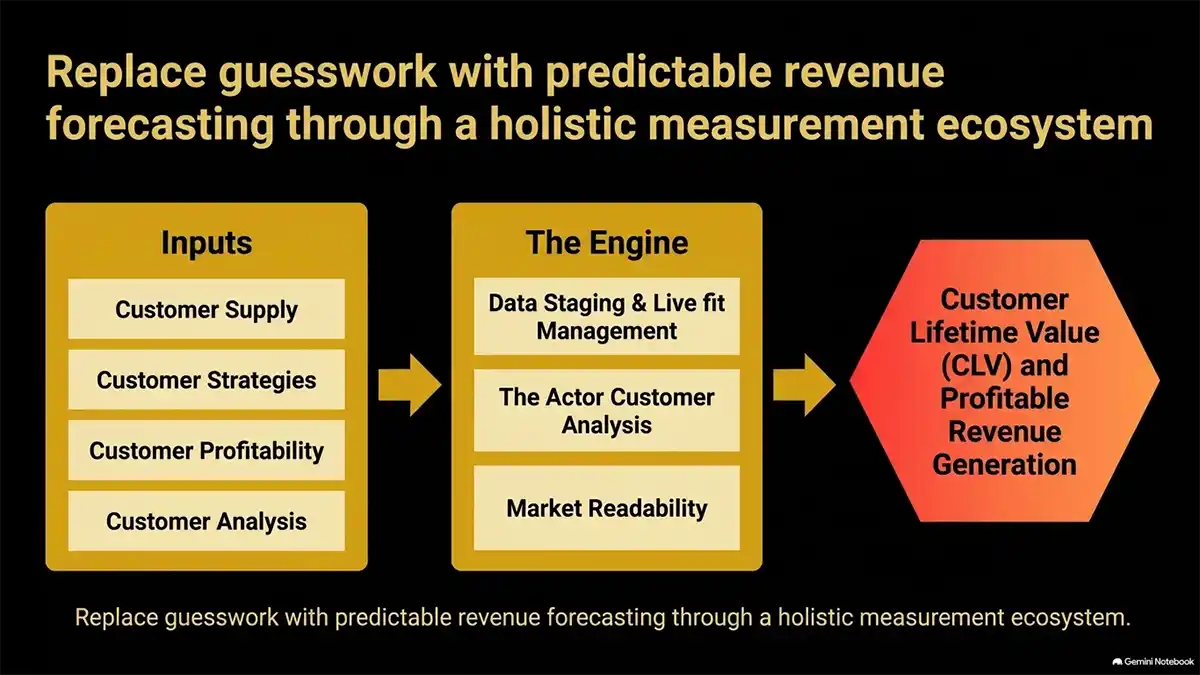
- Key performance indicators (KPIs): Tracking conversion rates, Customer Lifetime Value (CLV), and pipeline velocity replaces guesswork with predictable revenue forecasting.
- Marketing Qualified Leads (MQLs) and Sales Qualified Leads (SQLs): Qualify leads accurately based on engagement and buying readiness, making rapid sales follow-up with every SQL your top priority.
B2B lead generation is constantly evolving. When demand-generation and retail marketers combine clean target-account data with omnichannel tracking, creating and promoting content that converts becomes repeatable and scalable.
Frequently Asked Questions About Strategic B2B Lead Generation
How do Information Qualified Leads (IQLs) differ from MQLs and SQLs?
Information Qualified Leads (IQLs) are early-stage researchers who recognize a problem but have zero awareness of your specific brand or product line. They willingly exchange basic contact details for high-value spec sheets or guides. In contrast, Marketing Qualified Leads (MQLs) actively engage with brand assets (such as original research or webinars), while Sales Qualified Leads (SQLs) demonstrate clear purchasing intent and require direct sales follow-up.
How do AI Overviews (AIO) impact B2B website lead capture?
AI Overviews answer many top-of-funnel informational questions directly on Search Engine Result Pages (SERPs), resulting in zero-click impressions. To capture leads in an AI-driven environment, B2B marketers must structure content with clear Q&A schema, publish proprietary research data, and provide low-friction conversion paths for early-stage IQLs.
What is the B2B “Dark Funnel” and how do you measure it?
The “Dark Funnel” refers to the 67% of the buyer’s journey that occurs anonymously across third-party channels—such as Reddit, industry podcasts, peer referrals, and un-tracked social shares—before a buyer contacts sales. Marketers illuminate this funnel using Large Language Models (LLMs), first-party cookies, IP lookup, and multi-touch attribution.
How do GS1 QR Codes connect offline channels to online CRMs?
GS1 QR Codes represent the next global standard for machine-readable codes on product packaging, trade show displays, and print catalogs. When scanned by commercial buyers, GS1 QR codes deliver instant mobile access to spec sheets and reorder portals while passing offline referral and affiliate tracking data straight into your CRM.
When should a business update its B2B lead generation strategy?
You should refresh your lead generation strategy immediately if campaign conversion performance declines by 10% or more for two consecutive weeks. Other key triggers include regulatory updates (such as FCC rulings tightening Do Not Call text consent), key staff transitions, shifting buyer habits, or competitor advancement.
Why is original B2B market research essential for search visibility?
Over 55% of B2B buyers regularly consume original research reports when making purchasing decisions. Furthermore, search engines and AI engines prioritize documents that offer high Information Gain and proprietary data, increasing your probability of being featured in AI Overviews and Knowledge Panels.
B2B Dark Funnel & Revenue Leak Diagnostic
Estimate how many high-intent commercial buyers are researching anonymously in your “Dark Funnel” or AI Overviews without reaching your sales team.
Use Current B2B Lead Generation Strategies & Tactics
With our comprehensive approach—combining on-page SEO, technical schema improvements, targeted keyword strategies, and conversion-focused content—we help you increase search visibility and drive sustainable revenue growth. Our SEO strategies aren’t built just to please algorithms; we build lasting relationships with your target audience, ensuring your brand is trusted and your website converts decision-makers throughout the entire buyer journey.
Call 651-206-2410 and enlist our Minneapolis Lead Generation Services