From Website to Knowledge Graph: Building Your Brand Hub
There’s a massive shift in a website’s power. AI search levels the competitive arena between small and large companies.
Previously, small business websites faced a disadvantage in Search. Even with the best product or service in your niche, competing with big brands may feel like a young David facing Goliath.
In 2026, the shift toward AI-driven search has redefined visibility, moving from a, “top 10 blue links” model to a, “Generative Engine Optimization (GEO)” model. This allows your website to pull ahead of competitors who are still relying on outdated strategies.
Table of Contents
- From Website to Knowledge Graph: Building Your Brand Hub
- When Websites Fail
- How Websites Can Succeed in 2026
- Consistently Provide Value-Added Fresh Content
- Content freshness and gaining SERP mentions now decide who wins and who gets left without new sales.
- Your Website is Your Entity Home
- Here is the 2026 Reality About Websites
- The 2026 Shift: Transforming Your Website Into an AI-Ready Entity Home
Thanks to AI-powered search, how people find products and services is becoming more diverse, more personalized, and more context-aware than ever before. It has shifted from simple keyword matching to complex, conversational, and context-aware discovery.
Today, an SEO AI strategist can obtain more data to know what searchers are typing. These data insights empower you to precisely match your customers’ needs. Your website is the primary way to be the most credible, helpful, and trustworthy source for that intent.
When Websites Fail
- If approached with the mindset that a stagnant website is okay
- If you lack an understanding of how to present web content for the modern Internet.
- If crafted without a keen understanding of their audience’s needs.
- Lacking faithful maintenance for speed, privacy, security, core file updates, etc.
It’s Not About “Ranking Your Website”. It’s About Ranking Your “Web Entities”
Social signals and off-site verifications establish your overall site score.
In the past, Google looked at your website as a standalone thing. Today, Google sees your business as a cross-domain Web Entity.
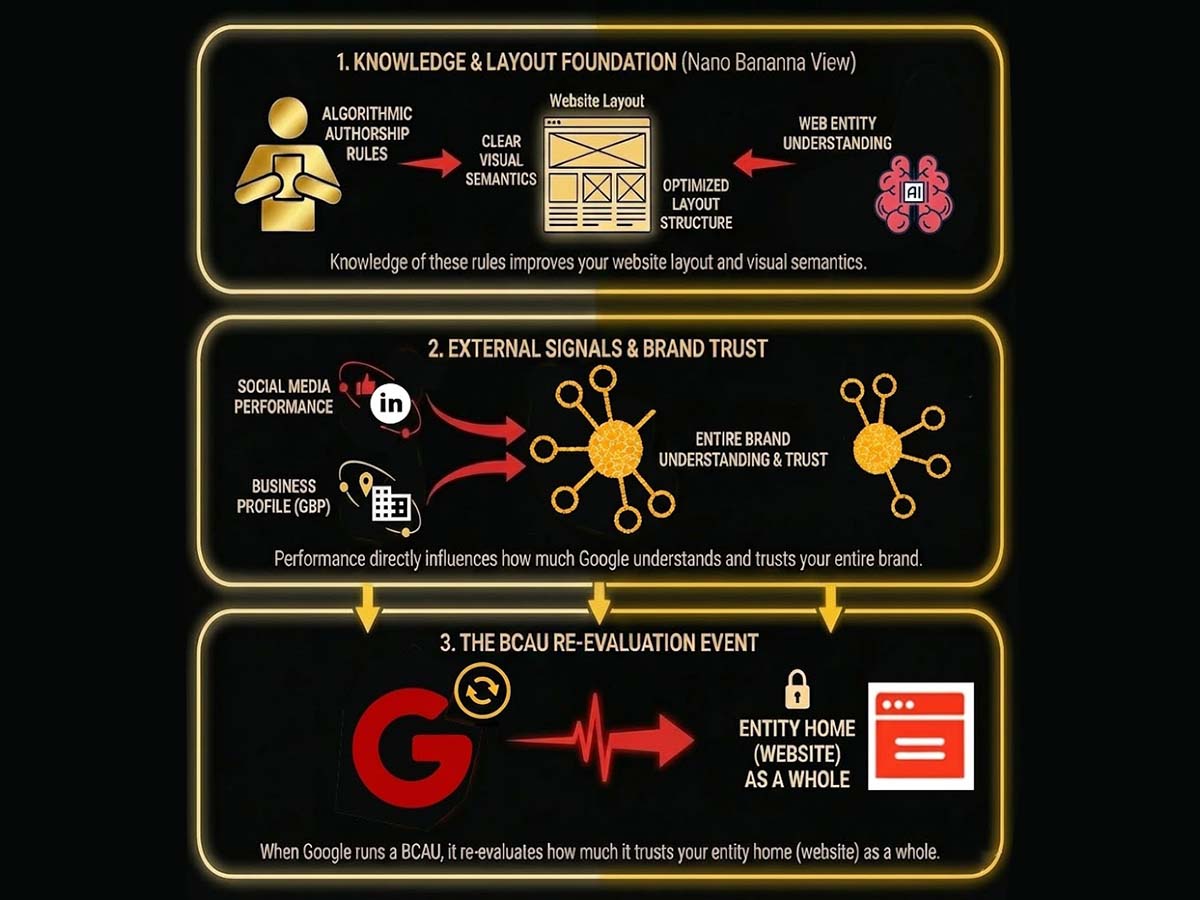
Knowledge of algorithmic authorship rules and Web Entity understanding can help improve your website layout and visual semantics.
The performance of your Google Business Profile, forum engagements, and social media directly influences how much Google understands and trusts your entire brand. When Google runs a BCAU (a Broad Core Algorithm Update), it is essentially re-evaluating how much it trusts your entity home (website) as a whole.
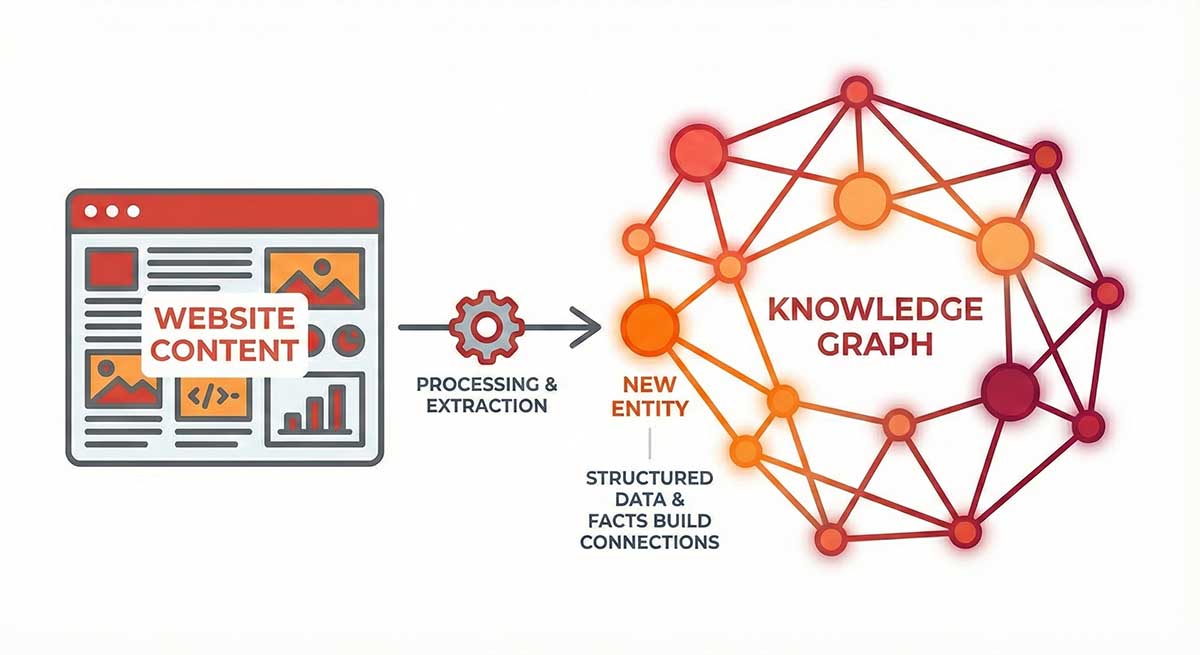
Holistic SEO deeply integrates with knowledge graphs by focusing on creating structured, entity-rich content that AI search engines understand. Thereby, building authority, improving visibility in panels, snippets, voice answers, and creating self-reinforcing authority loops.
These align with AI’s understanding of concepts (using schema markup), not just keywords.
Think of it this way: a website is bigger than itself. Domains and websites are ‘entities’ that Google understands and ChatGPT needs when sourcing answers.
Most importantly, your website can feed and transform your knowledge graph.
How Websites Can Succeed in 2026
👉 Prepare for AI Agent shopping.
👉 Become a source that LLMs recommend.
👉 Provide a knowledge base.
👉 Build a knowledge graph.
👉 Provide value-added fresh content.
Okay! Now I’ll talk through my thoughts for each strategy.
Prepare for AI Agent shopping
It’s critical to ensure that content is understandable and actionable for both humans and machines. Whether you like, are using, or know about Large Language Models (LLMs), they have upended how consumers find you.
“Forget your website. AI is your storefront.” – Andrea Volpini
Well, maybe not exactly, but the point is essential.
He goes on to talk about The Reasoning Web, where agents will read, decide, and act on our behalf. Visibility will depend on agentic readiness: clean, structured data; stable identifiers; precise ontologies; and knowledge graphs.
Become a source that LLMs recommend
Becoming an LLM-cited source is the new authority, shifting from just clicks to AI-driven citations that boost credibility and traffic. When cited, this drives credibility, authority, and high-intent traffic.
Embrace this shifting focus from clicks to citations. AI has become many users’ first stop for information. Becoming an LLM-cited source positions you as a trusted expert. It also future-proofs your content against zero-click searches, and offers qualified LLM referral traffic from users seeking deeper knowledge after an AI summary.
Provide a Knowledge Base
A website’s knowledge base can empower users with 24/7 self-service. You can put your money somewhere else by cutting staffing support costs.
A knowledge base on your website also offers the following benefits:
- Q&A: Improves customer satisfaction through instant answers.
- User Manuals, User Guides, or Instruction Manuals: Improving product and service adoption with guides that supplement your optimized product pages.
- Topic hubs: Provides searchable content that positions your brand as a niche expert. Multiple themed articles demonstrate expertise.
- UX: Improves website user experience by reducing repetitive inquiries.
- Demonstrates that you think ahead and solve user problems.
NOTE: A word of caution
So many times, I’ve read a Knowbase Base documentary that made little sense to me. It may cut costs and be quicker, but using someone who isn’t native to the language or audience can be super frustrating.
I’ve spent hours reading my coffee maker’s manual, only it’s really for other models. 🫤
Or when following technical steps for implementing custom schema on Shopify, and the documentation applies before the recent rollout. 🫤
A Knowledge Base only adds value if it is accurate and accessible.
Your website and its knowledge base lack value when:
- Information is too generalized: Content that is not regularly updated or improved leads to inaccuracies or uselessness. You may be tempted to lump users into a single persona, but then miss the specificity that helps people.
- Poor Ontology: Categorization and navigation are confusing, and the search functionality provides irrelevant results. It’s hard for the user to find the answers and solutions they are seeking.
- Lack of Structure: Information is disorganized, making it difficult for users to browse and find what they need.
- Insufficient content: Key information is missing, or thin content articles lack sufficient practical solutions. The user wants to gain clear how-tos or insight on what to do next.
- Missing User Feedback Loop: There is no mechanism to incorporate user input or analyze content performance to identify knowledge gaps.
- Content silos: Critical information scattered across various tools (such as Slack and Google Drive) rather than centralized in the knowledge base creates weakness.
Consistently Provide Value-Added Fresh Content
Content freshness and gaining SERP mentions now decide who wins and who gets left without new sales.
Implement a consistent publishing schedule that covers relevant industry trends, customer stories, and insights. This not only keeps your audience engaged but also signals that your website is active and relevant.
There is no once-and-done website. Rather, it should function like an active conversation.
Just “publishing” is no longer effective. Content is conversation, real “words.” It must “talk” consistently with your audience’s needs and reinforce your business plan.
“Your website should be a destination, with someone ‘at home.’ It should provide a reason for visitors to stay and engage with the content or services offered.” – Hill Web Marketing
Your Website is Your Entity Home
All social platforms, press releases, forum conversations, etc., are owned by someone else. You own and have control of your website.
Google Search, its Knowledge Graph, and all leading LLMs recognize and process websites and domain names as distinct, identifiable entities.
Your website is crucial for several reasons:
- Sourcing Information: Identifying the domain helps determine the authority and trustworthiness of the information presented. A medical claim sourced from a university health system website is treated differently from one from an unknown blog.
- Alignment: You know exactly who you are, how you want to shape your future, and add a relational tone. Your brand may be “mixed” in how it is represented elsewhere. Those voices can align with your entity home.
- Contextual Understanding: Websites provide context about the nature of content (e.g., news organizations, e-commerce sites, government services) and what you do best. It helps AI models categorize and prioritize information effectively.
- Fact-Checking and Verification: When generating answers, AI models use reputable domains to verify facts. If someone wants to know your exact address, especially if you have moved, you don’t have to wait for anyone else to post it correctly.
- Actionability: Recognizing service-oriented domains (such as a government website for applications or a store’s site for purchases) enables AI to provide direct, actionable links that help users complete tasks.
In essence, your website acts as an essential identifier that organizes and structures information about you that is available online. For example, Organization schema enables AI to process information with accuracy and reliability.
What we understand about how a website’s value is established.
Google values a website based on its helpfulness, relevance, unique UX, and authority, determined by signals like quality content (not keyword stuffing), fast loading (Core Web Vitals), mobile-friendliness, security, citation quality, and user interactions (clicks, time on page).
Essentially, a valuable site solves user problems and is trusted by others.
Here is the 2026 Reality About Websites
You must stay active. If your content confuses a human, it will confuse an AI agent.
When LLMs encounter ambiguous, poorly translated, or obsolete instructions, they cannot “reason” their way through the gaps. Instead, they will flag your entity as unreliable or, worse, generate incorrect answers (hallucinations) about your products.
To build your Entity Home, your documentation must be precise, native to your audience’s language, and strictly current.
Semantic AI data and knowledge graphs will be critical for AI visibility.
Your website is your most valuable asset. However, if algorithms manage your digital presence without your narrative, yikes! If it draws more from random third-party sources and your brand story is fragmented, you have effectively abdicated control.
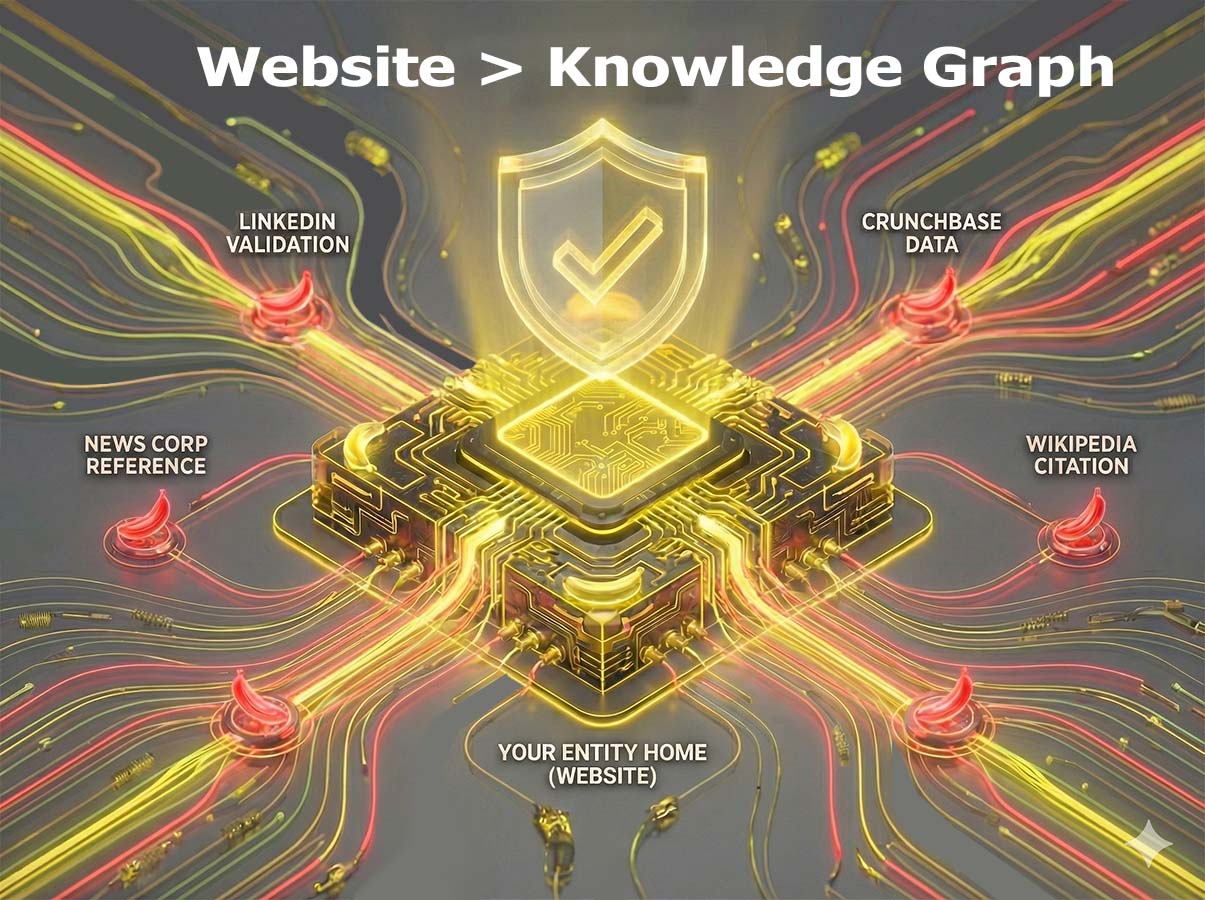
Your website is the “Reference Point,” but it’s not the “Proof.”
Google and LLMs operate on a trust-based system. You declare on your website, “I am the best SEO expert in Minnesota,” but Google will not award you a Knowledge Panel or high rankings based on that self-declaration alone. It looks for corroboration from third-party sources it already trusts.
This validation may come from reviews, Crunchbase, LinkedIn, major news outlets, industry directories, and Wikipedia.
While data trains AI models and generate answers, the user interaction point has moved from websites to the AI search interface itself.
Answer Engine Optimization (AEO) is not a replacement for traditional SEO, but rather an advancement built directly upon it.
The following table summarizes the significant change in website roles from traditional search models to the Reasoning Web.
| Feature/Aspect | Past/Traditional Website Role | 2026 AI-Ready “Entity Home” |
|---|---|---|
| Search Visibility Model | A “top 10 blue links” model based on simple keyword matching. | Generative Engine Optimization (GEO) focused on context-aware and conversational discovery. |
| Core Identity | A destination for human clicks and a silo of information. | A brand’s “Entity Home” and Knowledge Graph that feeds AI search engines. |
| Primary Audience | Primarily human visitors browsing via browsers. | AI Agents and LLMs that read, decide, and act on behalf of consumers. |
| Goal of Content | Driving clicks and traffic directly to the site. | Becoming an LLM-cited source to build authority and trust within AI summaries. |
| Content Nature | Often stagnant or “once-and-done” publishing. | An active conversation providing value-added fresh content to signal relevance. |
| Competitive Landscape | Small businesses were at a disadvantage against “Goliath” brands. | AI search levels the competitive arena between small and large companies. |
| Technical Foundation | Standard SEO, page speed, and keywords. | Agentic readiness: clean structured data, stable identifiers, precise ontologies, and schema. |
| Trust & Verification | Self-declaration of expertise was common. | Website acts as a Reference Point, but requires third-party “Proof” (reviews, citations) for AI to verify facts. |
| Interaction Point | The website itself was the primary destination. | The AI search interface is the new interaction point; the website serves as the authoritative backend. |
By implementing these strategies in managing your website, you establish your brand as a trusted authority in your field.
Three quotes about a website’s value:
Each of these quotes is stated so well; let’s include them here.
“The humble website may be the oldest tool in digital marketing that matters most.” – Your Website Still Matters in the Age of AI [1]
“Your website is the authoritative source for all information about your business and your brand. So you must make sure that your website is a rich, organized, and compelling.” – Are Websites Still Relevant in the Age of AI? [2]
“As a site owner, publisher, or creator, you may be wondering how to best succeed in our AI search experiences. Focus on making unique, non-commodity content that visitors from Search and your own readers will find helpful and satisfying.” – Top ways to ensure your content performs well in Google’s AI experiences on Search [3]
The 2026 Shift: Transforming Your Website Into an AI-Ready Entity Home
The humble website has evolved. It is no longer just a destination for human clicks, but the foundational ‘Entity Home’ where AI verifies facts, sources answers, and builds trust.
By structuring your data, maintaining fresh content, and optimizing for the Reasoning Web, you don’t just survive the shift to AI—you lead it. Don’t let your business be invisible to the agents of tomorrow.
Call 651-206-2410 to fine-tune your AI Marketing Strategy for Business Growth
Resources:
[1] Marcus Miller, July 2025, https://searchengineland.com/website-matters-ai-age-458829
[2] Chadwick Meyer, August 2025, https://gutensite.com/Blog/Are-Websites-Still-Relevant-in-the-Age-of-AI]
[3] Google Search Central, May 2025, https://developers.google.com/search/blog/2025/05/succeeding-in-ai-search
Images where crafted using Gemini