Knowledge Graph vs. Knowledge Panel vs. Google Business Profile: Understanding the Difference
Written by Jeannie M. Hill | Updated 10.27.2026
Google Knowledge Graph (KG) is a database that provides information for displaying Google Knowledge Panels, which are interactive boxes that appear on search engine results pages (SERPs).
The Google Knowledge Graph is a large data center that catalogs and connects facts, entities, and relationships to help Google provide more relevant search results. When Google last shared public figures in 2020, the Knowledge Graph already held over 500 billion facts across 5 billion entities—and it has since scaled exponentially to ground Google Search, Gemini, and AI Overviews.
The Knowledge Graph uses machine learning, artificial intelligence, and structured output for precise data extraction, alongside authoritative sources across the web, to accrue information.
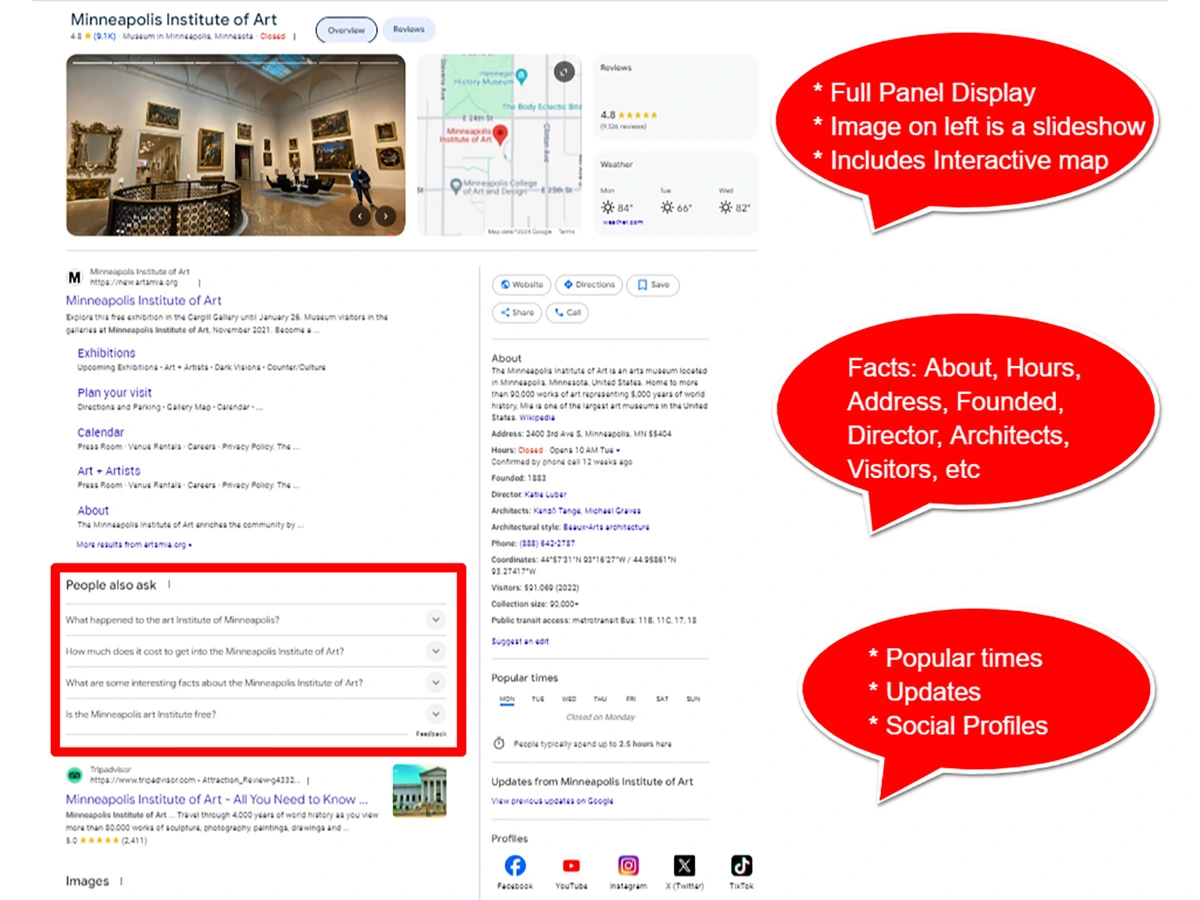
For example, a search query about the “ Minneapolis Institute of Art” returns answers from the Knowledge Graph, and the Knowledge Panel displays the entity and provides additional information.
While an SEO may be gathering data for optimization with a focus on Google’s ranking factors, the real benefit is that it enhances visitors’ on-site experience. How search works means this work can also draw potential new customers.
There’s a lot of overlap and confusion around these terms, so it’s easy to mix them up. A summary explanation is that the knowledge graph represents Google’s algorithmic view of your business. If an entity has been validated in Google’s Knowledge Graph, you’ve most likely been offered a chance to claim your knowledge panel. Let’s break down the differences.
Table of Contents
- Knowledge Graph vs. Knowledge Panel vs. Google Business Profile
- What is a Google Knowledge Panel?
- Google Business Profile Panel
- Google Knowledge Panel
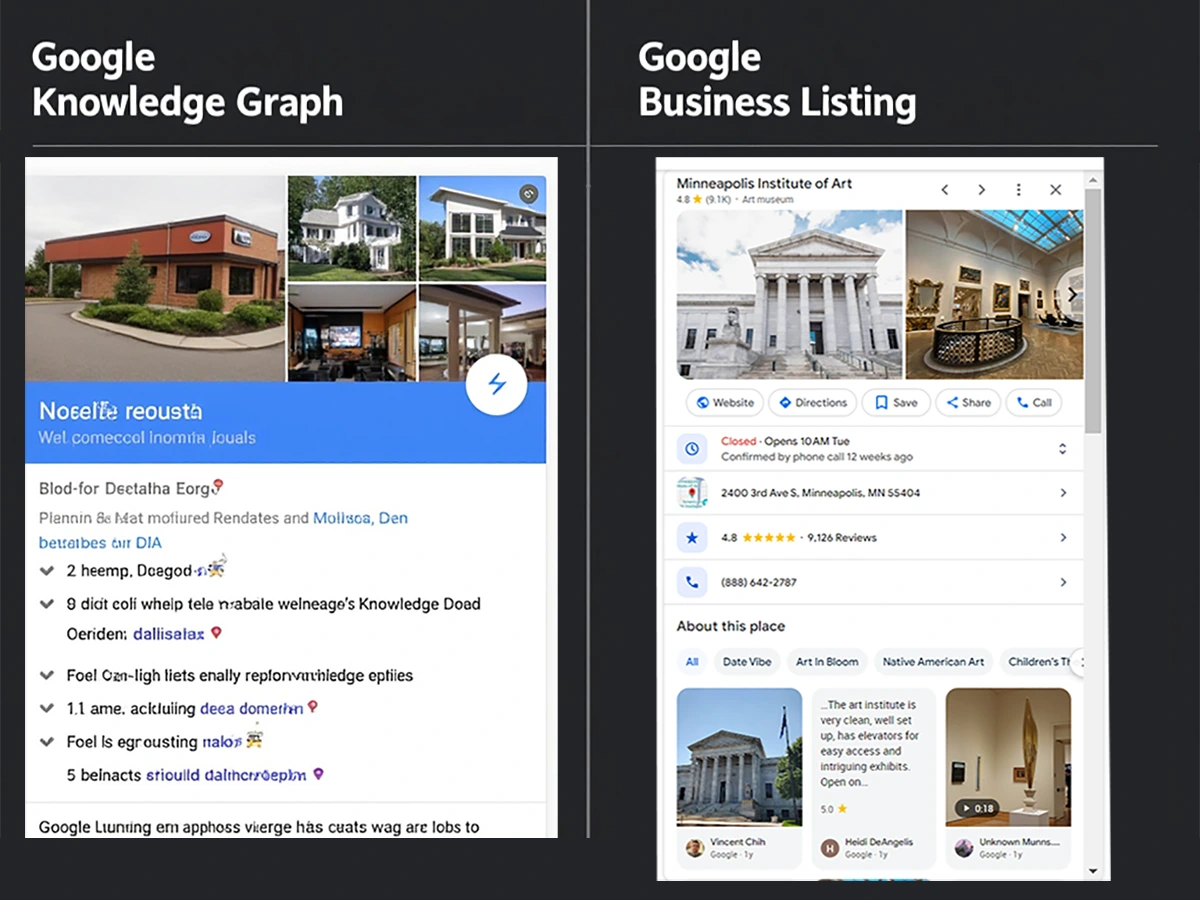
- How can the Average Searcher Tell them Apart?
- Knowledge Panels and Google Business Profile’ss Need Consistency
- Your Knowledge Panel and Google Business Profiles Need Consistency
- How Schema Helps Build Content for Your Knowledge Panel
- Encourage “Sprouting” Knowledge Panels
- Summary: Build Your Brand SERP Across Graphs, Panels, & Profiles
What is a Google Knowledge Panel?
Google Knowledge Panels summarize relevant topics
A Google Knowledge Panel is a box that displays on the right side of Google search results pages that summarizes relevant information about a topic. Its purpose is to provide a summarized preview of information about an entity (e.g., a person, place, fact entity, organization, or event), reducing the need to click on additional results. The panel populates data from various sources. Often, this is drawn from trusted third parties like Wikipedia, data partners, and verified entities; it is powered by Google’s Knowledge Graph.
Google’s algorithms strive to provide Google searchers with accurate, useful, and up-to-date information. Knowledge panels can include text, videos, QA, images, links to that entity’s website, social platforms, and related topics.
Google Business Profile Panel
- Focus: Primarily for local businesses.
- Content: Displays basic business information like name, address, phone number, website, hours, photos, reviews, and sometimes a map.
- Triggered by: Searching for the business name or a relevant local search (e.g., “ pizza near me”).
- Appearance: Typically appears on the right-hand side of the search results page (on desktop), or above the organic search results on mobile.
- Example: Searching “ Starbucks” in a city will likely show a Google Business Profile Panel with the nearest Starbucks location, its address, hours, phone number, etc.
Google Knowledge Panel
- Focus: Provides information on a broader range of subjects, including people, places, things, and organizations.
- Content: Offers a rich selection of information, including:
- Basic facts (birthdays, locations, etc.)
- Related topics
- Images and Videos
- People Also Search For
- News articles and Top Stories
- Related searches
- KG Question Answering feature
How Knowledge Panels work:
- Triggered by: Searching for a specific topic or entity.
- Appearance: Usually appears on the right-hand side of the search results page (on desktop), or at the top of the mobile search results.
- Example: Searching “ Albert Einstein” will show a Google Knowledge Panel with his biography, key accomplishments, related topics, images, and more.
How can the Average Searcher Tell them Apart?
| Dimension | Google Knowledge Graph (KG) | Google Knowledge Panel (KP) | Google Business Profile (GBP) |
|---|---|---|---|
| Core Definition | Algorithmic database of verified entities and relationships. | SERP visual information box summarizing an entity. | Local merchant profile for brick-and-mortar / service areas. |
| Primary Data Source | Wikidata, Wikipedia, Schema.org markup, trusted data partners. | Directly powered by the Google Knowledge Graph. | Merchant dashboard (Google Business Profile) & user reviews. |
| Scope | Universal (people, places, concepts, organizations, events). | Broad informational entities across all industries. | Local businesses, storefronts, and service-area providers. |
| Direct Control | Indirect (influenced via structured data and brand authority). | Verification & suggested edits via “Claim this Knowledge Panel”. | Full direct control via verified Google Business Profile account. |
| Role in AI / GEO | Ground truth for Gemini, Perplexity, and AI Overviews. | Visual proof of high entity authority on search SERPs. | Source for local Pack results and local AI agent recommendations. |
| Key Differences Between Google Business Profiles & Knowledge Panels | |
|---|---|
| Factor | Details |
| Scope | Google Business Profiles focus on local businesses, while Knowledge Panels cover a wider range of subjects. |
| Content | Knowledge Panels provide richer and more comprehensive information, going beyond basic details. |
| Trigger | Google Business Profiles are triggered by local searches, while general searches trigger Knowledge Panels. |
| Overlapping Points: Google Business Profiles & Knowledge Panels | |
|---|---|
| Factor | Details |
| Visual | Both appear on search engine results pages, whereas the Google Knowledge Graph is not something you can see. |
| Informative | Both aim to provide relevant information to users. |
| Editable | Both can be edited and managed by the owner of the entity. |
In essence, think of a Google Business Profile Panel as a mini-profile for a local business. At the same time, a Google Knowledge Panel is a comprehensive information hub for a wider range of subjects.
What are various types of knowledge panels?
There are two primary types of Google Knowledge Panels: Local Panels and Branded/Personal Panels. Both depend on Google’s approval; however, U.S. local businesses can establish their local panel by claiming and verifying a Google Business Profile (typically completed via Google’s video, phone, or document verification process).
In addition – and separate – are Product Knowledge Panels and Google Merchant Knowledge Panels. Both are very useful for ranking brands’ and retailers’ product detail pages. Again, consistency is needed here for “confidence gain” through data alignment. Google now displays modular, card-style Knowledge Panels across both desktop and mobile search results, highlighting dynamic entity attributes, social profiles, and third-party corroboration.
By identifying your small business, you can differentiate yourself in each Knowledge Panel type and other Google entity search results. This expands your website’s ability by appealing to a customer base directly on the SERP that actively seeks what you offer.
What is knowledge extraction?
Knowledge extraction is a process in artificial intelligence that involves extracting useful information from raw data available on the web. When you grasp this concept, you can build your knowledge graph, knowledge panel, and Google Business Profile with much of the same effort. To augment the accuracy of named entity recognition, domain-specific knowledge is vital.
Relation prediction, or node relationships, is a key task in knowledge graph completion and related downstream tasks that rely on knowledge representation. Your website’s structural features and semantic information are valuable for predicting missing relations in knowledge graphs. This has led to the development of semantics-based methods. You can suggest intricate interactions among entities by constructing your website in a manner that integrates knowledge representation into both node construction and schema path inference.
It is best if you can combine deep semantic and strong structural features for relation prediction. By constructing a framework for entity and relation extraction and mining, you are providing a structured representation. The results can profoundly assist knowledge and pattern extraction, providing a comprehensive solution for your graph data management. To see how structured, machine-readable files allow AI agents to extract entity relationships without heavy HTML overhead, explore our OKF Interactive Sandbox.
Your Knowledge Panel and Google Business Profile Need Consistency
Prompt engineering can use the data from your knowledge graph and a fine-tuned model customized to align with your brand’s core identity. Google’s KG seeks confirmation of who you are. Consistent data, tone, and style best affirm your brand’s identity.
This “consistancey” can be developed multiple ways. Named Graph Indexing makes algorithms “round-trippable.” The SPARQL 1.2 Update supports a more current language for RDF graphs. JSON-LD is a directed graph. The document itself is a node object; keys in the document are edges from one node object to other “node objects” and “value objects.” A significant global graph database with universal semantic schemas has long been discussed and is being retuned with contextual structure. It allows multiple named graphs to be indexed by a single graph name.
When Google’s Knowledge Graph is updated for an entity, it updates what information is displayed in the related Knowledge Panels and Google Search. A graph database (GDB) is a database that relies on graph structures for semantic queries, using nodes, edges, and properties to represent and store data. For example, pairing a medical brand graph (OKF) with Schema markup for a a healthcare practice or medical device entity adds clinical accuracy and compliance to that Knowledge Panel and AI search citations.
How Schema Helps Build Content for Your Knowledge Panel
SEO schema is valuable for translating human-readable web content into a language that machines understand. By using this vocabulary, you are helping search engines clearly understand and contextualize the content on your web pages. This is used to answer AI Mode Follow Up questions and to construct a knowledge graph based on your input.
Your knowledge graph can be built using various ontologies, vocabularies, or glossaries. However, to provide users with the most benefits, and to disambiguate your business entity on SERPs it from similar entities, two basic SEO tactics are necessary. Firstly, implement relevant Schema.org vocabulary types to annotate your web content.
Secondly, help populate your Knowledge Graph with accurate data by using semantic triples in your content. By having your business’s critical information appear directly in the SERP, you can drive more user engagement, increase click-through rates, and attract higher-quality traffic to your website.
Google can show the connections an entity has in its knowledge panel and break down those connections by category.
“ Knowledge panels provide information from multiple, authoritative sources. The information comes from Google’s Knowledge Graph, which is like a virtual encyclopedia of facts.” – How to Get a Google Knowledge Panel
Encourage “Sprouting” Knowledge Panels
Don’t think your work is done once you’ ve gained a knowledge panel when you search for yourself. Emerging or sprouting knowledge panels usually don’t appear for most other users’ direct searches. If it displays within the context of a link from another, better developed knowledge panel, learn how to encourage it along. Google seeks strong third-party validation before feeling confident of an entity.
In my line of work, I find that a robust knowledge graph is imperative for organizations looking to implement generative AI technologies. Knowledge graphs can help brand entities ground their AI initiatives in factual data about the organization. Organization schema also significantly influences how a brand is represented in search results.
Knowledge graphs have been foundational to semantic technology for decades. From healthcare and eCommerce lead generation to local SEO, knowledge graphs empower you to harness the full potential of your information architecture.
The rise of Generative AI (GenAI) has heralded a new era in content creation, dissemination, and consumption – especially in Knowledge Graphs (KGs). This technological revolution is reshaping content marketing for KG inclusion.
So don’t let the confusion between them hold you back. Google Search is evolving fast. They may look different tomorrow. It’s important to know that being featured in a Knowledge Graph does not always mean the entity will have a Knowledge Panel when searched by name. Conversely, spotting a Knowledge Panel is a surety that the entity is in the Knowledge Graph.
Summary: Build Your Brand SERP Across Graphs, Panels, & Profiles
While both SERP types provide information, their content, context, and visuals help distinguish between a Google Business Profile Panel and a Google Knowledge Panel. If you’re still unclear, assess the information presented: if it largely covers a local business’s basic details, it’s likely a Google Business Profile Panel. If it displays a broader overview of a person, place, event, or concept, the chances increase that it is probably a Knowledge Panel.
Content knowledge graphs can enable more detailed content analysis by establishing connections between content pieces based on entities, types, and properties.