
How Schema Markup Supports Medical Device Marketing
By Jeannie Hill | Updated 2.16.2026
Medical device sales can improve by leveraging Schema Markup to boost SEO and achieve rich results that help you get featured in search engine result pages (SERPs).
The medical device market is highly competitive due to competitors selling similar software devices and hardware products. Better conversion rates rely on the effectiveness of your sales team working with your writers, SEOs, and search marketers to convert leads into new customers. Aligning your sales and marketing team is the best way to determine the quality of leads and support the work of your schema markup expert.
Table of Contents
- How Schema Markup Supports Medical Device Marketing
- Good Healthcare Marketing Needs Clear Communication
- Primary Medical Device Marketing Strategies
- Advanced Technical SEO and Quality Data
- Semantic Vocabulary Enrichment
- Building Trust and Credibility
- Networking and Collaboration
- Attracting Media Attention
- What are Common Health and Medical Schema Types?
- MedicalDevice Schema Specifications and Broader Marketing Strategies
- How Healthcare Schema Markup Helps Build Knowledge Graphs
- Example Schema Code for Medical Devices
- Knowledge Graphs and GenAI in Medical Device Engineering & Marketing
- Ready for Your Medical Device to Dominate the Knowledge Graph?
Schema markup can significantly boost medical device marketing by:
- Improving search visibility:
- Enhanced listings with rich snippets (ratings, images, etc.) attract more clicks.
- Specific medical device schema clarifies product details for search engines, improving relevance.
- Building trust & credibility:
- Displaying ratings & reviews directly in search results builds confidence in your brand.
- Clearly presenting certifications ®ulatory information establishes authority.
- Providing detailed product information:
- Including technical specs, usage instructions, and safety information directly in search results helps potential customers make informed decisions.
- Driving qualified traffic:
- Schema-enhanced listings attract users actively seeking specific medical device information, increasing the likelihood of conversions.
Healthcare types of semantic markup add structured data to web pages or other data sources, annotating various elements with specific types and properties defined in a shared vocabulary. This creates machine-readable metadata that describes entities (e.g.medical device products), their attributes, and their connections to other entities.
Marketing medical devices to specialized B2B healthcare audiences requires a dual-pronged approach:
- Mastering technical visibility through advanced digital infrastructure (AI SEO and Schema).
- Executing high-touch relationship strategies that convey trust and authority.
Good Healthcare Marketing Needs Clear Communication
Digital marketing and SEO for healthcare companies require a comprehensive 8-pillar audit; schematics is only one aspect.
Schema is just one part of your communication efforts. It is not meant for searchers; it is code to help search engines find and display your content to relevant search queries.
Schema markup empowers you to highlight key details about your product, including features, benefits, pricing, and reviews. This information helps stakeholders quickly assess the value proposition and relevance to their needs, making them more likely to engage with your company.
Custom schema markup strategies are powerful tools for communicating your product’s value, building credibility, and connecting with stakeholders. By making your information more accessible and understandable to search engines and users, you increase your chances of securing funding and reaching the right Audience for your product.
Aligning your sales and marketing teams is the best way to assess lead quality and support your schema markup expert.
Primary Medical Device Marketing Strategies
- Advanced Technical SEO and Quality Data.
- Semantic Vocabulary Enrichment.
- Improved Search Visibility.
- Targeted Audience Reach.
- Building Trust and Credibility.
- Networking and Collaboration.
- Attracting Media Attention
Now, I’ll dive into specifics.
Advanced Technical SEO and Quality Data
Quality data and semantic schema markup help your message reach professional stakeholders and funders.
In a competitive digital landscape, traditional SEO is often insufficient. A critical strategy involves implementing Schema.org structured data to help search engines “understand” complex medical content and present it effectively to the right audience.
A medical device may offer life-saving solutions that healthcare providers and patients desperately need. The urgency increases when the value of your solution to their problems gets lost in the online noise.
Problem: In today’s competitive marketplaces, getting your new medical product in front of the right audience is crucial. Traditional SEO and marketing efforts alone might not be enough to reach the specific healthcare professionals, stakeholders, and patients who need your solution.
Solution: By implementing schema markup, a web page “speaks” the language that empowers search engines to understand the unique nature of your product. This enables us to achieve enhanced visibility in medical search results, driving increased traffic and engagement from the audience you are trying to reach.
Semantic Vocabulary Enrichment
Marketers can leverage specific schema types such as MedicalDevice, MedicalTest, and MedicalBusiness to annotate content.
This creates machine-readable metadata that describes the product, its intended use (diagnostic vs. therapeutic), and its relationships to other entities (e.g., a specific medical condition or therapy).
By utilizing a shared vocabulary and defining clear relationships, schema markup imbues data with semantic meaning. This enhances the machine’s ability to understand the context and connections within the data, allowing for more sophisticated reasoning and analysis.
Since there are many medical devices of all sorts and types flooding the market, semantic enrichment disambiguates your product from others.
Improved Search Visibility:
By using relevant schema types like Product, Service, or Organization and accurately marking up your healthcare product or company’s information, you increase the chances of appearing “Ask the doctor” question-answer SERPs, and knowledge panels. This enhanced visibility helps potential investors, partners, and customers discover you more easily.
Targeted Audience Reach:
To distinguish between content meant for patients, researchers, or clinicians, marketers can nest the audience and specialty properties within the schema. This helps serve up personalized content. LLMs (Large Language Models) can understand which technical content should reach B2B buyers, while patient-centric content reaches consumers.
Schema markup enables search engines to understand better your offerings, target audience, and niche expertise. This helps connect your product to relevant search queries from investors, stakeholders, and potential customers looking for solutions like yours. Learn how to utilize structured data with Google Vertex AI.
Using specific schema types like ‘PathologyTest’, ‘MedicalTest’, and ‘MedicalDevice’ ensures that your products appear in search results relevant to the specific needs and queries of healthcare professionals and patients. For instance, if marketing a new MRI machine, using the contraindication property can automatically alert physicians to safety restrictions in the search result itself, building immediate trust.
There are also specific uses for MedicalContraindication and MedicalGuidelineContraindication.
You can win clicks organically without the repeat cost of health product advertising. More below.
Building Trust and Credibility
For medical topics (YMYL – Your Money or Your Life), Google’s systems place “even greater emphasis on signals of reliability”.
By providing structured data about your product and company, you project a professional image and demonstrate transparency. This builds trust with stakeholders, making them more confident in considering your product for funding or partnership opportunities.
Verification & Transparency: In an era of AI-generated content, verification (proof) is business currency. By using citation and reviewedBy schema properties, you can link your product claims directly to clinical studies or medical reviewer profiles. This helps LLM systems corroborate your information, a key factor in ranking high-quality medical content.
Networking and Collaboration
Certain schema types, such as Person and Organization, can trigger connections with potential investors, mentors, and collaborators within your industry. This networking potential can open doors to funding opportunities and valuable partnerships.
For example, your organization’s profile page or about page should be fully crawled, indexed, and disambiguated from similar entities.
Nothing fully replaces in-person networking. It is where you shake hands with regulators and policy makers, introduce your investors to your staff, and/or sign a deal with a research partner. It isn’t about telling people you are great; it is about associating yourself with the people and institutions that make you undeniable.
Attracting Media Attention:
Rich search results with detailed information about your product can capture the attention of journalists and bloggers. This increased media exposure can further raise awareness about your product and attract potential investors and stakeholders.
Investor-Specific Schema:
Investors often use specialized discovery tools that rely on structured data to find widely adopted technology. Specific schema types like Grant, FundingScheme, and MonetaryGrant can clearly outline your funding needs, preferred investment types, and past funding successes. This targeted information helps attract investors seeking opportunities that meet their criteria.
Schema annotations (or enumerations) allow us to control specific definitions, such as descriptions, names, types, example values, and allowed values, for model properties. Additionally, it offers additional filtering properties for medical device types.
What is a schema enumeration?
A schema enumeration is an element that defines a list of acceptable values for a class or attribute. Enumerations are often described at the beginning of a schema, before the main element, and can be accessed from other schemas. They help create a “controlled vocabulary” for values, enabling standardized reporting and categorization.
What are Common Health and Medical Schema Types?
Examples of frequently used schemas for medical device enumeration:
MedicalDevice
Any object used in a medical capacity, such as to diagnose or treat a patient.
MedicalTest
A device used to perform the test. Properties from MedicalEntity. A medical code for the entity, taken from a controlled vocabulary or ontology. Instances of MedicalTest may appear as a value for the following properties: MedicalClinic, Physician (a medical service available from this provider), or DiagnosticLab.
MedicalEntity
The most generic type of entity related to health and the practice of medicine. Property, Expected Type, Description. Properties from MedicalEntity. It may include MedicalSystem, the system of medicine that consists of this MedicalEntity, for example, ‘evidence-based,’ ‘homeopathic,’ ‘chiropractic,’ ‘WesternConventional’ for traditional medical procedures, etc.
PathologyTest
A medical test performed by a laboratory typically involves an examination of a tissue sample by a pathologist.
Health and medical types
These schema types complement existing vocabularies and ontologies. It is helpful to annotate entities with codes that refer to existing controlled medical vocabularies (examples: MeSH, SNOMED, ICD, RxNorm, UMLS, etc.).
MedicalTestPanel
A medical code for the entity, taken from a controlled vocabulary or ontology such as ICD-10, DiseasesDB, MeSH, SNOMED-CT, RxNorm, etc. Includes funding: A Grant that directly or indirectly provides funding or sponsorship for this item. It can also leverage ownershipFundingInfo.
MedicalDevicePurpose
Categories of medical devices, organized by the purpose or intended use of the device.
MedicalStudy
A medical study is an umbrella term that covers all kinds of research related to human health or medicine. MedicalStudy includes observational studies, interventional trials and registries, and randomized, controlled, or uncontrolled studies that may be useful to support medical device sales.
Diagnostic
A medical device used for diagnostic purposes. Diagnostic procedures identify problems, illnesses, or diagnoses, while therapeutic procedures treat or prevent illnesses.
Therapeutic
A medical device used for therapeutic purposes. A member value for the enumeration type: MedicalDevicePurpose.
MedicalObservationalStudy
An observational study is a type of medical study that attempts to infer the possible effect of a treatment by observing a cohort of subjects over a specified period. This contrasts with controlled studies, such as the randomized controlled trials represented by MedicalTrial, in which each subject is randomly assigned to a treatment or control group before treatment begins.
Next, let’s circle back to our “Targeted Audience Reach” section with a helpful example.
MedicalDevice Schema Specifications and Broader Marketing Strategies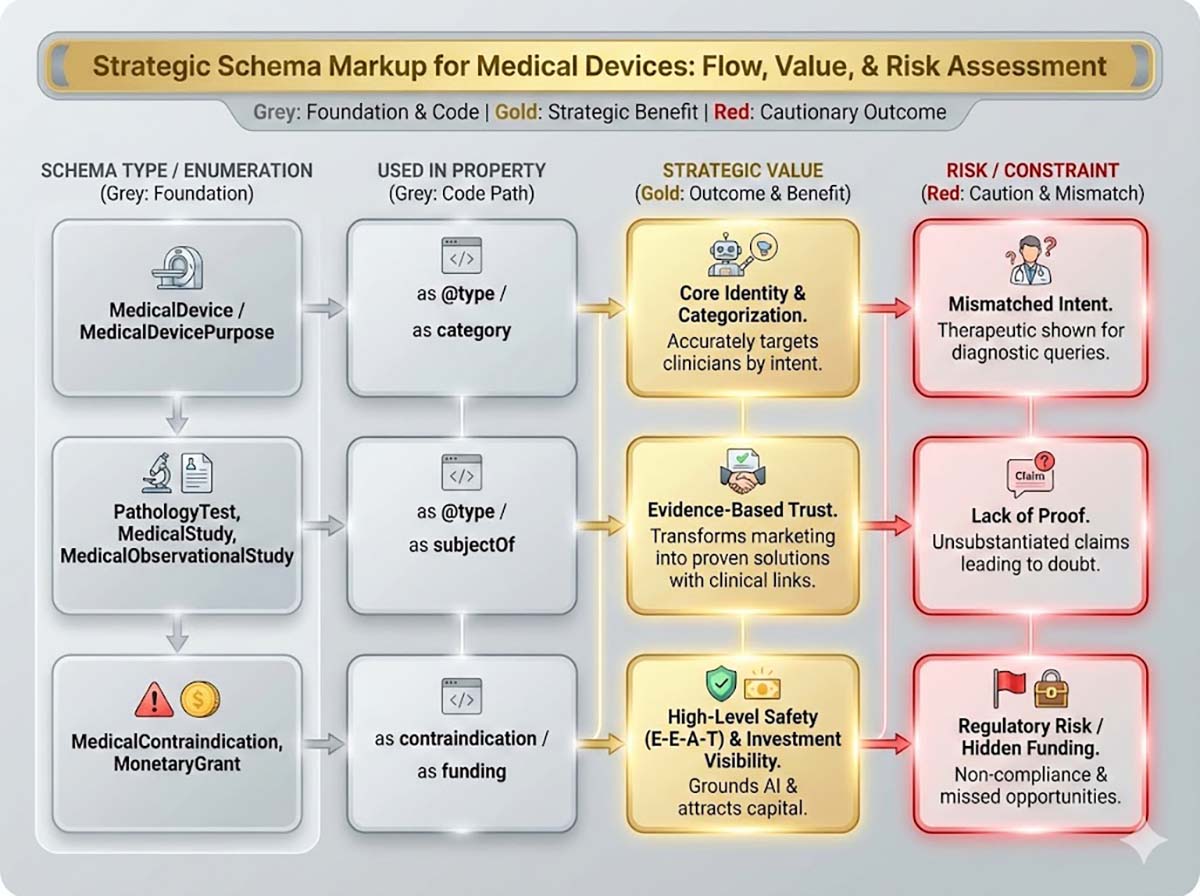
Using MedicalContraindication as a strategic move to enforce safety, build patient and provider trust, and refine audience targeting.
Here is how a medical device marketer can use this specific schema type:
- Hard-Coding Safety into the Digital Product Profile: MedicalDevice schema explicitly includes a property called contraindication. This property expects a value of MedicalContraindication or simply Text. By using this markup, you are not just listing safety warnings in plain Text on a PDF; you are embedding them into the machine-readable code of your website.
- How it works: You create a “link” in the code that tells search engines: “This MedicalDevice has a contraindication for this specific MedicalCondition.”
- Strategic Value: This supports the “evidence-based marketing” approach, where accuracy is key. It ensures that LLMs and search engines strictly associate your device only with appropriate use cases. This form of “grounding” reduces the risk of the device appearing in search results for patients or conditions where it is unsafe.
- Demonstrating Transparency to Build Trust (E-E-A-T): Trust is a primary currency in B2B healthcare marketing. Sources indicate that providing structured data helps project a professional image and demonstrates transparency, which builds confidence among stakeholders.
- The “Anti-Pitch”: While marketing usually focuses on benefits, explicitly marking up who should not use the device signals high “Expertise, Authoritativeness, and Trustworthiness” (E-E-A-T).
- Regulatory Signaling: As the industry moves toward AI-driven compliance and “autonomous compliance monitoring”, having contraindications clearly structured in your data helps automated systems (like those used by regulators or hospital procurement systems) verify that your digital presence aligns with approved regulatory labeling.
- Disambiguation and Audience Filtering: In a crowded market, “semantic enrichment” is used to disambiguate your product from others. MedicalContraindication acts as a precise filter for your Audience.
- Precision Targeting: If your device is contraindicated for pediatric patients, marking this up ensures that search engines understand the limitation. This prevents your content from being served to a surgeon specifically looking for pediatric solutions, thereby improving the quality of your leads by filtering out irrelevant traffic.
- Future-Proofing for AI “Learning Systems:” The healthcare industry is shifting from static devices to “learning systems” where AI agents assist with research and compliance.
- Machine Readability: AI agents cannot easily “read” a warning label on a photo of a box, but they can instantly process Schema markup. By using MedicalContraindication, you ensure that future AI tools used by doctors or procurement officers can automatically cross-reference your device against a patient’s electronic health record (EHR) to flag potential conflicts immediately.
How Healthcare Schema Markup Helps Build Knowledge Graphs
Gain the untapped potential of Schema Markup to build a content knowledge graph to enhance website visibility and, ultimately, sales.
Schema structured data is a coding language that search engines leverage to build knowledge graphs. Knowledge graphs consist of nodes and edges, where nodes represent essential entities such as people, places, or products.
These “edges” represent connections between them. Schema markup helps search engines understand articles so they can display it to users in large, visual graph formats.
Semantic schema markup currently plays a significant role in the construction and enrichment of knowledge graphs by providing a standardized way to represent and connect entities and their relationships within a document.
When information is conveyed effectively through schema, the knowledge graph and knowledge panels can be the best way to improve rankings and traffic performance.
Knowledge Graph Accuracy
LLMs and search engines use structured data to build “Knowledge Graphs.” Accurately mapping contraindications prevents AI-generated summaries from mistakenly labeling your device as a “cure-all,” ensuring the summary remains medically accurate.
Product schema annotation relies on semantic triples that support graph embeddings. It can take your article writing skills to a whole new level. Your particular healthcare niche is most likely highly competitive. Those who put in the extra strategic effort sell the most products.
The knowledge graph is a massive display box on the right in SERPs.
It is increasingly popular, taking up more real estate in Google Search results and commands. Brands need to ensure they are relevant and correctly represented. Companies should use schema markup to gain product knowledge panels. These capture traffic and increase rankings within the knowledge graph itself.
Example Schema Code for Medical Devices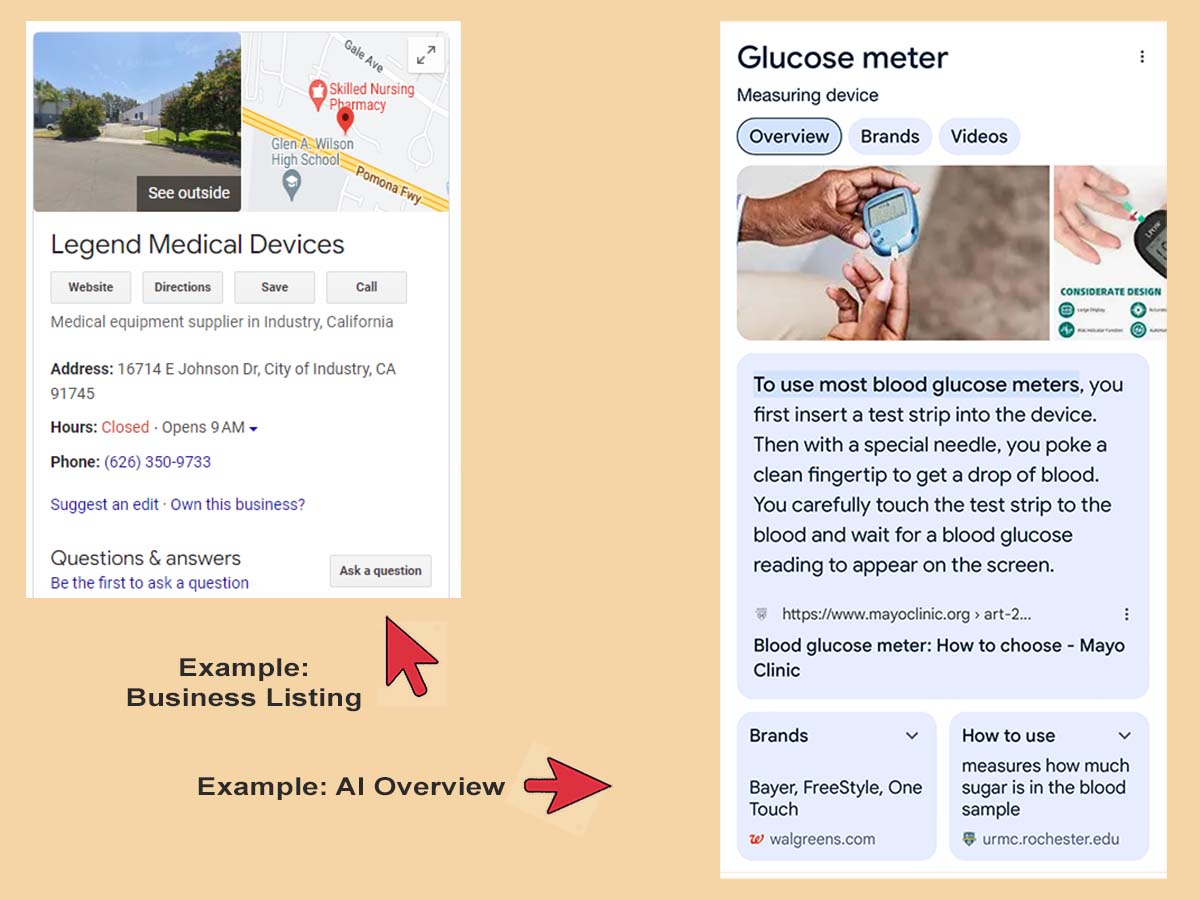
While Google doesn’t create Knowledge Panels specifically for individual medical devices, it sometimes generates Product Panels for specific devices. These panels are similar to Knowledge Panels in that they appear on the right-hand side of the search results page, but they focus exclusively on product information. This data is either supplied by or confirmed through schema markup.
- Product Images: Usually a prominent image of the device or its featured image. See (Google Merchant Center Image Requirements)
- Key Features: A brief list of the device’s main features.
- Pricing: Sometimes shows prices from various retailers.
- Reviews: May include user reviews if available.
- Links to Purchase: Links to online stores where you can buy the device.
Example of basic schema code for MedicalDevice:
<script type="application/ld+json"> { "@context": "https://schema.org", "@type": ["MedicalDevice", "Product"], "name": "MyNewMedicalDevice", "description": "A groundbreaking diagnostic device for [intended use].", "manufacturer": { "@type": "Organization", "name": "Your Company Name" }, "image": "https://www.yourwebsite.com/product_image.jpg", "url": "https://www.yourwebsite.com/product-page", "category": "Diagnostic", "sku": "1234567890", "offers": { "@type": "Offer", "priceCurrency": "USD", "price": "1999.00", "availability": "https://schema.org/InStock" } } </script>NOTE: By adding “Product” to the @type (making it [“MedicalDevice“, “Product“]), you gain the ability to categorize the device legally within the schema rules.
NOTE: This code includes the “@context”: “https://schema.org” declaration, which is required for the structured data to validate and work correctly in Google’s Rich Result Test.
Knowledge Graphs and GenAI in Medical Device Engineering & Marketing
Automatically generating knowledge graphs is more difficult for healthcare retail products.
In our tightly regulated medical device product engineering and marketing sphere, using advanced data structures and artificial intelligence provides an edge when overseen by human intelligence. The knowledge graph is revolutionizing how data is managed, analyzed, and utilized in this field.
Without knowing the technology behind it, funders, stakeholders, hospitals, patients, etc., often find answers to their search queries from a combination of knowledge graphs, ML, and GenAI. This transformative approach in the medical device industry can enhance marketing efficiency and pave the way for more advanced, reliable, and personalized medical marketing solutions.
If you struggle to reach decision-makers, we can use data-driven insights to help you optimize your medical device sales cycle. With the proliferation of AI, the need to establish verified online identities has become increasingly important. The verified status of your medical device can enhance trust and authenticity.
Ready for Your Medical Device to Dominate the Knowledge Graph?
Utilizing schema markup demonstrates your commitment to staying ahead of the curve in terms of modern search engine optimization. It helps you stand out from competitors who may not be leveraging this valuable technology. As more patients turn to the web to find medical information, it’s imperative that they receive meaningful and accurate results.
Healthcare providers also search for the right provider to refer to for specific patient needs. More and more often, healthcare sites are found via Google Business Profiles Meaning, it is important to keep them current.
Contact Jeannie Hill today to build a semantic strategy that puts your medical device in front of the funders and clinicians who matter most. 651-206-2410
Visibility in AI Overviews isn’t an accident—it’s engineering. Request your Cutting-Edge E-commerce Healthcare Marketing