How Semantic Triples Assist Knowledge Graph Embeddings
Written by Jeannie M. Hill | Updated 11.6.2026
Semantic triples and knowledge graph embeddings help content creators establish the topic hubs for which the business entity wants to be recognized.
Semantic triples help organize and categorize website content so that search engines can understand, rank, and populate knowledge panels easily. A set of three entities that codify a statement about semantic data requires a clear SEO content strategy. By implementing structured data and helpful context, semantic triples can help search engines better match a webpage’s content with related search queries. This results in more relevant and useful search results for users.
Table of Contents
- How Semantic Triples Assist Knowledge Graph Embeddings
- What are Semantic Triples?
- Benefits of A Foundational Semantic Triple Model
- Knowledge Graph Semantic Embedding
- Semantic Triples are Machine-Readable Representations of Knowledge
- Comparing Semantic Triple Representations Across Web & AI Systems
- Frequently Asked Questions: Semantic Triples & Knowledge Graph Embeddings
- SUMMARY: Semantic Triples Boost Context and Meaning of Content
My head has been in this for years. At first it is complex (and continues to be). First, I’ll provide some common question answers and definitions I’ve gathered while working to improve content and knowledge graph embeddings using semantic triples.
What are Semantic Triples?
Triples (known as semantic facts) are a method of expressing graph data. They convert unstructured text data into meaningful structured data for easier search consumption and are also known as “statements” or “RDF statements”. A triple id is made up of three components: A subject, a predicate, and an object. They are the most foundational aspect of how information is encoded in a knowledge graph using semantic web technologies.
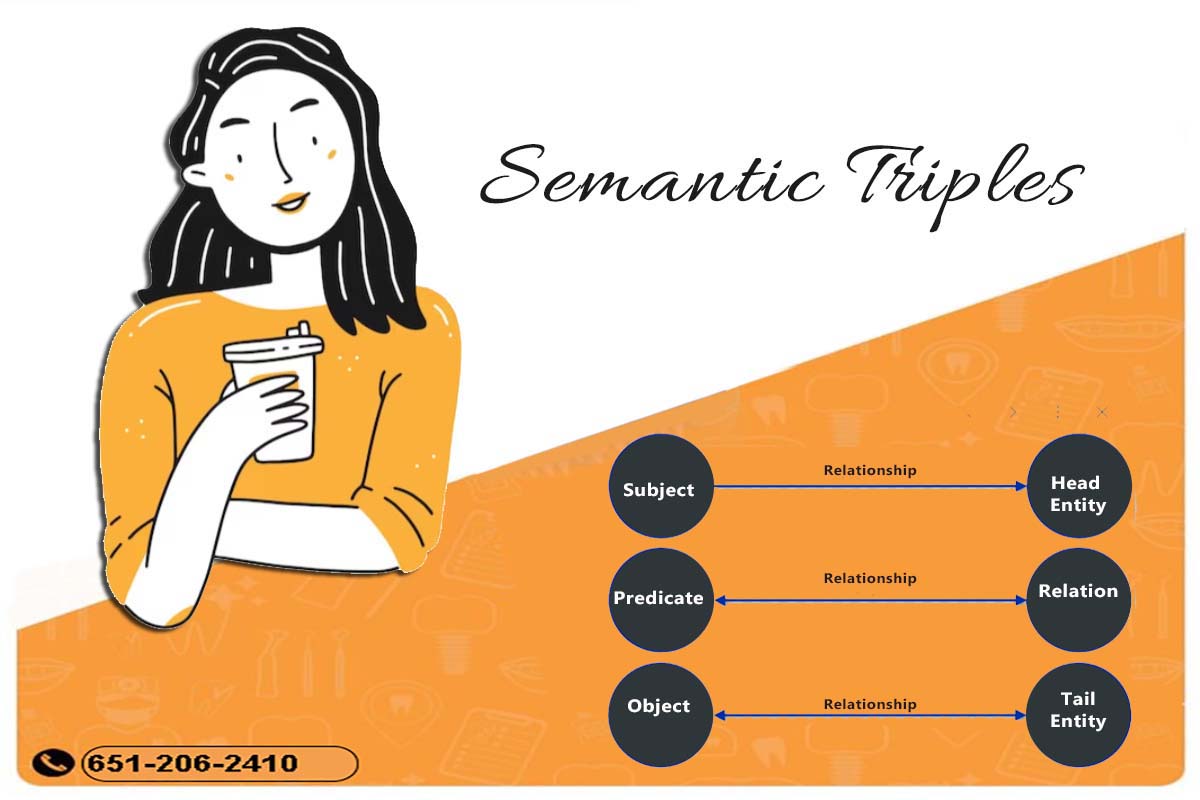
A semantic triple typically consists of a head entity, relation, and tail entity to indicate that two entities share a relationship by a stated connection, such as Mouthguards, treat, TMJ. The sentence might read, “Mouthguards are used to treat sports-triggered TMJ.” In 2026, the Knowledge Graph embedding algorithms have gained widely accepted recognition as an integral part of semantic question answering systems (QAS).
These embedding algorithms learn the representations (i.e., embeddings) of entities and relations in low-dimensional vector spaces. Such embeddings enable search engines to answer questions extremely quickly within knowledge graphs. Even for large-graph information retrieval, triples are processed in ways that run counter to traditional constructs.
According to Oxford Semantic Technologies, “Triples are a part of the RDF data model. They have one additional and very important constraint—every item in an RDF triple must be uniquely identifiable via IRI, except blank nodes. According to the RDF standards, IRIs must take the form of a web address, but stripped back to its most basic utility, an IRI acts as a label for each item.” (RDF stands for Resource Description Framework)
The components of a triple, such as the statement “Northern Red Oaks have bright orange fall color”, consist of a subject (“Northern Red Oaks”), a predicate (“have”), and an object (“orange fall color”).
How AI reads content: Use clear and direct syntactic structures
=
Short, well-structured sentences make it much easier to extract accurate semantic triples (Subject-Predicate-Object). When text is clear and direct, AI models can map relationships with high precision, significantly reducing the “hallucinations” or factual errors often caused by complex, winding language.
Short, direct sentences reduce grammatical ambiguity and clarify the core relationship between the subject, verb, and object. When you eliminate filler phrases and complex conditional clauses, you make it much easier for a language model (or a human reader) to parse the exact intent, constraints, and actions required.
What is a Knowledge Graph Model?
Knowledge graphs (KGs) categorize data from multiple sources, collect information about entities of a specified interest in a specific domain or task (i.e., people, places, things, or events), and establish node connections between them. A knowledge graph model helps maximize your content marketing efforts by enhancing structured data. This can reduce vague assumptions about your content by infusing brand values into the model.
Semantic triples are a way of expressing graph data in knowledge graphs using semantic web technologies and entity extraction. I like how Ontotext explains this:
“The heart of the knowledge graph is a knowledge model: a collection of interlinked descriptions of concepts, entities, relationships and events. Knowledge graphs put data in context via linking and semantic metadata, and this way provide a framework for data integration, unification, analytics and sharing.” – What is a Knowledge Graph?
A method of multi-strategy ontology mapping aids semantic expression when developing the process of knowledge graph modeling techniques.
What is entity extraction?
Entity extraction is the foundational step in knowledge extraction. It automatically scans unstructured or diverse model data to identify and categorize core elements.
Entity extraction—also called named-entity recognition (NER) or entity chunking—is a natural language processing (NLP) technique that automatically identifies key information in unstructured text and classifies it into predefined categories [1]
Three basic language syntaxes exist for expressing semantic triples in schemas.
- JSON-LD
- Microdata
- RDF
With so much data online, these query languages help express the meaning of key concepts in your content. In some applications, RDF is classified as triple data, without schema or ontology information unless explicitly included in the RDF source. Whichever syntax you prefer, you are attaching semantic information to your content pieces and strategically embedding machine-processable information.
Only recently has Google permitted mixing structured data formats.
What are the basic elements of a semantic triple?
To create a structured semantic triple, understand its three core elements:
- ID: Each ID is an entity.
- Property: Each entity has properties.
- Value: The value of an entity can be an ID of another entity.
The three different parts of your matching schema code can be described as: Type, Property, and ID.
What are RDF N-Triples?
N-Triples is a line-based, plain text format for encoding an RDF graph.
RDF N-Triples were introduced on W3, November 4, 2023, as quoted triples that offer a fourth RDF term type. It states that they “can be used as the subject or object of another triple, making it possible to make statements about other statements. RDF 1.2 N-Triples also adds support for directional language-tagged strings.” [2]
I’ve used JSON-LD markup the most, as Google has stated it prefers this markup language. It is possible to leverage multiple production environments, such as adding Microdata and RDFa. However, problems can currently emerge, and we find them hard to detect. It takes skill to mix syntaxes.
Benefits of A Foundational Semantic Triple Model
Search engines are needed to make your content findable by your active audience. A primary value of the semantic triple data model is that it helps them identify the intent behind search queries. Structured data formation aids in information retrieval and validation by making each triple like a classical relational database entity–attribute–value model.
By writing Triples or subject → verb → object formats, your content translates easily to structured data. Search engines seek and consume triples more easily. This saves resources; it assists the calculation of semantic similarities.
Semantic triples can improve SEO efforts by:
- Making content’s language easy to understand.
- Ensuring necessary and helpful content elements are included.
- They improve users’ searchability within a website.
- Aiding the process of matching search intent to the best answer.
- Including SEO structured data within the website’s HTML code.
- Increasing your website’s visibility in search engine result pages (SERPs).
- Increasing your chances of gaining rich snippets.
- Simplifying how search engines view the relationships between content pieces on your website.
- Driving qualified clicks to your website from interested users.
- Improving the accuracy of query matching results.
- They help get your data included in your Google Knowledge Graph.
The Schema.org vocabulary is ideal for making semantic triple statements that combine to generate graphs of interconnected resources. When building knowledge graphs, nodes in these triples store information in what we call “triplestores”. The SPARQL query language for RDF can be crafted to target specified triples. In this way, your website article optimization can be better integrated and connected to your World Wide Web of Data.
They can become more complicated and more expressive by using more complex models. We often create triples as objects or subjects of other triples. This provides semantic search benefits for websites we manage.
I enjoy studying which specifics help achieve the right schema architecture for a given website. Semantic expressivity can take many forms. Consider the following.
(, worked at, ) (, studied at, ) (, is author of, ) (, is headquartered in, ) (, partnered with, ) (, was created by, ) (, edited by, ) (, was funded by, ) (, was founded by, ) (, worked with, ) (, was created for, ) (, reviewed by, )
Knowledge Graph Semantic Embedding (KGSE)
This learning framework, combined with triple semantic information, is at the core of many artificial intelligence applications, such as intelligent search and AI question answering information retrieval.
“KGSE comprehensively considers the structural embedding and semantic embedding of triples, where semantic embedding is used as a supplement to improve the quality of embedding. Specifically, KGSE uses the improved TransD model to obtain the structural embedding of triples, and employs the deep convolutional neural model combined with an attention mechanism to obtain the semantic embedding of triples.” – A Knowledge Graph Embedding Framework With Triple Semantics [3]
How do schemas assist semantic search?
Google crawler parses your web data and converts it into triples that it can insert in a graph database. Triples are the universal and fundamental atom of web information. In our practice, this is why knowledge of how the semantic triple works is foundational to optimizing structured data and content for semantic search and KGSE.
Metadata formats represent knowledge in a machine-readable way. Every part of a schema.org triple is individually addressable via a unique ID. URI can be used to represent those IDs — for example, the statement “Benson married Jane” may be enriched by schema as:
{"@context": "https://schema.org",
  "@type": "Person",
  "@id": "Person1",
  "name": "Benson",
  "knows": {
    "@context": "https://schema.org",
    "@type": "Person",
    "@id": "Person2",
    "name": "Jane"
  }
}
All information fragments are understood, stored, and accessed as triples in schema.org.
Triples are important in semantic search. As Google’s Knowledge Graph rapidly expands in the era of AI, business context and semantics play a vital role in SEO strategies. On-page semantic triples provide microdetails that Google’s Merchant Center feed uses for product validation.
The searcher’s intent and context behind a search query have removed former reliance on exact-match keywords.
What are the components of a semantic triple?
Head Entity → Relation → Tail Entity
Subject → Predicate → Object
The subject references the entity being described, the predicate is used to explain the relationship between the subject and object, and the object refers to the entity being related to the subject.
Semantic triples are commonly used in natural language processing and machine learning to help search engines and computers understand and interpret the meaning of your text. They understand content easily by finding connections and patterns in web documents.
Knowing how each element of a semantic triple works means that you can optimize it. More importantly, applying this knowledge to a semantic network can inform Google of three different relevant entities. Each ID is an entity, and each entity owns properties. Each element is unique and yet interrelated; you can explain their value and context.
Here are some examples of basic semantic triples:
- “Konrad drives buses”
- “Samantha is caucasian”
- “Timothy plays Agricola”
Semantic triple code is formatted so that it’s machine-readable. A unique URI can identify each component of a triple. This is what makes them useful in resource description frameworks. The third statement above might be encoded as:
https://example.name#Timothy https://xmlns.com/foaf/0.1/plays https://example.name#Agricola
How triples express graph data
Knowledge graph completion (KGC) seeks to predict missing links based on known triples.
Semantic triples are commonly stored in a graph-like format, with single triple components representing a unique relationship between three elements. This contrasts with array and list data structures, which are often stored in a linear or hierarchical sequence.
Leveraging entity relationships and structured information found in triples can boost your content marketing’s performance. You can assist the discovery of related entities on a specified web page by identifying the parent and children (tail entity) of its named entities. This adds structure to your content; it helps search engines evaluate you as the expert searchers seek.
Every web page can have a clear data graph when published using linked data. Better data management, strong typing, and a common, clear data model can deliver your site’s content in a more useful way.
I like to think of triples as word neighborhoods. Every house on your street may be different, with different people living in them, but they share the same neighborhood. When SEOs and schema markup experts seek to explain entities and relations within a content piece, this concept is helpful. Semantic relevance and triplet classification come into play.
Knowledge graph embedding adversarial learning (HARPA) creates a way “to learn the information of triples and neighborhoods at the triples-level and further utilizes the rich inference information of paths to deeply learn relation embedding at the paths-level.” [4]
Testing your semantic triples
While I utilize Google tools for schema validation, testing, and implementation, the need is to go beyond that and rely on practical knowledge. Jarno van Driel shared the following nugget of wisdom with me. Jarno van Driel shared the following nugget of wisdom with me.
Google’s position is that if you can provide advanced markup, then you should also be able to judge whether the warnings/errors are correct or not. Their tooling only reports on the things they officially support, and only on the examples they provide themselves. Anything beyond their examples is something their tooling really isn’t meant for. – Jarno Van Driel
Semantic Triples are Machine-Readable Representations of Knowledge
Schemas help organize and mark up web page content for easier search engine consumption. Schemas help establish connections among entities, such as products, people, services, organizations, events, and more. Using schema markup on your website to express semantic triples helps search engines establish relevance between your content, your brand entities, and the knowledge graph for user queries.
Relevance engineers and SEO/GEO specialists use semantic architecture to turn unstructured text into machine-readable facts that search engines and AI models can easily parse, ground, and cite. They also help with a website’s user searchability, especially for larger sites.
They provide supplemental context so that people can gain more relevant and useful search results.
Complex triple: To put this into a practical business application, consider the use of the Organization schema. We’ll start with a simple semantic triple example.
Amazon sells products.
Organization structured data can accomplish a lot of hard work. It can define the brand entity name, logo, contact details, hours, Google Maps URL, and the organization’s social profiles.
A complex triple may be “My sister and I are shopping on Amazon for new winter coats and color-coordinated boots.” Here, a lot more data information is provided versus “Amazon sells products”.
Preparedness for Google’s Search Generative Experience and Gemini is imperative. Schemas that incorporate the Knowledge Graph improve user experience and provide more context for search engines. You can future-proof your digital presence by implementing structured data and adhering to the appropriate content hierarchy, architecture, and semantic triples.
Comparing Semantic Triple Representations Across Web & AI Systems
| Format / Layer | Triple Structure | Primary Role in AI Search & Knowledge Graphs |
|---|---|---|
| Prose Triple (NLP / NER) | Subject → Verb → Object | Helps natural language parsers extract unambiguous claims directly from article sentences. |
| Schema.org JSON-LD | @id (Type) → Property → Value / Target @id |
Disambiguates public web entities for search crawlers, Knowledge Panels, and Google Merchant Center validation. |
| W3C RDF 1.2 N-Triples | <Subject IRI> <Predicate IRI> <Object IRI> . |
Provides line-based graph exchange and quoted triples (statements about statements) for triplestores and SPARQL. |
| Open Knowledge Format (OKF) | YAML Frontmatter subject / predicate / object |
Bridges public Schema.org entity IDs with version-controlled Markdown nodes for enterprise GraphRAG retrieval. |
| Knowledge Graph Embeddings (KGSE) | Head Vector (h) + Relation (r) ≈ Tail Vector (t) | Maps symbolic triples into low-dimensional vector space for fast link prediction and AI question answering. |
Frequently Asked Questions: Semantic Triples & Knowledge Graph Embeddings
How do semantic triples improve Knowledge Graph embeddings for AI search?
Knowledge Graph embedding frameworks map entities and their relationships into low-dimensional vector spaces while preserving structural graph connections. When web content expresses clear Subject → Predicate → Object statements backed by matching Schema.org @id URIs, AI search systems can align dense vector similarity with verified symbolic facts, reducing ambiguity and hallucination during retrieval.
Why do automated schema plugins sometimes fail on complex semantic triple pages?
Automated entity-linking plugins rely on strict HTML DOM parsing and automated Named-Entity Recognition (NER). Unclosed paragraph tags, raw JSON-LD examples in body text, or ambiguous anchor attributes can break automated DOM injection. Using a custom, unified JSON-LD @graph with explicit @id node references prevents schema markup drift and gives relevance engineers complete control over entity relationships.
What is the difference between a simple semantic triple and a quoted triple in RDF 1.2?
A standard semantic triple connects one Subject entity to one Object entity or literal value via a Predicate. An RDF 1.2 quoted triple allows an entire triple statement to serve as the subject or object of another triple, enabling provenance, timestamps, and source attribution (making machine-readable statements about statements).
SUMMARY: Semantic Triples Boost Context and Meaning of Content
When you utilize schema markup and semantic triples, you are providing chances for improved search accuracy for knowledge graph embedings. Embrace semantic web principles by effectively leverging tools like RDF, named graphs, and node relational datasets. Regularly audit and optimize your schema markup to ensure it remains up-to-date and avoid schema markup drift. Google continues to rely on good markup best pratices to deliver search results.
651-206-2410 for your Schema Markup Audit
Resources
[1] https://en.wikipedia.org/wiki/Named-entity_recognition
[2] https://www.w3.org/TR/rdf12-n-triples/
[3] https://ieeexplore.ieee.org/document/10077479
[4] https://link.springer.com/article/10.1007/s10618-022-00888-3