
AI’s Impact in Fresh Content Production and Search Retrieval
Written by Jeannie M. Hill
The era of static content is over. Driven by AI-assisted generation, the pace of production has accelerated. Recency and citations have replaced static authority as the primary currencies of visibility.
Google’s core goal remains unchanged: to help people find outstanding, original content that adds unique value. The new differentiator in AI search experiences isn’t just volume; it is the strategic combination of high-quality information and content freshness.
Table of Contents (Click to Expand)
- AI’s Impact in Fresh Content Production and Search Retrieval
- Strategic Implications in AI Visibility
- Content Gap Analysis Reveals the Importance of Update Frequency
- Schema Markup Opportunities
- Statistics Demonstrating The Value of Creating and Maintaining Fresh Content
- Your Top Take-Away
- Answers to Common Questions
- SUMMARY: Evolving with Your Users
Content production alone does not guarantee visibility. The quick pace of content production, driven by AI-assisted content generation, has changed the game. History proves that quality endures.
Google’s ranking systems have long rewarded original, high-quality content regardless of how it is produced.
The significant qualification is content quality over speed and frequency. While AI allows for a much faster pace of production, the fundamental criteria for success remain centered on providing user value.
How AI is influencing content production:
The “game” has shifted in several specific ways due to the integration of AI in content production and search retrieval:
- Preference for Recency in AI Assistants: AI search engines and assistants (like ChatGPT, Gemini, Grok, and Perplexity) prioritize significantly fresher content than traditional search results.
Research indicates that AI-generated content is 25.7% fresher than organic Google results, and ChatGPT favors sources that are over a year newer than traditional organic results. [1]
- Transformation of content marketing strategies: AI is transforming content marketing by shifting the focus toward Answer Engine Optimization (AEO).
Marketers are now using AI to automate the identification of content gaps, analyze performance at scale, and refine content to appear in AI-generated answers.
- Proactive strategy vs. reactive activity: When AI is used as a “proactive strategic ally” rather than just a reactive tool.
However, rushing to adopt AI without the right infrastructure can create more disorder than direction, especially if legacy systems and skill gaps exist within a team.
The following table compares the characteristics of traditional organic search with emerging LLM-powered search engine result page (SERPs), which places a significantly higher premium on content freshness.
| Feature | Traditional Search (Google) | Freshness / LLM-Powered Search (Current Standards) |
|---|---|---|
| Core Ranking Signal | One of many factors; balanced heavily with backlinks and domain age. | Engages users; used as a primary signal for relevance and trustworthiness. |
| Content Evaluation | Matches keywords to indexed documents; values “static” authority. | Values “dynamic” updates and semantic clarity. |
| Update Frequency | Content can often remain static if it maintains authority. | Quarterly or monthly updates are the new standard for visibility. |
| Average Source Age | Results tend to be older. | Cited content is 25.7% fresher; ChatGPT favors sources over a year newer than organic results [1]. |
| Query Type | Standard keywords and short queries. | Handles longer, more specific, and complex follow-up questions. |
| Authority vs. Date | A high-authority guide (e.g., from 2021) can rank well for years based on reputation. | A newer guide (e.g., from the current year) may outrank a 2021 guide with 10x the backlinks due to perceived content factuality. |
We check for URLs that used to appear in AI answers or drive conversions stop being cited or clicked.
In my conversations, almost everyone ends up asking if this matters to their site. Because of the work involved, it’s an important question.
Identify the primary types of queries that benefit from fresh content
Many search engines use the “Query Deserves Freshness” (QDF) system to identify searches that require the most up-to-date information.
Common query types that fresh content benefits include:
- Breaking news and current events: This includes immediate information on world events, natural disasters, election results, core algorithm updates, new medical device announcements, and trending topics.
- Regularly recurring events: These are predictable events that happen on a cycle, such as sports scores, training classes, annual award ceremonies, quarterly profit margins for businesses, and seasonal shopping deals like Black Friday.
- Rapidly evolving topics: Queries involving information that changes rapidly, such as smartphone technology, software features, stock market fluctuations, interest rate adjustments, and AI industry regulations, demand recent data.
- Seasonal products and services: Information relevant to specific times of the year, such as holiday decorations, tax preparation services, pool maintenance, and landscaping, requires timely updates.
- “Best Of” lists and reviews: Users searching for “best restaurants,” “top contractors,” or the latest product reviews (e.g., “iPhone review”) expect current recommendations rather than outdated information from prior years.
- Time-sensitive featured snippets: Queries seeking quick answers for data that fluctuates, such as “revenue reports,” “model rollouts,” or “weather forecasts,” are prioritized for freshness to ensure accuracy.
Strategic Implications in AI Visibility
For businesses, the changes in the “providing content value” extend beyond producing content faster. AI assistance may speed up content production, but other factors are more important.
Both new and updated content need to maintain relevancy and accuracy:
- Maintaining Freshness: Because AI assistants and Google’s “Query Deserves Freshness” (QDF) system favor recent data, regularly updating content is now considered one of the most effective ways to stay competitive.
- Human-AI Collaboration: The best content production results come from combining human creativity with AI intelligence. A balanced approach can produce authentic, efficient content without sacrificing quality to speed.
Now may be the right time to move from static content to dynamic content.
Dynamic fresh answers
Query retrieval seeks the best content on the Internet. For Gemini, Perplexity, and Bing Chat, it’s not a static set; it’s a dynamic set.
Searchers benefit from finding the latest content, which can be indexed in seconds.
Content can be a form of interaction for complex queries.
Interactive content can further converse with the user via chat experiences and sessions. Your customer can continue conversing with you through a search engine.
Content Gap Analysis Reveals the Importance of Update Frequency
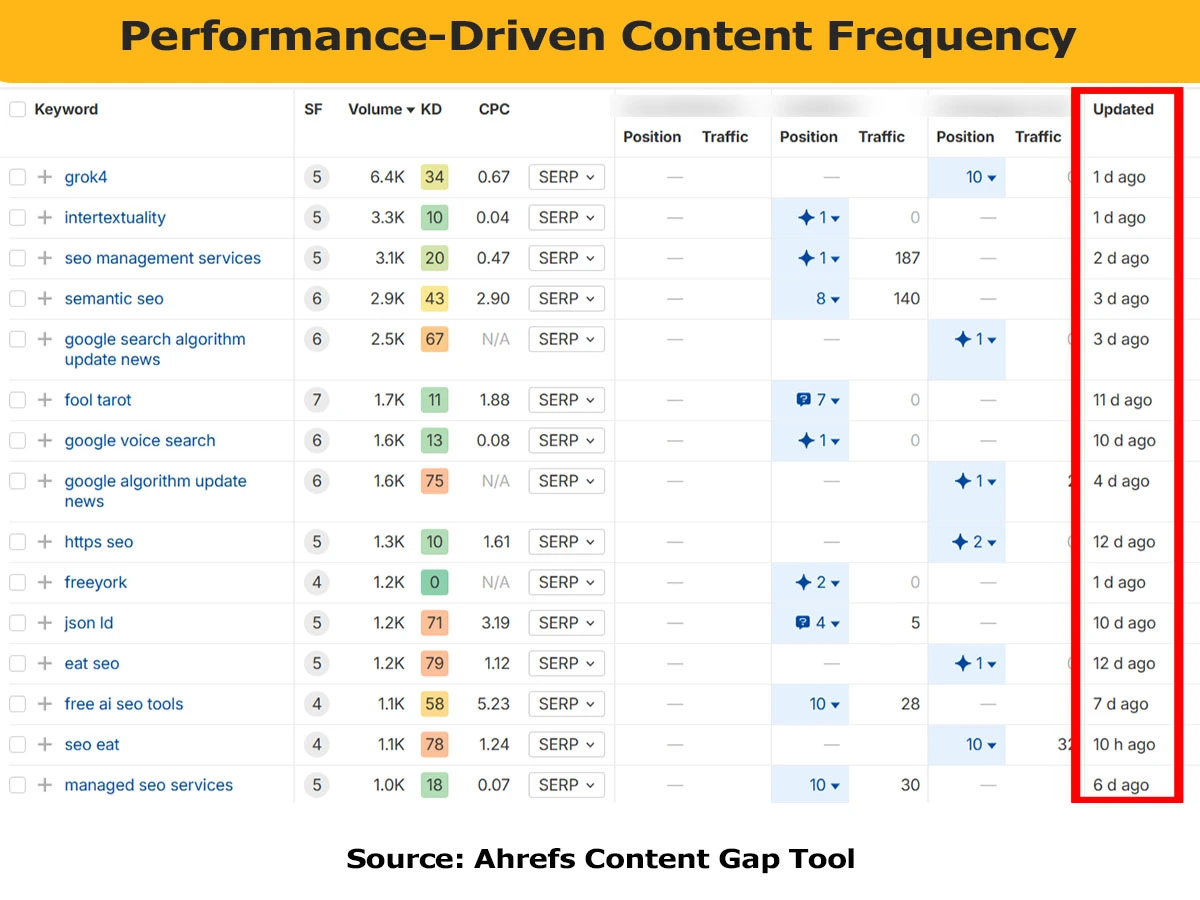
If I use a tool like Ahrefs, I notice that top-performing pages for a search query typically have a recent refresh date.
Content gap analysis is a strategic process used to identify missing, outdated, or underperforming content. It’s the process of comparing a website’s offerings with top competitors to determine the necessary update frequency.
For some niches and some topics, the frequency of refresh dates is a matter of days.
Know your niche and audience needs for content frequency
- High-Velocity (Update Monthly or Weekly):
- FinTech & Crypto: Market data, US tax code changes (IRS updates), and interest rate adjustments require near real-time accuracy.
- SaaS & AI Tech: With software versions and AI capabilities changing weekly, a “2024 guide” is already obsolete.
- News & Pop Culture: User intent here is strictly for the latest development.
- Medium-Velocity (Update Quarterly or Bi-Annually):
- Health & Wellness: While human biology doesn’t change, treatment protocols and US FDA guidelines do. Annual reviews are critical for E-E-A-T compliance.
- Digital Marketing: Best practices shift, but core principles often hold for 6-12 months.
- Low-Velocity (Update Annually):
- Legal (Statutory): Core laws change slowly, though recent court case precedents may need adding.
- History & Evergreen Education: The date of the Battle of Gettysburg doesn’t change, but how you present it (video, schema, modern parallels) might need a refresh to stay competitive.
For example, Healthcare & Wellness content for AI citations should be refreshed annually at a minimum. Public health is high-stakes in YMYL content. Search engines will deprioritize outdated content to ensure current accuracy.
This is due to increased scrutiny regarding E-E-A-T (Experience, Expertise, Authoritativeness, and Trustworthiness) and the use of AI in clinical workflows.
To boost E-E-A-T, provide clear authorship and job title information. Readers should reasonably expect accurate author bylines.
Leveraging reports with updated content frequency triggered my research on the difference between “content freshness” and “content frequency.”
A comparison of Content Freshness and Content Frequency
| Aspect | Content Freshness | Content Frequency |
|---|---|---|
| Definition | Refers to the timeliness and relevancy of content—specifically how “new” or “up-to-date” it appears to search engines and users. | Refers to how often a website publishes or updates its content over a specific period; a measure of volume and rhythm. |
| Focus | The “When” of the content. | The “How Often” of the strategy. |
| Scope | Recently published blog posts, updated product info, current news/press releases, modified service descriptions. | Your content calendar schedule (e.g., publishing one blog post every weekday). |
| Primary Goal | To satisfy ‘Query Deserves Freshness’, prioritizing recent data for time-sensitive topics. | To broaden the scope of topics covered, helping rank for diverse but related search queries and potentially attracting engagement. |
| Attribute Level | Page-Level: Often an attribute of an individual page’s data (e.g., last-modified date). | Site-Level: An attribute of the overall site activity and AI SEO strategy. |
| Ranking Influence | Google values quality; one well-written page updated monthly (high freshness) can outperform many poor pages. | Publishing more often (high frequency) does not guarantee ranking for time-sensitive queries if the content lacks freshness. |
| Interdependence | Is the result or status achieved by updates. | Drives the ‘freshness’ factor; consistent updates increase the site’s overall “freshness score.” |
Next, I’ll offer some practical action steps.
Regular Expression (regex) formulas to scan website’s HTML
<script type="application/ld+json">
{
  "@context": "https://schema.org",
  "@type": "Article",
  "headline": "Your Content Title",
  "datePublished": "2025-01-15T08:00:00Z",
  "dateModified": "2025-12-30T14:30:00Z"
}
</script>
To audit website metadata for content decay, use the following formulas to check source code for outdated publication and modification dates.
- To find content never updated since publication: <meta [^>]*property=[“‘]article:published_time[“‘]<]*content=[“‘](?:20(?:0\d|1\d|2)-\d{2}-\d{2}|2025-(?:0)-\d{2})T This formula specifically targets content published between 2000 and 2024, as well as the first five months of 2025.
- To find content last updated before a specific date: <meta [^>]*property=[“‘]article:modified_time[“‘]<]*content=[“‘](?:20(?:0\d|1\d|2)-\d{2}-\d{2}|2025-(?:0)-\d{2})T This formula scans for modification dates that fall outside of your current maintenance period, signaling potential knowledge decay.
Schema Markup Opportunities
To signal “freshness” and “relevance” to AI, specific schema feeds Large Language Models (LLMS) needed information.
Recommended SEO schema strategy:
- Article Schema with dateModified: This is the strongest technical signal for freshness. Ensure the dateModified field is updated only when significant changes are made.
- FAQPage: Since users are asking longer, specific questions and follow-up questions, wrapping your “Common query types” section in FAQ schema can help you appear in conversational AI results.
- Speakable: As search evolves to handle voice queries, this markup identifies sections of the article best suited for text-to-speech playback on assistants.
Below is some of the market research prompting my writing this article.
Statistics Demonstrating The Value of Creating and Maintaining Fresh Content
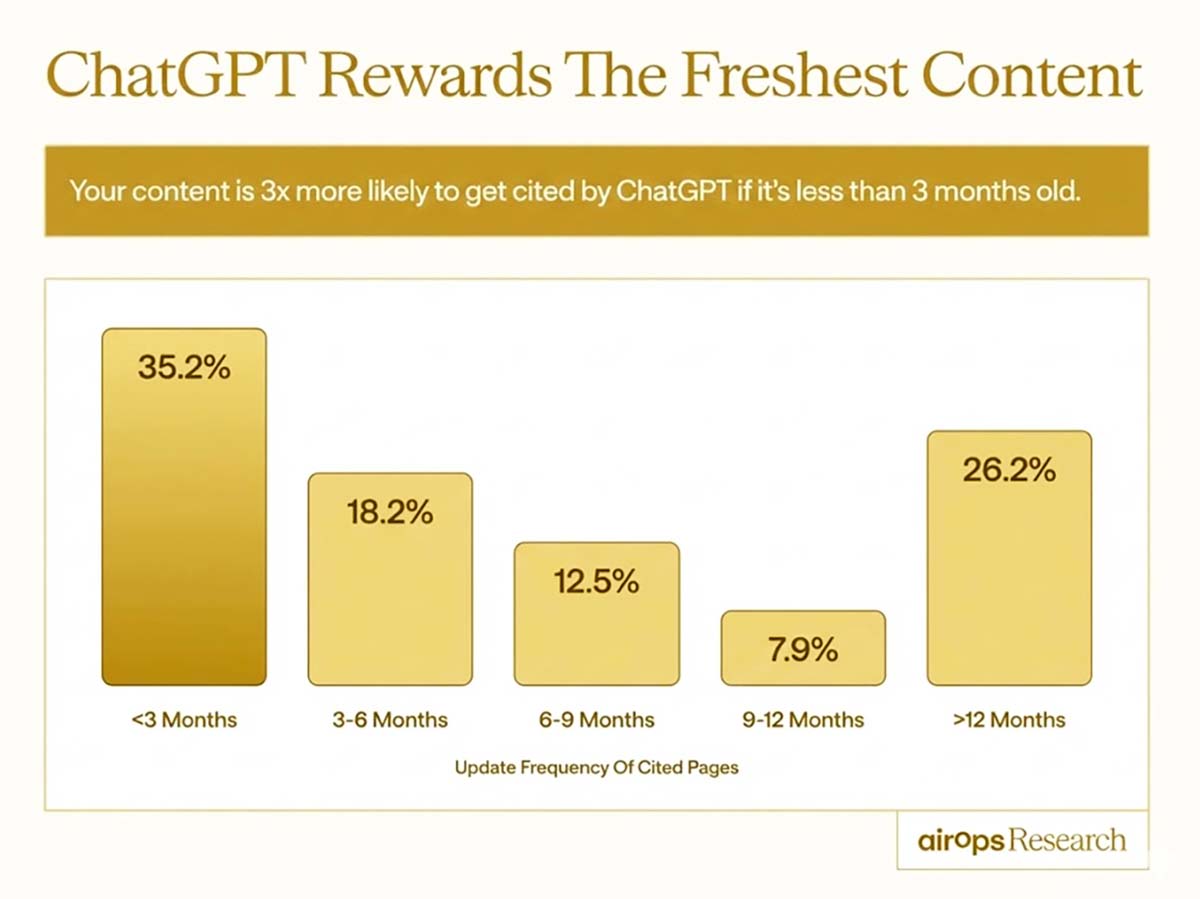
- Oshen Davidson stated on August 4, 2025 that “Over a third of AI citations go to content updated in the last 3 months.” See The Silent Pipeline Killer: How Stale Content Costs You AI Citations (and Customers)
- Approximately 26% of all winning content gets regular updates (within 3 months) to stay relevant and accurate. [1]
- High-quality, long-form evergreen content can generate traffic for 24+ months, with 57% of marketers identifying it as their top-performing content type. [2]
- Throughout 2025, long-form content (1,500–3,000+ words) continued to dominate as the most effective format for long-term SEO and best user engagement. [2]
- Over 70% of pages cited by ChatGPT were updated in the past year. [4]
- Over 30% of cited Healthcare and Wellness content was refreshed in the past six months, signaling growing urgency as competition for AI visibility intensifies. [5]
Proof that Fresh Content Boosts AI Rankings
An early signal of this freshness concept, Hill Web Marketing, was watching our client’s Google Insights reports. I noticed that the frequently visited pages were either new or newly updated. In other words, more recent publications garnered the most impressions and clicks.
Google documentation does not list “freshness” as a specified requirement for AI rankings beyond its existing role in traditional search. While Google claims no special treatment, external research shows that freshness significantly affects AI citations, often more than it does traditional organic search results.
We do the research for you: “LLM Freshness Signals”
- Textual cues: Models look for “as of” statements, version labels (e.g., “2025 edition”), and changelogs to determine if a source reflects the current state of the world.
- Technical metadata:: Machine-readable fields like dateModified in structured data help retrieval systems prioritize newer facts over older ones.
- Query Deserves Freshness: Assessing your trending or time-sensitive topics, AI systems intuitively favor the latest results because users expect current information.
“I recently audited a client in the healthcare sector where we saw a 28% drop in traffic on a key page that hadn’t been updated in 11 months. Once we refreshed the statistics and schema along with adding recent news, traffic recovered within 3.5 weeks.” – Jeannie Hill
Additionally, I’ve used NotebookLM to add infographic, video, and data tables for new multimodal components. It’s important to benchmark changes and then watch your data reports to determine impact.
Your Top Take-Away
The sites that consistently update their best-performing content stay visible while competitors slowly fade from rankings. The compounding effect of regular updates—better rankings, more traffic, increased AI citations, and fresh backlinks—makes this one of the highest-ROI SEO activities you can do.
Answers to Common Questions
What is Query Deserves Freshness (QDF)?
Query Deserves Freshness (QDF) is a Google algorithm concept that prioritizes newer, up-to-date content in search results for topics experiencing a sudden surge in interest. Examples are: breaking news, trending events (sports, music), or product launches. The goal is to ensure users receive the most relevant, timely information rather than outdated pages.
It flags queries where freshness is crucial, elevating recent articles, press releases, and updates over older, established pages to meet immediate user needs. [3]
How often should content be updated?
Our research signals that an every 3 months cadence is typically ideal for keeping pace with industry shifts. High-stakes or rapidly changing topics may need even daily updates. At a minimum, conduct a content audit every 2-3 months to gauge audience interest and competitive levels.
Rather than a one-time task, conduct this audit regularly to keep content timely and competitive.
What key indicators signal that a content update is needed?
Key indicators for prioritizing updates include:
- Dropping traffic: Articles experiencing a decline in organic traffic (month-over-month or year-over-year) should be prioritized immediately.
- Ranking decay: A consistent decline in SERP positions for your target keywords suggests that Google or AI assistants no longer view your content as the most relevant or timely answer.
- Page falls out of Google’s index: Check your Search Console report to know how many pages are indexed
- Query gaps: Important search queries your competitors rank for, but you do not.
- Topical gaps: Missed audience needs, missed opportunities to answer questions, or stages of the buyer’s journey.
Is the “Stale Content Penalty” real?
The “stale content penalty” is a real phenomenon in SEO, even if not an officially named Google penalty. However, it is best understood as a ranking decline due to lost relevance, rather than a formal, manual penalty from AI Search.
While there is no manual ‘stale penalty,’ content relevance is key. Even the best content can be disappointing if people arrive at a page that is cluttered or difficult to navigate.
Search evolves because peoples’ needs are always evolving. If your content remains static while needs shift, you lose visibility
SUMMARY: Evolving with Your Users
The shift to AI-powered retrieval isn’t just about technology; it is about satisfying users who are now asking longer, more complex questions. While frequency matters, it must never supersede value.
By combining a consistent “freshness” strategy with unique, people-first insights, you position your brand to serve the high-intent visitors that AI experiences deliver.
Call 651-206-2410 Schedule Your AI Visibility Audit Today
Resources:
[1] Ryan Law, “New Study: AI Assistants Prefer to Cite ‘Fresher’ Content,” July 2025, https://ahrefs.com/blog/do-ai-assistants-prefer-to-cite-fresh-content/
[2] Bill Nash, “Long-Form Content Statistics 2025,” Nov 2025, https://marketingltb.com/blog/statistics/long-form-content-statistics/
[3] Google, “A guide to Google Search ranking systems,” Last updated 2025-12-10, https://developers.google.com/search/docs/appearance/ranking-systems-guide
[4] Grace Harmon, “Fresh content boosts visibility in genAI and ChatGPT results,” October 2025, https://www.emarketer.com/content/fresh-content-boosts-visibility-genai-chatgpt-results
[5] Pam Landis, “The Battle for Healthcare Brand Visibility in the Age of AI-Powered Search,” December 2025, https://ehealthcarestrategy.com/the-battle-for-healthcare-brand-visibility-in-the-age-of-ai-powered-search/
One reply on “Content Freshness”
[…] Hill Web Creations — Content Freshness […]