
Multisearch With AI Generated Answers: A Broader Scope
Written by Jeannie M. Hill | Updated 11.10.2026
The future of search marketing is clear; businesses should diversify their search strategy beyond Google
Multisearch can mean getting past a singular focus on optimizing for Google Search. We’re at a significant time of pivot with a new digital landscape, ignited by new AI technology in combination with government regulations putting pressure on Google’s monopoly.
This article will answer how digital marketers, content creation managers, and SEO professionals can prepare for the future of search. It covers connecting with your target audience more effectively and capitalizing on the growing influence of visual search in shaping online discovery and click conversions in AI search that lead to purchasing decisions.
It requires updates to your content marketing strategy, tracking and measurement, as well as monitoring your agility to engage practical methods to increase conversions.
Table of Contents
- What is Google Multisearch?
- Adapt Your Web Content Beyond Text
- How Gen AI-Powered Multisearch Works
- The Difference Between Multisearch, Multichannel, Multitouch and Omnichannel Marketing
- The Future of Search Is AI-Powered
- Multifocus Marketing for Multimodal Reach
- How Google Multisearch Impacts SEO Strategy
- Thinking Long-Term About Multisearch
- Frequently Asked Questions About Google Multisearch & AI-Generated Answers
- Conclusion: Helping People Gain More Relevant and Precise Search Results
What is Google Multisearch?
Multisearch is an enhanced Google search feature that was introduced in April 2022 [1]. It utilizes artificial intelligence (AI) to help users find whatever they are searching for.
The intent is to answer the user’s question without the need to navigate your way through multiple results and sources. Rather, this form of AI Generated Answers has already vetted and surfaced what Google believes are the best related responses that match your query.
Being featured when Google AI Overview answers is one thing; gaining consistent URL placements within them – that people engage with matters more. Lens and Circle have become a powerful aspect of Google image search. I’m taking the concept of “multisearch” to a broader approach to marketing in general.
Interactive Audit: Is Your Page Ready for Google Multisearch & Visual AI Answers?
Paste any page URL below and click Scan Multimodal Signals. This diagnostic tool inspects your live page and checks off the 6 technical signals required for Google Lens, Circle to Search, and AI Overview citations:
6-Point Multisearch & Visual Entity Checklist:
1. Descriptive Image Alt Text & File Naming (20 pts): Awaiting URL scan…
2. High-Resolution ImageObject & OpenGraph Metadata (20 pts): Awaiting URL scan…
3. Entity JSON-LD Schema & Knowledge Graph Links (20 pts): Awaiting URL scan…
4. Multimodal “Content Sandwich” Passages (15 pts): Awaiting URL scan…
5. Structured Lists, Tables or FAQ Markup (15 pts): Awaiting URL scan…
6. Clean Heading Hierarchy (No Images Inside H2–H4) (10 pts): Awaiting URL scan…
Status: Paste a page URL above and click Scan Multimodal Signals to evaluate visual entity and AI answer readiness.
Leverage Visual Search Trends
Based on data, your winning efforts can scale you forward. Efficient marketing research to determine your traffic potential of the best AI Answers may leverage NotebookLM or another Generative AI tool. It will take a savvy human to look at the data to determine accuracy, usefulness, and which insights to implement.
The introduction of Multisearch underscores the concept that SEO is an ongoing process that requires adaptation to changing user behaviors and search technologies. Staying informed about new features, testing different optimization techniques, and monitoring search performance are crucial for maintaining visibility and relevance in the evolving search landscape.
Adapt Your Web Content Beyond Text
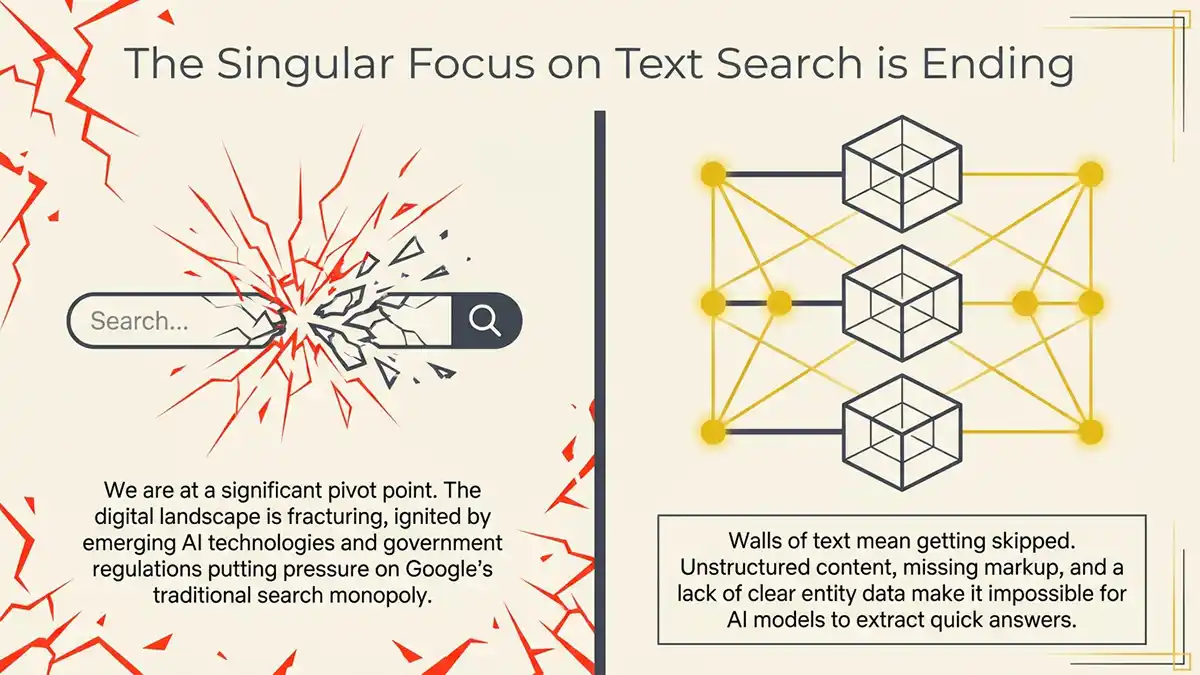
- Structured Data & Knowledge Graphs: Implement schema markup (JSON-LD) and enterprise knowledge structures so AI models understand your products, services, and entity relationships.
- Visual & Video Optimization: Use descriptive human-readable file names, detailed alt text, captions, transcripts, and structured content “sandwiches” around images and videos so multimodal AI can index and cite them.
- External Validation & E-E-A-T: AI platforms look for consensus and trust across independent reviews, mentions, and authoritative ecosystems rather than just self-promotional copy.
- Enriched Content (move past walls of text): Walls of text mean getting skipped in AI Search. Unstructured content, missing markup, and lack of clear entity data make it hard for AI models to parse or extract quick answers from your site.
Multisearch relies entirely on semantic search architecture to unify diverse data formats into a single, cohesive intent.
It works best for brands with limited resources that wish to test or maximize AI visibility and effectiveness on specific, high-performing platforms.
Rather than treating a text phrase and an uploaded image as separate, disconnected queries, emerging AI search capabilities utilize advanced semantic frameworks to bridge the gap. Semantic technologies power and support multisearch in multiple ways.
Entity and Context Recognition
Multisearch queries are inherently vague without contextual grounding. If you point your camera at a plant and type “care instructions,” the text itself contains zero identifying information.
- Knowledge Graphs: Semantic engines pass the image through an object-recognition layer integrated with Enterprise Knowledge Graphs.
- Intent Extraction: The semantic layer identifies the specific plant genus (the entity) and pairs it with the user’s intent (“care instructions”). This ensures the engine returns watering schedules and sunlight needs instead of shopping links to buy the plant.
How Gen AI-Powered Multisearch Works

Anyone can now use their camera to point at an object, ask questions about it, and receive AI-generated answers. You have two major ways to tap into a web of knowledge — including many web pages in Google’s index — but they display results in a different format.
Ways to use Google Multisearch
- Lens: Lens takes users a step further. You can ask questions about the image you’re searching for and obtain AI generated answers from multiple sources. Google includes a button in some local panels and Google Business Profiles, that says “Search Products With Camera.” You can use it to “search your screen.” Google Lens makes it happen. The image-based, AI-powered Google search tool lets people use Google search using image uploads and links or from a camera app.
- Circle to Search: It’s quick and easy to search without switching apps by circling an image, text, or video. Bingo! You get quick answers using AI. And it works for users who don’t even think of “AI”!
Rapid Adoption of Google Lens & the Shopping Graph
“Lens is used for nearly 20 billion visual searches every month, and 20% of those searches are shopping-focused,” according to Lilian Rincon, Vice President of Google Product Management, in New ways to holiday shop with Google Lens, Maps and more [2]. In the November 9, 2024 article, Lilian Rincon shares how shoppers can quickly snap a photo to find product information, similar products in-stock, whether a store’s price is competitive, and related reviews. Building on its foundation of over 35 billion listings refreshed at 1.8 billion per hour, I recommend staying current on how Google’s Shopping Graph evolves.
By 2026, the Shopping Graph expanded to cover 45 billion+ product listings, pairing live in-stock inventory data from retailers with Google’s Gemini models to give shoppers an entirely new way to shop in-store. With 72% of Americans using their smartphone while shopping in-store—and more than half leaving empty-handed because they lacked the confidence to buy—bridging online visual discovery and offline inventory is essential for closing gaps in your question-answering content.
For local businesses, we find great success with Google’s Multisearch “near me” queries. Multisearch, particularly the “near me” aspect, has significant implications for local business findability. By empowering users to search for products or services visually and then refine their search based on proximity, Multisearch bridges the gap between online discovery and offline action. It can help cover your gaps in your question answering content.
Practical example:

Google multisearch can assist you by removing irrelevant results and providing more precise results. For example, if you want to buy an antique table lamp to match your interior decor, you can upload a photo of one you already have or like and type ‘antique table lamp’ into the search box, along with preferred colors and other dimensions. The screen will show the best matching combination as well as information such as price, brand, where to buy it, and so on.
User-Focused Applications for Healthcare Businesses
Below are tips on how to leverage multisearch effectively for a healthcare site to leverage AI answers:
- Symptom Visualization: Users can upload images of skin conditions, rashes, visual injuries, etc., and supplement with a text comments of the symptoms. It triggers a more detailed search compared to a text-only description of a medical condition.
- Medication Identification: Let people upload a picture of a prescription capsule and add keywords like use, color or shape. This is beneficial to quickly identify unknown medications, a helpful feature for both patients and medical professionals.
- Visual Anatomy Guides: Healthcare entities can integrate multisearch into detailed anatomical charts. A patient could take a picture of a body part and add text specifying their question like “pain” or “impact,” providing contextual details within the search.
- Medical Equipment Search: Users can search for medical equipment (casts, oral appliances, hearing or mobility aids) using an image along with descriptive terms for faster, more focused product searches.
- Web Accessibility: Multisearch offers alternative forms of content engagement. People with visual impairments or difficulties describing medical issues textually find multisearch and access information much easier via a visually-led search.
The work involved can quickly pay off by improving B2B lead generation and direct to consumer conversions.
Many who are new to this marketing approach find it confusing to grasp new marketing phrases. I’ll explain a few that I use and summarize what they mean. While multisearch is a feature within Google Search, the other three terms – multichannel, multitouch, and omnichannel – are marketing strategies. You may use all of these; however, you need an overarching strategy that makes things closer to the state of optimized.
The Difference Between Multisearch, Multichannel, Multitouch and Omnichannel Marketing
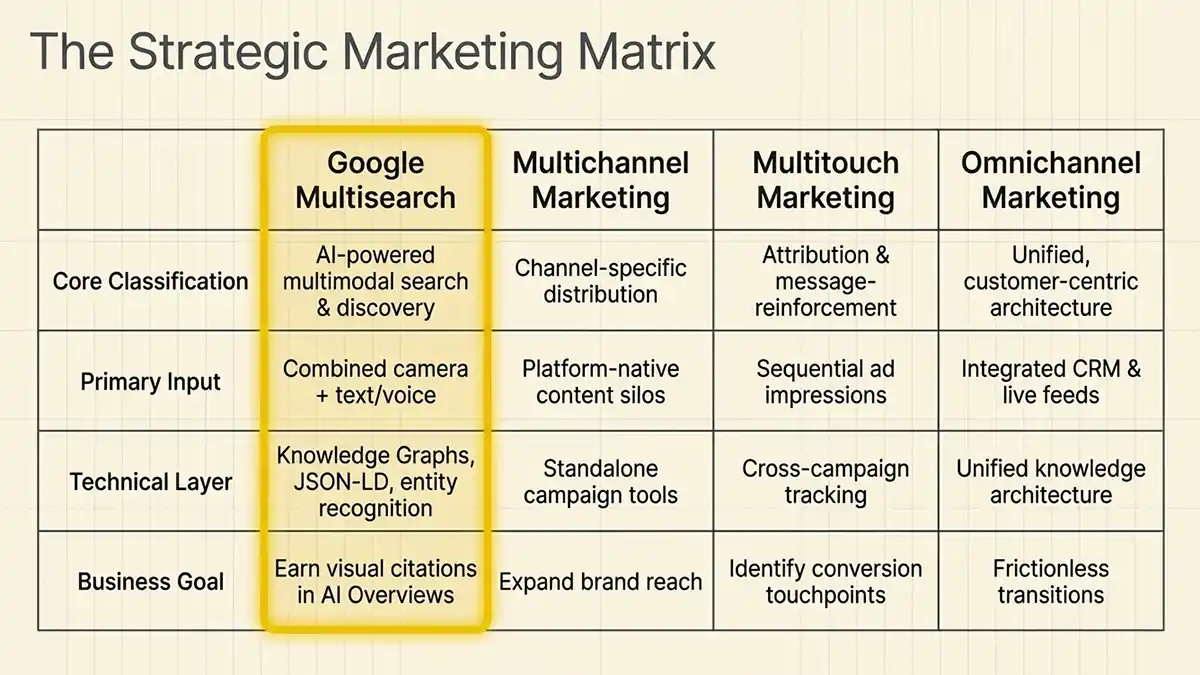
Multisearch, multichannel, multitouch and omnichannel marketing are effective, individual strategies that use multiple digital channels to reach customers; however, they differ in their approach and goals.
Multichannel marketing
Uses a limited number of channels to reach separate audiences, and focuses on engagement within those channels. Multichannel marketing can be a good option for businesses with limited resources. However, it can be difficult to manage separate campaigns across multiple channels, which can lead to a disjointed customer experience.
Multisearch
Uses Google’s AI to improve browsing and searching, which can help elevate a brand’s web presence. Google introduced Multisearch in April of 2022 [1]. Multisearch allows users to search with both images, voice, and text individually or at the same time. With Multisearch, you can ask a question about an object in front of you using your camera and/or voice. The tech giant continues to develop new AI models in Search with the intent of providing better AI generated answers that are more accurate.
Omnichannel marketing
Uses all available channels to reach customers, and focuses on creating a seamless customer experience across all touchpoints. Omnichannel marketing uses data and automation to anticipate customer needs and deliver personalized interactions. Omnichannel marketing aims to provide a more fluid customer journey by considering the needs of customers and reaching them where they are.
Multi-Touch marketing
Multi-touch campaigns reach your target with a consistent message in a variety of formats to reinforce your brand and message.
Summary of the differences:
- Multisearch enhances the search process by allowing users to refine their queries with images and text.
- Multichannel marketing expands the reach of marketing efforts.
- Multitouch attribution helps analyze the effectiveness of various marketing touchpoints.
- Omnichannel marketing takes a holistic approach to create a consistent and personalized customer experience across all interactions.
| Dimension | Google Multisearch | Multichannel Marketing | Multitouch Marketing | Omnichannel Marketing |
|---|---|---|---|---|
| Core Classification | AI-powered multimodal search capability & discovery behavior. | Channel-specific distribution strategy across separate platforms. | Attribution and message-reinforcement strategy across buyer touchpoints. | Unified, customer-centric experience architecture across all touchpoints. |
| Primary User / Data Input | Combined camera/image upload + natural-language text or voice refinements (Google Lens, Circle to Search, AI Mode). | Platform-native content (search, social, email, display) managed in separate silos. | Sequential ad impressions, content views, and conversion events tracked across sessions. | Integrated first-party CRM data, live local inventory feeds, Google Business Profile (GBP), and web/app history. |
| Underlying Technical Layer | Enterprise Knowledge Graphs, Schema.org JSON-LD, Google Shopping Graph (45B+ listings), and entity recognition. | Channel-specific publishing tools and standalone campaign analytics. | Multi-touch attribution modeling and cross-campaign conversion tracking. | Unified knowledge architecture, Merchant Center feeds, and cross-channel automation. |
| Primary Business Goal | Earn visual + conversational citations in AI Overviews, AI Mode, and “near me” visual product/service lookups. | Expand brand reach on high-performing platforms with limited resources. | Identify which sequence of touchpoints drives qualified leads and sales. | Deliver frictionless transitions from online visual discovery to in-store or digital conversion. |
What it really comes to is the press to expand and deepen marketing efforts to maintain a lead in the future. AI generated answers will shrink most everyone’s number indexed pages. The competition is fierce, and the move is away from the website being the central source of truth about who you are. Google compiles all that it knows about you, and if trusted, it favors showing your web answer in your Google Knowledge Panel.
Marketing agencies can utilize a first-party data strategy within a holistic marketing approach.
The Future of Search is AI-powered
This means radical adjustments for many sites to be fully prepared. Multisearch can help you get featured in new Question Answer SERPs.
It requires understanding how Google AI search works. Multisearch requires building a strong brand to surface across multiple channels and search engines. Being featured in future AI-powered search engine result pages (SERPs) is neither a one-step process nor a one-time effort. It is definitely harder and needs a long-term commitment.
By staying on top of opportunities, you can surface in emerging AI generated answer SERPs for shoppers using AI Agents.
Multifocus Marketing for Multimodal Reach
A multifocus marketing approach entails enhancing audience discovery and engagement with content across multiple viewing platforms.
Technically, “multisearch” is a search feature, versus a marketing strategy. However, as a marketer, I’m taking it beyond Google’s “multisearch feature” and applying it to an overarching approach. In my opinion, digital success in 2026 and beyond means pursuing broader multisearch applications than just the Google platform. By “multiple viewing platforms,” I’m thinking of multiple search engines, devices (smartphones, laptops, tablets), and online platforms (websites, social media, apps). After testing, you can turn off your money waster and dial up what’s effective.
How Google Multisearch Impacts SEO Strategy
Your integration and consistency across channels, moving beyond mere “discovery” to create a unified customer experience is important. It should involve consistent interactions and data integration across all touchpoints, including business planning, SEO teams, customer support, sales, and marketing efforts.
For many products and services, this means marketing to Gen AI buyers. To reach an audience that is broadly representative of relevant users, emphasis should be given to media such as television, gift-packs, in-store displays, and maybe even printouts. However, reaching your active audience through an AI multisearch approach is likely the most effective.
Embrace the broader implications of visual search to reach consumers. Incorporate the principles and opportunities presented by Multisearch. It begins with prioritizing qualifying, high-quality, relevant images. Since Google’s Multisearch leverages images as a primary input, ensuring your website has visually appealing and correctly formatted images is crucial. Think beyond product photos and consider incorporating owned media that represent your services, brand values, community engagements, and customer experiences.
Thinking Long-Term About Multisearch
It’s best to predict and anticipate how search behaviors may evolve. As AI technologies become more mainstream, consider how your marketing approach can adapt to new ways that users experience and interact with information. It is not push-button simple.
Remember, a successful multisearch-focused marketing approach requires a holistic mindset. This means considering new features, technical aspects of search optimization, optimizing for Knowledge Panel question answering, and user’s seeking a seamless and informative experience. How do they react to things? What aspects of search do they take action on? What leads to successful conversions?
You cannot afford to miss the user conversation. Multisearch means embracing the principles of visual search, local SEO, and diverse content creation. AI is one tool to help you enhance your marketing efforts and connect with your audience in more engaging and meaningful ways.
Structured data feeds directly into your AI-populated knowledge graph, allowing Google to showcase specific details in its Multisearch. The AI Answer Feature in Google’s search results incorporates generative AI answers as an alternative to visiting websites. Its AI answer typically takes 5-10 seconds to pop up after typing a search query. Users then have the choice to read AI answers or click on website links. Either way, go for being there!
Frequently Asked Questions About Google Multisearch & AI-Generated Answers
How does Google Multisearch combine images and text to generate AI answers?
When a user photographs an object with Google Lens or circles an item on their screen and adds a text or voice question, Google passes the visual input through an object-recognition layer tied to its Knowledge Graph and Shopping Graph. It identifies the specific entity first, then applies the user’s text modifier to synthesize a targeted AI Overview or AI Mode response.
How do local businesses capture “near me” traffic from Google Multisearch?
Local businesses win visual “near me” searches by pairing high-resolution, original photos and clean Product/Service schema on their website with an actively maintained Google Business Profile (GBP) and synced local inventory feeds. This allows Google to verify real-time local availability when nearby shoppers snap a photo of a product they want to buy today.
What is an image “content sandwich” for multimodal SEO?
A multimodal content sandwich surrounds an optimized image or video with a descriptive heading above it, human-readable file naming, detailed alt text, and a concise 2–4 sentence explanatory passage immediately below it. This contextual grounding helps multimodal AI models accurately index the visual entity and cite your page in synthesized answers.
How can healthcare organizations use visual multisearch safely?
Healthcare organizations can publish high-resolution anatomical diagrams, FDA-verified medication identification guides, and durable medical equipment visuals paired with structured MedicalWebPage schema and clear educational passages. All public educational assets and search tools must operate purely on public clinical knowledge without collecting Protected Health Information (PHI).
What is the difference between Google Multisearch and omnichannel marketing?
Google Multisearch is an AI-driven search modality that lets users query with images, voice, and text simultaneously, whereas omnichannel marketing is a broader business strategy that unifies customer data, inventory, and messaging across every digital and physical touchpoint. Optimizing for multisearch feeds high-intent visual discovery directly into your omnichannel funnel.
Google’s evolution into an AI-powered answer engine has fundamentally changed how content surfaces.
CONCLUSION: Helping People Gain More Relevant and Precise Search Results
The past two years let us experience the Generative Web (Text-to-X). It radically changes the ways people create, find, and consume content online. While Google (and people) prefer human-generated content, multisearch is revolutionizing marketing strategies, journalism, SEO, and content marketing. Hill Web Marketing can help you create helpful content that users engage with in multiple ways.
At the get-go, we analyze organically ranking URLs where you show up and visual search and AI Overviews.
Call 651-206-2410. Request your AI Overviews Assessment
Resources:
[1] April 2022, https://blog.google/products/search/multisearch/
[2] Nov 2024, https://blog.google/products/shopping/google-maps-lens-holiday-shopping/