Human-Reviewed AI Answers That Drive Customer Conversations
By Jeannie Hill
Craft a Knowledge Graph that feeds Google and LLMs verified, high-quality answers. Our AI Answer Optimization (AIO) service helps your content earn SERP citations, drive conversions, and ignite customer conversations.
Generative AI Answers can deliver instant answers from your company’s knowledge base. Brand entities focused intensely on ‘selling’ over providing helping content will likely find that they are missing among vast Question-Answer search engine result pages (SERPs).
The remarkable advancing pace of conversational memory in multi-turm, stateful search is built on data foundations.
Table of Contents (Click to expand)
- AI Answers: How they Impact Content Publication
- Google Improves Bard’s Answer Accuracy with Search Injections
- AI Content Marketing Workflows to Win Answer SERPs
- Concern for Fake or Misleading AI Answers
- AI-powered Responses With AI Mode
- How Google AI may Formulate Quality Answers
- Generative AI Answer Outputs Need Human Reviewers
- SUMMARY: AI Answers Can Ignite In-Person Conversations
Success in these technological advancements boils down to the quality of that data and your prompt refinements. An AI SEO strategist can use the correct data when combining generative AI, search, and content marketing when publishing question-answer content.
Key Takeaways: How to Show up in AI Answers
Here is what you’ll learn:
- A content marketing workflow for citations in SERP answers
- How to formulate quality answers
- How to answer the most important questions
- The place for human reviewers
- How to encourage in-person conversations in a AI sphere
Search Engine Results Page (SERP) Provide Direct, Concise AI Answers
You can create better answers once you realize that most using AI rely primarily on internet-based information. This article helps you gain citations in synthesized answers that can show up in this sea of data.
“Getting the answer right could mean the difference between higher sales or losing to the competition. But new Wharton research shows that 57% of marketers are incorrectly crunching the data and potentially getting the wrong answer — and perhaps costing companies a lot of money.” – What Marketers are Doing Wrong in Data Analytics [1]
Google Improves Answer Accuracy with Search Injections
A Google October 5, 2023 publication talks about how “in-context learning is an appealing alternative in which real-time knowledge can be injected into an LLM’s prompt for conditioning generation.
Work to further augment LLMS with web search results (Lazaridou et al., 2022; Press et al., 2022), hopes to improve Google Search outputs by improving LLM factuality.
“Most large language models (LLMS) are trained once and never updated; thus, they lack the ability to dynamically adapt to our ever-changing world. We introduce FRESHQA, a novel dynamic QA benchmark encompassing a diverse range of question and answer types, including questions that require fast-changing world knowledge as well as questions with false premises that need to be debunked.” – Refreshing Large Language Models With Search
The Google study identifies Question-Answer retrieval types.
Question-answer retrieval classified into categories:
- Never-changing: in which the answer almost never changes.
- Slow-changing: in which the answer typically changes over the course of several years.
- Fast-changing: in which theanswer typically changes within a year or less.
- False-premise: which includes questions whose premises are factually incorrect and thus have to be rebutted.
AI prompt engineering skills are vital to produce quality content
Prompt engineering is more about knowing “how Google or GPT4 thinks” and how the latest algorithm works.
May 12, 2023, the Global VP of AI & Business Solutions at Google Cloud Philip Moyer indictated that it’s possible to get fresh answers with the right retrieval methods.
“For…frequently-changing data, organizations can limit the information the model considers. Rather than asking the model to devise answers from training data, they can direct it to specific sources that are constantly refreshed.” – The Prompt: Invest in AI platforms, not just models + a recap of Google I/O [5]
THE CHALLENGE / OUR SOLUTION
AI Content Marketing Workflows to Win Answer SERPs
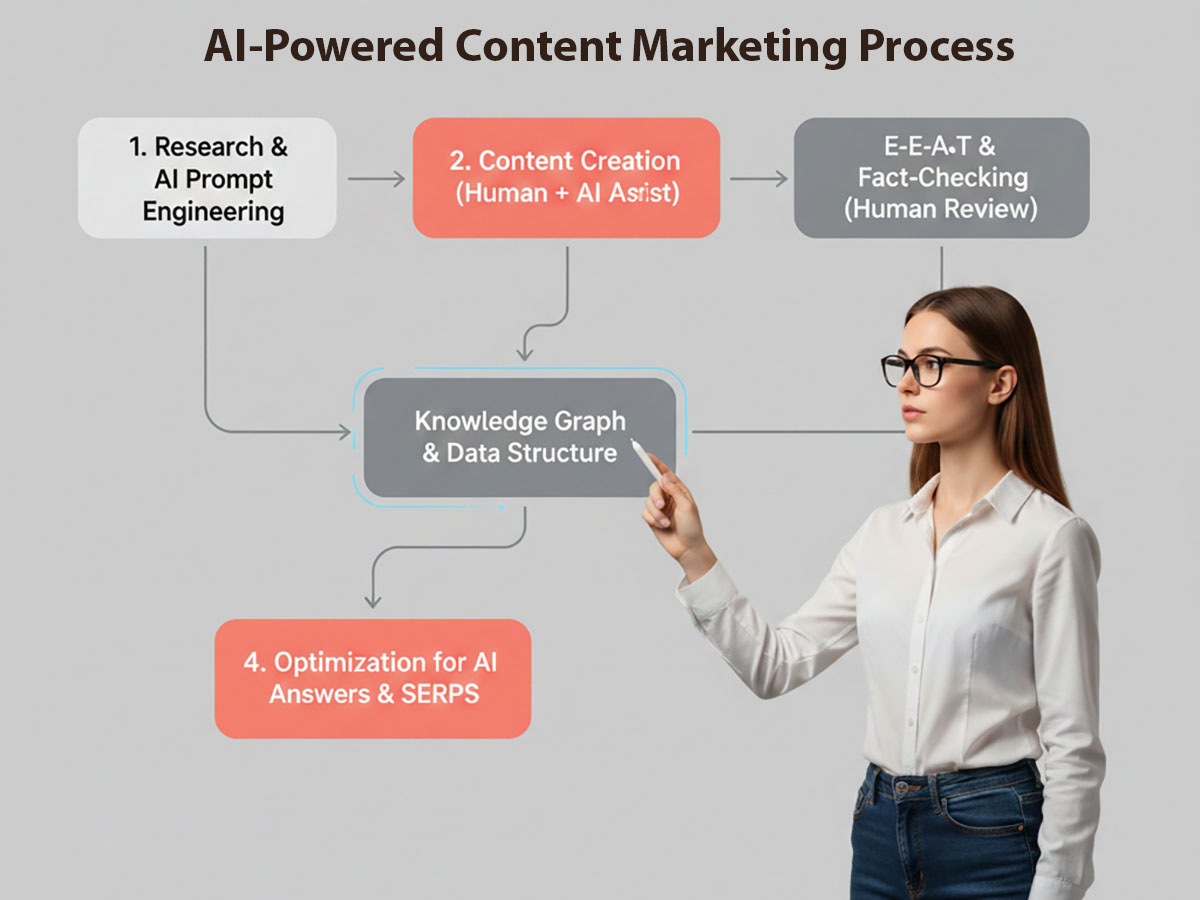
AI can augment content workflows and editoral processes to increase chances of your answers displaying on the SERP.
AI makes it easier for everyone to produce content faster. However, it cannot include your tone, personality, and answers drawn form your personal experience. Search engines are evolving to sort out low qualtiy AI generated content from high-quality, human edited content. AI can enhance productivity.
With the jump in content production and publication, we help you find and distribute your digital assets with increasing accuracy and efficiency.
Turn your AI-answer rich content and creative teams — enhanced with AI technology — into a workable process. Our solutions increase content ROI through a robust Google Knowledge Graphs’ question answering section.
Augmenting Content with an AI Question Answer Generator
Note of caution: An AI Question Answer Generator should be used to augment your content but not to replace the human expert. Large Language Models that are combined with a Topic Model will analyze specifc documents versus whatever is published on the web.
The trend towards direct AI answers is affecting website traffic. With people finding answers directly on SERPs, it lessens their need to click through search results to gain information. This change leads some to believe it causes declining organic website traffic.
Now you understand more about the workflow for augmenting AI answers and some useful tools. What else is critical to know?
Prompt criteria for AI answer optimization
Significant funds and research are continually invested to improve Artificial Intelligence Answer optimization methodology. Better AI question-answering entails the generation of fresh prompts, all with the singular goal of enhancing answer accuracy.
Your prompts provide key criteria that will refine output responses. Take SEO best practices into account when preparing your prompts and specify that it only outputs factual answers. This should improve answer quality. These models will generate text as an extrapolation from your prompt.
Google’s FRESHPROMPT introduced the capability to respond to a specific question, by extracting all up-to-date and relevant information (including knowledge from relevant questions that search users also ask).
The effectiveness of your prompt is a core part of how Google and other companies deliver current and factual AI-generated answers.
Here are several types of Google Search results for one query:
- The answer box.
- Organic results.
- AI populated knowledge graphs (KG).
- Questions and answers from crowdsourced QA platforms.
- Related questions that search users also ask.
One thing we are confident of, Google Search will continue to test and display evolving question-answer SERP types.
What AI answers mean for your content strategy
Every business entity needs a flexible and applicable marketing strategy that can adapt to a variety of scenarios. Skip the pain of investing your marketing efforts to people without money, interest, or incentive to contact you. Rather, answer your audience’s burning questions.
We find queries asking “What is the AI that answers questions?” From a search engine perspective, they real question may be “what is the AI website that answers questions?” How does you website perform for Google’s Answer Engine?
While attempting to future-proof your business by introducing a culture of experimentation with AI may feel perilous. The solution is to know how to apply the right knowledge.
Managing Concern for Fake or Misleading AI Answers
Without humans involved in content creation, it means consumers engage with AI bots for answers
If you rely on generative AI for creating your QA content, you are responsible for its accuracy. We believe this can be done and accomplished responsibily with the right workflows in place. It means managing AI Risk and ensuring factuality (E-E-A-T).
So, does this apply to all niches’ content creation processes?
Health-related articles have experiences a noticeabe decline during Google’s recent algorithm update. Observing which health sites were hit includes those who failed to clarify the difference between a “health fact”, a “health claim”, and a strongly stated health opinion.
For example, if you state “This cake recipe is gluten-free,” it is not a health claim. It’s a health fact. The sum of the ingredients are either “gluten-free” or not. Writing for anyone with Celiac disease is a Your Money Your Life (YMYL) article and must not mislead readers. Someone may get really sick if you are not facutal.
Whether you miss proper fact and claim document support – accidentally or intentionally – can impact your site’s AI content marketing effectiveness. Always have a human editor double or triple check for AI answer hallucinations.
Google helpful content system guidelines stress asking yourself, “Does the information make you trust the author by means of clear sourcing or verifiable information?”
AI-powered Responses With AI Mode
Providing answers is occuring right on the SERPs. Or if not, your competitors are using Conversational AI strategies
A good approach for your content marketing strategy is to realize that search is becoming conversational. The Google AI Mode lets people explore further. Directly under the snapshot is the option to “ask a follow-up question” or click on a suggested next step. This opens up a conversational mode.
Retailers are happy to see ads now displaying in AI answers. And Google explained they will be further testing sponsored content and intends to further simplify SERPs.
Also, redundant local pack displays now show fewer results if it avoids repeating what Google showed directly above in its AI-powered answer. Google would show a “three pack” in the main traditional search results, and it would often be redundant to what was shown in the AI answer.
AI-generated “overviews” assist with tasks. Generative search let you find answers to how-to questions or gain suggested code snippets for common tasks. It also lets you “Explore on page” to see questions the article answers and go to that relevant section.
AI generated answers can be trusted – if you know their limitations and how to evaluate them. You’ll need to validate AI generated answers; use your own judgment to assess their accuracy.
How Google AI may Formulate Quality Answers
AI-generated answers display above Google’s traditional search results listings.
By finding examples in Google patents, how Google may populate generative AI answers becomes clearer.
AI fact-based answers improve with nuanced, and contextual responses
People turn to Google for quick factual answers from its intelligent question-answering engine.
The tech giant’s AI generated answers are “stitched together” from various indexed website sources. We already see that its knowledge graph, featured snippets, and shopping graph are populated from node connections when fresh information is available. These query responses are created from broader “trusted” information across the world wide web.
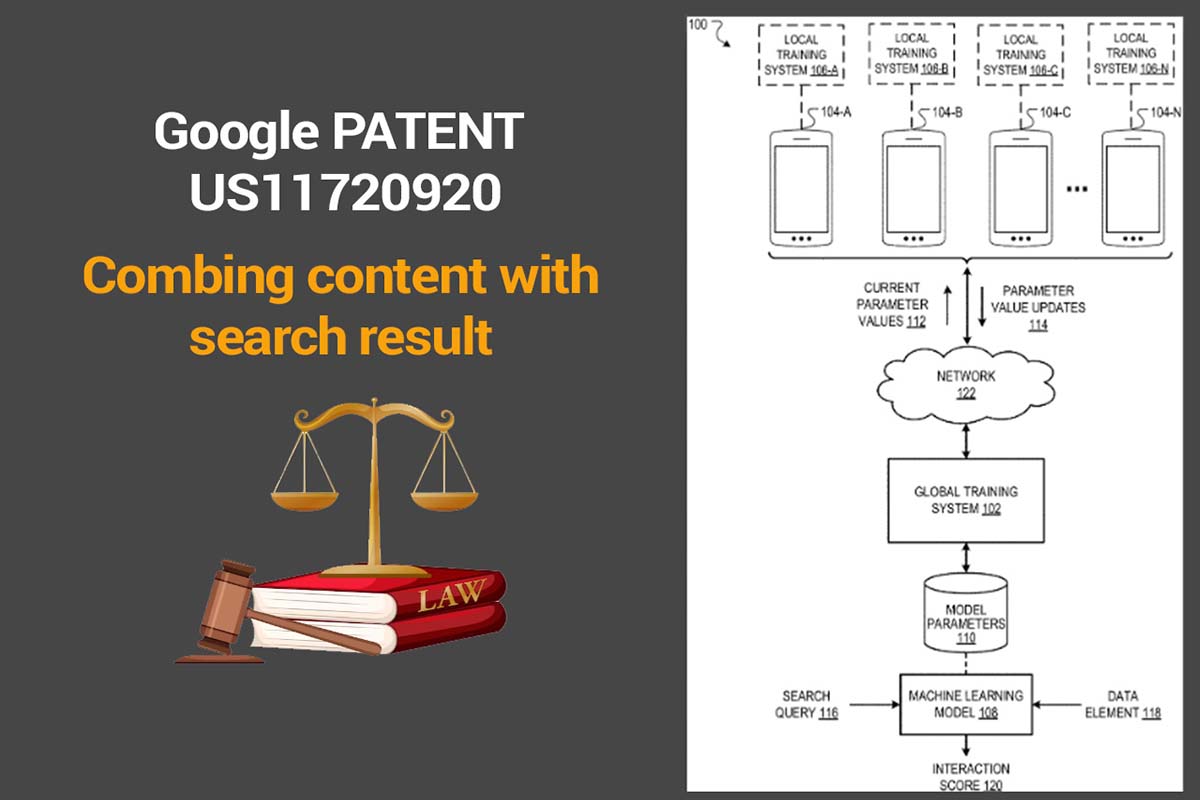
The big “G” is leveraging AI technologies — like LaMDA, PaLM, Imagen and MusicLM – for “synthesizing insights for questions where there’s no one right answer.” Google Patent US11720920B1, granted August 2023, and named Combining content with a search result describes how search results may respond to a query.
Google AI and its Knowledge Graph (KG) improve entity data and website accuracy by transitioning from keyword-based search to semantic, entity-driven understanding. By analyzing billions of facts, AI merges disparate data sources tp provide the best AI answer,
Your website feeds your knowledge graph. What you say on your website can provide factual answers with citations in AI Overviews.
Generative AI Answer Outputs Need Human Reviewers
If you rely totally on LLM’s output, your answers lack differentiation. They are “copied” and cannot represent your unique brand entity.
The pace of AI answer adoption is exploding. Back in 2011, Google’s (then) executive chairman Eric Schmidt stated the following at the annual All Things Digital conference.
“But the other thing that we’re doing that’s more strategic is we’re trying to move from answers that are link-based to answers that are algorithmically based, where we can actually compute the right answer. And we now have enough artificial intelligence technology and enough scale.” – Google now wants to answer your questions without links and with AI. [5]
We may complain about AI Question Answering without sourced links, but we need to be transparent ourselves. Content creators should state when content is purely AI generated, as well as when a human reviewer has refined the content.
Be transparent about how people (companies, bots, systems, cameras, etc) are involved in your content creation workflow. Did they edit, write, strategize, copied it, out-sourced it, etc.
The human reviewer is like a final checkup. Trust is earned in your transparent details, otherwise your writing may draw more questions and provide answers. It must be helpful content versus meaninglessness.
Your article schema can further enhance your author’s experience, expertise and perspective. This indicates that an human topic expert is behind your answers – not just a bot.
It’s about providing helpful, verified answers
Google Search, Bing, and other search engines continue to improve how Artificial Intelligence is used in matching answers to questions. Google has made it clear multiple times – it is not about if your content is AI-generate as much is it is about high-quality content.
Creating helpful AI answers focuses on:
- Writing (or augmenting) from personal knowledge.
- Let your experience come through, which supports relationship building.
- Answers need to be helpful, consise, and correct.
- Providing a natural and intuitive search experince.
Verified AI answers added to existing Google Search
The human editorial element adds necessary authenticity and correctness. For companies facing data management challenges, editors also protect you from the possible degradation of training material for generative AI itself.
With ChatGPT, OpenAI, as well as Google Bard, test a more accurate and efficient dialog-based general-purpose language model. Once search engines are confident of correct and needed answers, your QA content has a greater chance of being rolled into Google’s no-click search. This is my opinion and what our ongoing SERP Analysis results lend us to think.
To gain a verified AI answer for your KG, employ research-backed metrics to evaluate the quality of your inputs (data quality, RAG context quality, etc) and AI tool outputs (avoid hallucinations). This also assists in building LLM-powered applications.
Context-rich questions in the GSE let users ask longer context-rich questions and receive comprehensive answers powered by AI directly on the SERPs. This new search summarizes answers for searchers, without needing a click, a source link or pulling information from Wikipedia.
Focus on nurturing important customers’ top questions
One study by Digital Information World determined that the AI’s directness and less emotional tone fared better with respondents as opposed to the more emotional responses made by human CEOs. [4] This may inspire a company to revise and implement better procedures for publishing answer-rich content.
Data science and a research expert can help you take advantage of the mathematical strengths of generative AI. Continuously test your LLM outputs and how your content performs, The number of correct answers measures test and output quality.
Another bit of incentive – Google Assistant sometimes elects to show ads in some answers. Meaning your answer, typically related to a product or service, can lead a potential buyer to your ad.
Make ALL of your communications valuable. Google’s AI chatbot can now answer questions based on the information it finds in your Gmail inbox and Drive storage.
How Hill Web Marketing’s AI Answer Optimization (AIO) Works
1. The Problem: Google Gemini/ChatGPT partly guess
Right now, AI bots and search engines have to guess what your content is about. If they guess wrong, you lose customers to competitors who are optimized for the new AI search tools.
They may generate plausible-sounding but incorrect information.
2. The Solution: We organize your digital assets
Think of your website content as a pile of Lego® blocks. Currently, they are scattered. We organize your content and connect them into a solid structure that Google and AI bots can understand instantly.
This is called a Knowledge Graph, but you can just think of it as a map we give to Google.”
3. The Result: You get found
By “grounding” and handing AI bots this map (the Knowledge Graph) we integrate your organization’s KG with LLMs. It works to improve AI visibility, enhance sourcing accuracy, and drive sales.
- For your Blog:We answer the specific questions your customers are asking (Search Intent).
- For your Store: We make sure your products show up with prices and ratings directly in search results (Product Enrichment).
- For your Future: As people start asking AI for recommendations instead of just searching keywords, your brand is already formatted to be the answer,
AI Answers That Ignite In-Person Conversations
We anticipate that search will produce more shopping-related results. Product carousel SERPs encourage user spending just by the ease of seeing immediate purchase options. Semantic search and skilled use of LLMs can expand your content-to-query matching capabilities.
Answering vital comsumer questions can give you a competitive lead to gain more revenue.
Success in QA content creation is about the number of useful conversations you trigger with potential clients.
Request Your Website AI Visibility Audit
FAQs
Which tools are best for AI-generated Question-Answering content?
The emergence of tools and controls is exploding and includes AI generative APIs.
The following tools assist with Generative AI marketing through the seeding of training data to predictably answer queries with amalgamated answers:
- Falcon 180B: An open-source LLM similiar to Google’s PaLM-2.
- Gemini.
- Midjourney.
- Wordlift AI Question Answering App (Free).
- JasperAI.
- Market Muse AI Dataset.
- IBM Watsonx Assistant.
AI-powered tools assist content creators by reducing both time and effort required to consistently publish high-quality content. As tempting as it is, the goal isn’t just to create more content in less time. It’s about adding value to searchers. AI can also help content creators improve the accuracy and consistency of their work – if properly reviewed and edited.
How do I evaluate and edit AI-generated answers?
- Evaluate your answer sources when including them in your content strategy. Are they from websites or organizations with Experience, Expertise, Authoritativeness, and Trust (E-E-A-T)?
- Provide an article publication date and when it is updated. Let readers know it is current.
- Is your author providing evidence to support answers? Are there links to quoted facts? Are you using FactCheck schema markup?
- Think through it yourself. Is there a good flow to your answer? Does the answer seem logical? Is it credible?
- Offer more on your website so that people find it valuable enough to click beyond the AI-generated answer.
- Check any Gemini/Bard Answer you plan to incorporate by using Google Search.
By thinking like the searcher, you can see why providing accurate and reliable information within AI generated answers. To check and refine Gemini answers, do the following.
How can I verify the sources cited in AI model answers?
Verifying AI-cited sources requires a multi-pronged approach, tools, and skill. You can manually extract factual statement or phrases from the AI answer and perform targeted web searches using reputable search engines like Google or academic databases. Cross-reference information from multiple authoritative domains (e.g., government sites, established research institutions, peer-reviewed journals). The ‘About this result’ feature in Google Search can also offer context on a source’s credibility.
How do AI ‘hallucinations’ impact finding and validating sources for AI-generated answers?
AI ‘hallucinations’ can profoundly erode trust in your answers. When an AI confidently fabricates URLs, authors, or statistics, users waste significant time verifying nonexistent data. This undermines the efficiency promised by AI and introduces a critical trust deficit. Hallucinations necessitate a ‘trust but verify’ approach, meaning every fact and source presented by an AI must be reviewed and authenticated by a human reviewer.
What are the legal implications of intellectual property and copyright when an AI model provides unsourced answers?
The legal implications of intellectual property (IP) and copyright center on when an AI model provides unsourced answers are complex and rapidly evolving. While not strictly a legal issue, presenting unsourced AI output as one’s own work can constitute academic or professional plagiarism. It may deteriorate trust. The responsibility is firmly on the AI user to ensure compliance with IP law and ethical attribution standards.
Resources:
[1] https://knowledge.wharton.upenn.edu/podcast/knowledge-at-wharton-podcast/what-marketers-are-doing-wrong-in-data-analytics/
[2 https://blog.google/technology/ai/an-update-on-web-publisher-controls/
[3] https://blog.google/products/search/search-generative-ai-tips/
[4] https://www.niemanlab.org/2023/02/google-now-wants-to-answer-your-questions-without-links-and-with-ai-where-does-that-leave-publishers/
[5} https://blog.google/products/search/google-search-ai-mode-update/