Biomedical Knowledge Graphs & AI Architecture
Written by Jeannie M. Hill
Biomedical Knowledge Graphs & AI transform fragmented clinical research, medical device specifications, and life sciences data into deterministic, machine-readable entity architectures built for GraphRAG and AI Search.
As biotech firms, medical device manufacturers, clinical research organizations (CROs), and multi-specialty health systems adopt generative AI, unstructured web copy is no longer enough.
I’ve been approached by amazing healthcare products and medical business entities – but they struggle competitively with the “bog guys.” By uniting public Schema.org @graph JSON-LD with private, Git-versioned Open Knowledge Format (OKF v0.3) repositories grounded in SNOMED CT, MeSH, and UMLS, your organization become a recognized leader in your niche.
Become a verified, hallucination-resistant source of truth across Google AI Overviews, Gemini, ChatGPT, and Claude— is a foundational step in architecting knowledge for the AI era.
We engineer biomedical knowledge architectures that connect clinical ontologies, regulatory compliance, and enterprise AI retrieval—keeping Protected Health Information (PHI) strictly isolated while scaling your scientific and commercial authority.
Table of Contents
Why Biomedical Organizations Need Knowledge Graphs for AI
In Your Money Your Life (YMYL) healthcare and life sciences verticals, AI models penalize ambiguity. Standard keyword-based SEO cannot disambiguate complex molecular interactions, Class II/III medical device indications, or multi-site clinical trial eligibility. Healthcare domains fall under strict Your Money or Your Life (YMYL) scrutiny in both traditional search and AI-driven discovery. This challenge becomes your opporutnity as an agile businesses who can turn compliance and clinical expertise into a major competitive wedge.
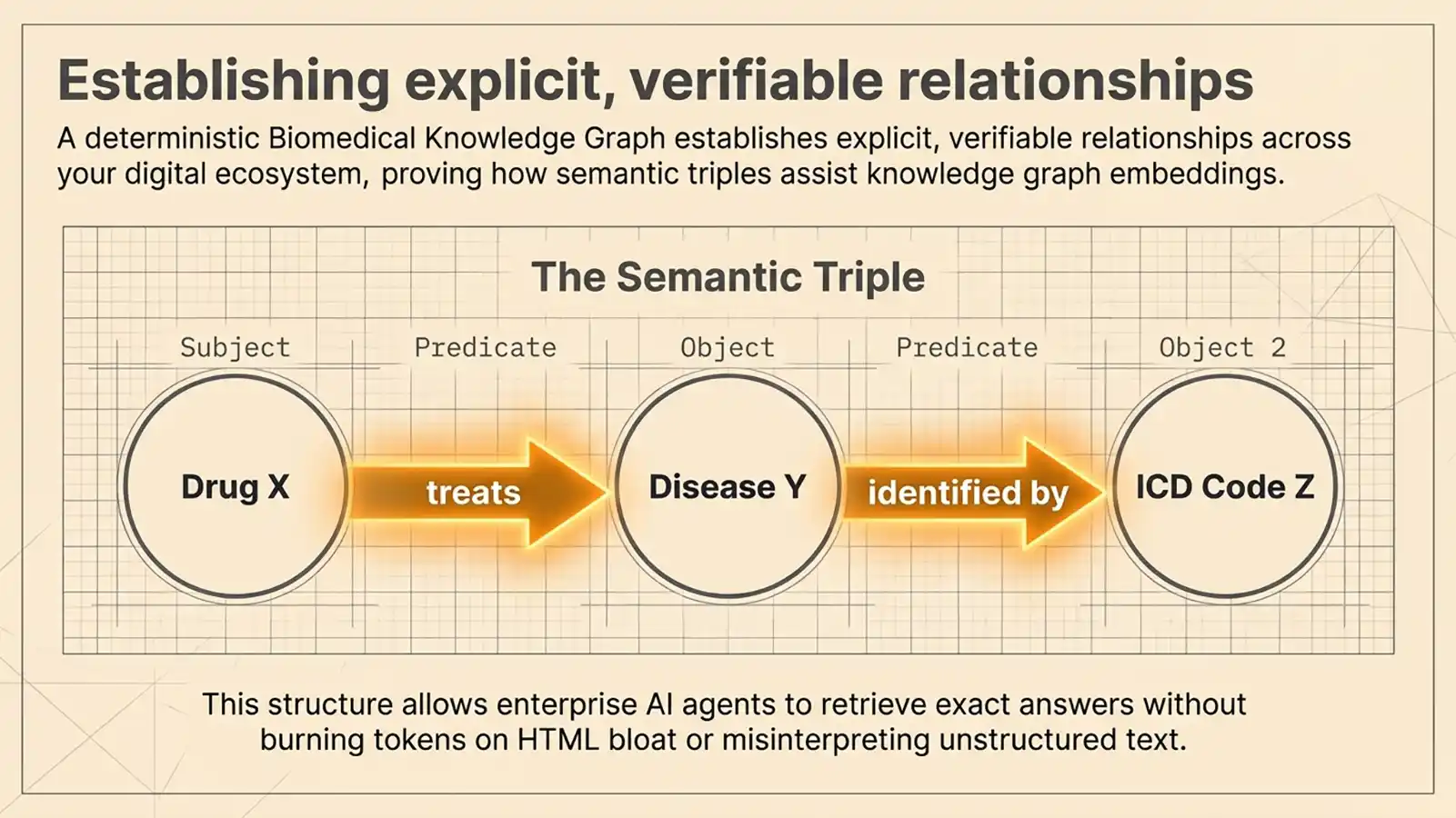
A deterministic Biomedical Knowledge Graph solves this by establishing explicit, verifiable relationships (Subject → Predicate → Object) across your digital ecosystem—demonstrating how semantic triples assist knowledge graph embeddings:
Fact-based GraphRAG solves content ambiguity by structuring medical data into discrete entities and validated edges (subject-predicate-object triples) before generation. Your business’s trust factor needs strict architectural guardrails to ensure that subjective notes, speculative diagnoses, or outdated advice in the source data are not taken as established clinical facts.
- Reducing AI Hallucinations in Clinical & Device Queries: Grounding product specifications, indications, and contraindications in verified semantic triples prevents LLMs from fabricating clinical claims and supports compliant health product advertising.
- Stronger YMYL & E-E-A-T Verification: Linking principal investigators, peer-reviewed publications, and institutional affiliations to canonical Wikidata and PubMed identifiers strengthens trust signals for Google AI Overviews and Gemini.
- Enterprise GraphRAG Readiness: Structuring internal research, regulatory documentation, and public brand facts in OKF v0.3 Markdown/YAML bundles enables internal AI agents to retrieve exact answers without burning tokens on HTML bloat.
- Cross-Platform AI Citation Resilience: Ensuring your organization is cited accurately across Google Search, Perplexity, ChatGPT, and enterprise knowledge catalogs.
- Basing Clinical Statements on Facts: Basing clinical statements on verified facts from trusted sources is essential for building safe, reliable, and legally compliant AI knowledge graphs.
Because healthcare AI systems directly influence people’s well-being and clinical decisions, unverified or hallucinated relationships within a knowledge graph can cause severe harm to one’s health and erode institutional trust.
Fact-based GraphRAG extraction ensures that what you state about things like symptoms, diagnoses, dosages, and medical treatment plans map accurately without misleading AI synthesized answers fed by causal semantic relationships.
Core Biomedical Ontologies & Semantic Standards
While solo local clinics may manage on baseline Schema.org entity cleanup and Google Business Profile (GBP) alignment, multilocation biomedical, biotech, and multi-specialty organizations require deep clinical ontology grounding. A single clinic can be findable using MedicalClinic or Physician Schema.org markup paired with local GBP signals to establish proximity and trust. However every enterprise biomedical, biotech, and multi-specialty organization operates in an entirely different semantic tier.
Through our semantic architecture framework, we map your public brand assets directly to established biomedical vocabularies:
| Biomedical Standard | Primary Scope & Vocabulary | Strategic AI & Knowledge Graph Role |
|---|---|---|
| SNOMED CT | Clinical terms, surgical procedures, anatomy & diagnostics | Disambiguates medical treatments, clinical specialties, and device indications for AI search synthesis. |
| MeSH (Medical Subject Headings) | National Library of Medicine (NLM) biomedical literature taxonomy | Connects whitepapers, clinical studies, and educational hubs to authoritative PubMed subject hierarchies. |
| UMLS (Unified Medical Language System) | Cross-vocabulary metathesaurus & semantic network | Bridges disparate drug classifications, ICD codes, and clinical terminology into unified graph nodes. |
| FHIR & PubChem | Healthcare interoperability & molecular/pharmaceutical data | Structures technical specifications for health-system integrations, diagnostics, and life sciences R&D. |
OKF & Zero-PHI GraphRAG Architecture
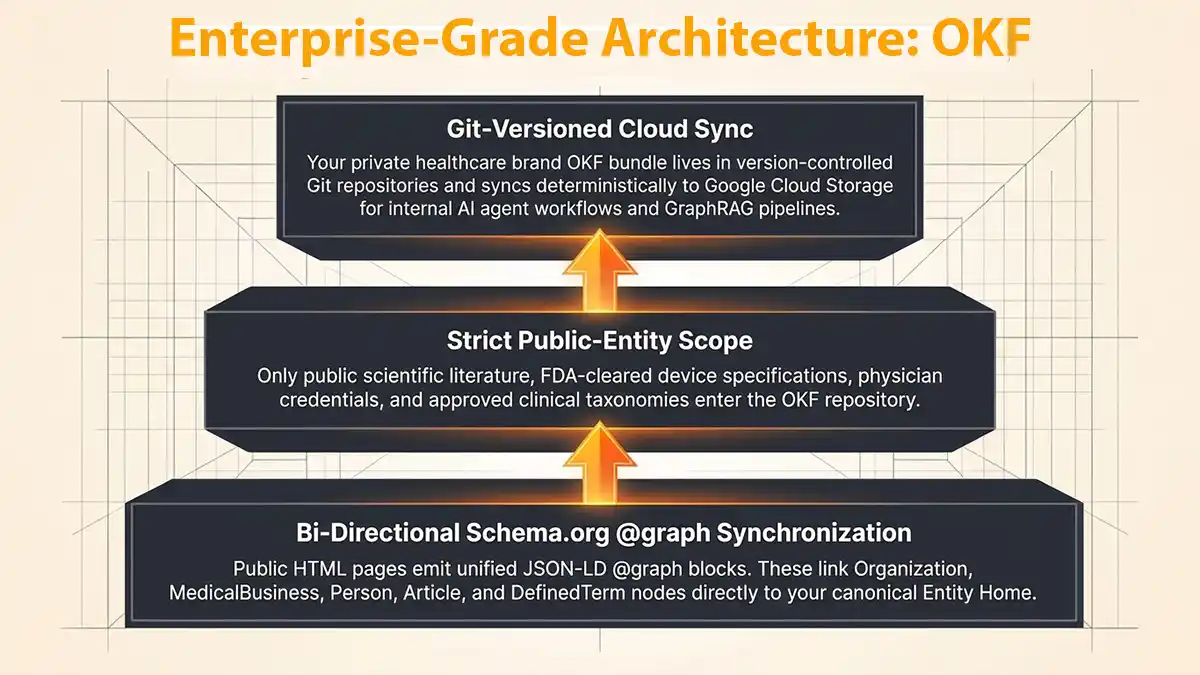
Every biomedical knowledge graph engineered by Hill Web Creations adheres strictly to Open Knowledge Format (OKF v0.3) standards and zero-PHI HIPAA guardrails:
- Strict Public-Entity & Institutional Scope: Only public scientific literature, FDA-cleared device specifications, physician credentials, and approved clinical taxonomies enter the OKF repository. Zero Protected Health Information (PHI) or 18 HIPAA identifiers are ever ingested.
- Bi-Directional Schema.org
@graphSynchronization: Public HTML pages emit unified JSON-LD@graphblocks linkingOrganization,MedicalBusiness,Person,Article, andDefinedTermnodes directly to your canonical Entity Home. - Git-Versioned Cloud Sync: Your private healthcare brand OKF bundle lives in version-controlled Git repositories and syncs deterministically to Google Cloud Storage for internal AI agent workflows and GraphRAG pipelines.
Biomedical Knowledge Graph Service Tiers & Pricing
We structure our biomedical and enterprise healthcare engagements to match your organization’s technical complexity, compliance requirements, and ability to scale business growth — building knowledge graphs and ontologies that drive revenue:
| Service Tier | Investment | Core Deliverables & Scope | Ideal Organization |
|---|---|---|---|
| Biomedical OKF Blueprint Setup | $3,500 – $5,000 (One-Time Flat Fee) |
• Biomedical entity audit & canonical Entity Home mapping • Initial SNOMED CT, MeSH & UMLS ontology alignment• Integrated Schema.org @graph JSON-LD architecture• Zero-PHI HIPAA architecture review & OKF v0.3 repo setup |
Biotech startups, medical device brands, and specialty groups establishing an AI-ready foundation. |
| Enterprise Biomedical Knowledge Graph Retainer | $6,000 – $8,500+ / mo |
• Ongoing biomedical OKF v0.3 & GraphRAG management in Google Cloud Storage • Deep clinical ontology expansion ( SNOMED CT, MeSH, UMLS, FHIR)• 2x Monthly semantically-enriched, entity-anchored technical/clinical articles with author bio links • Full Schema.org @graph, AI Overviews, Gemini & GBP optimization• Executive monthly AI citation & conversion reporting |
Knowledge management for Medical device retailers, CROs, multi-location health systems & surgical centers. |
Frequently Asked Questions
How does a Biomedical Knowledge Graph differ from standard healthcare SEO?
Standard healthcare SEO focuses on keyword placement and traditional search rankings. A Biomedical Knowledge Graph builds a machine-readable semantic layer using SNOMED CT, MeSH, UMLS, and OKF v0.3 triples so AI platforms (Google AI Overviews, Gemini, ChatGPT, Perplexity) understand exact clinical relationships and cite your brand accurately.
Do you ingest patient records or Protected Health Information (PHI)?
No. Our Biomedical Knowledge Graphs and OKF v0.3 bundles operate on a strict Zero-PHI architecture. We structure public institutional authority, physician credentials, clinical taxonomies, and published research while keeping all patient interactions walled off behind HIPAA-compliant tracking systems backed by Business Associate Agreements (BAAs).
Who needs deep SNOMED CT and UMLS ontology grounding?
Deep clinical ontology grounding is engineered for enterprise medical device manufacturers, biotech organizations, clinical research groups, and multi-specialty medical centers. Single-location practices typically start with our core Schema.org @graph, Google Business Profile (GBP), and HIPAA-safe Local Services Ads (LSA) optimization tiers.
How does OKF v0.3 integrate with our internal AI agents and Google Cloud?
Open Knowledge Format (OKF v0.3) stores your curated knowledge graph as plain-text Markdown files with structured YAML frontmatter and an automated index.json manifest. It syncs directly from Git to Google Cloud Storage, enabling both internal GraphRAG agents and external coding agents to traverse verified biomedical facts without proprietary database lock-in.
Launch Your Biomedical Knowledge Graph
Position your biotech, medical device, or healthcare organization as the definitive, machine-verified authority in AI Search and enterprise GraphRAG.